
Geometric Optics, Vision and Optical Instruments
76 Telescopes
Learning Objectives
- Describe how a telescope forms magnified images of distant objects.
- Explain the roles of the objective lens (or mirror) and the eyepiece in a telescope.
- Calculate the angular magnification of a simple telescope.
- Compare refracting and reflecting telescopes and explain why modern astronomical observatories primarily use mirrors.
- Recognize how telescopes operating across the electromagnetic spectrum have expanded our understanding of the universe.
Like microscopes, telescopes extend the capabilities of human vision. Instead of enlarging tiny nearby objects, telescopes allow us to observe objects that are so distant they would otherwise appear as faint points of light or remain completely invisible. By collecting far more light than the human eye, telescopes reveal planets, stars, galaxies, and other astronomical objects in remarkable detail.
Although Galileo Galilei is often credited with inventing the telescope, the first telescope was likely developed in the Netherlands around 1608 by spectacle makers including Hans Lippershey. Galileo's greatest contribution was not inventing the instrument but dramatically improving its design and becoming the first person to systematically use it to study the night sky. His observations transformed astronomy by revealing mountains and craters on the Moon, the four largest moons of Jupiter, the phases of Venus, sunspots, and the countless stars that make up the Milky Way.
Today, telescopes are among the most important scientific instruments ever created. They allow astronomers to study objects billions of light-years away and have provided evidence for phenomena such as black holes, exoplanets, dark matter, and the expansion of the universe.
How a Refracting Telescope Works
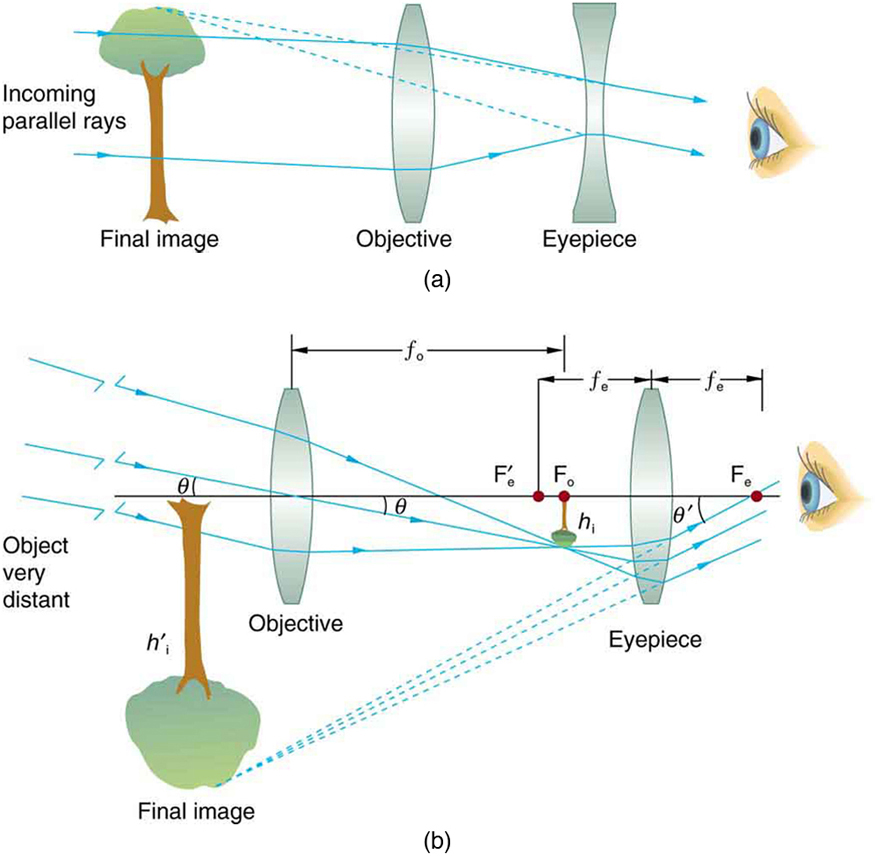
A refracting telescope uses two lenses: a large objective lens, which collects light from a distant object, and an eyepiece, which magnifies the image formed by the objective.
Because astronomical objects are extremely far away, the incoming light rays are essentially parallel. The object distance is therefore effectively infinite:
Applying the thin lens equation,
and recognizing that
gives
Thus, the objective forms a real image at its focal plane. Although this image is relatively small, it contains all of the information collected by the objective lens.
The eyepiece acts as a magnifier. It is positioned so that the image formed by the objective lies just inside the focal length of the eyepiece. The observer therefore sees a large virtual image that appears much larger than it would to the unaided eye.
Key Concept: Angular Magnification
Unlike a microscope, which enlarges the physical size of a nearby object, a telescope increases the apparent angular size of a distant object.
The angular magnification is defined as
where
- [latex]\theta[/latex] is the angle subtended by the object when viewed with the unaided eye, and
- [latex]\theta'[/latex] is the angle subtended when viewed through the telescope.
For a simple refracting telescope,
The negative sign indicates that the image is inverted relative to the object.
The equation shows that increasing the focal length of the objective or decreasing the focal length of the eyepiece increases the telescope's angular magnification.
However, magnification alone does not determine image quality. The amount of detail visible also depends on the telescope's aperture, optical quality, atmospheric conditions, and detector sensitivity.
Why Doesn't Image Inversion Matter?
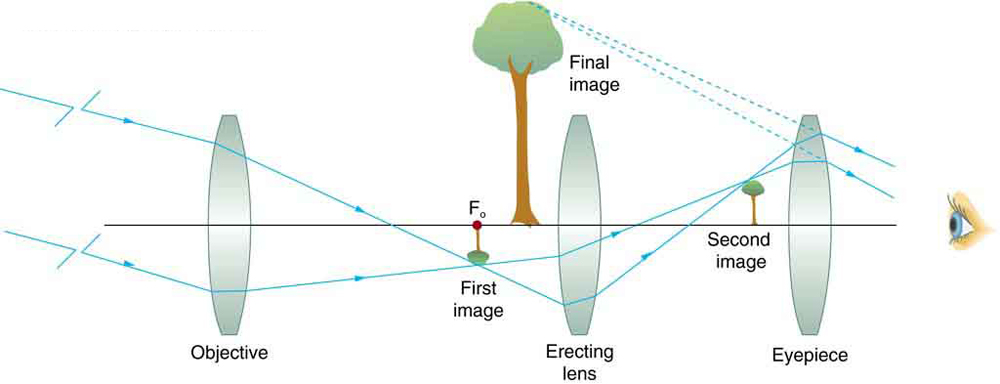
Most astronomical telescopes produce inverted images. For observing planets, stars, galaxies, and nebulae, there is no preferred "up" direction in space, so image orientation is usually unimportant. In contrast, terrestrial telescopes used for navigation, bird watching, or surveillance must produce upright images because people expect landscapes to appear correctly oriented.
If an upright image is required, additional optical elements can reverse the image orientation. Galileo accomplished this by using a concave eyepiece, while many modern terrestrial telescopes and binoculars use extra lenses or prisms to erect the image.
Reflecting Telescopes
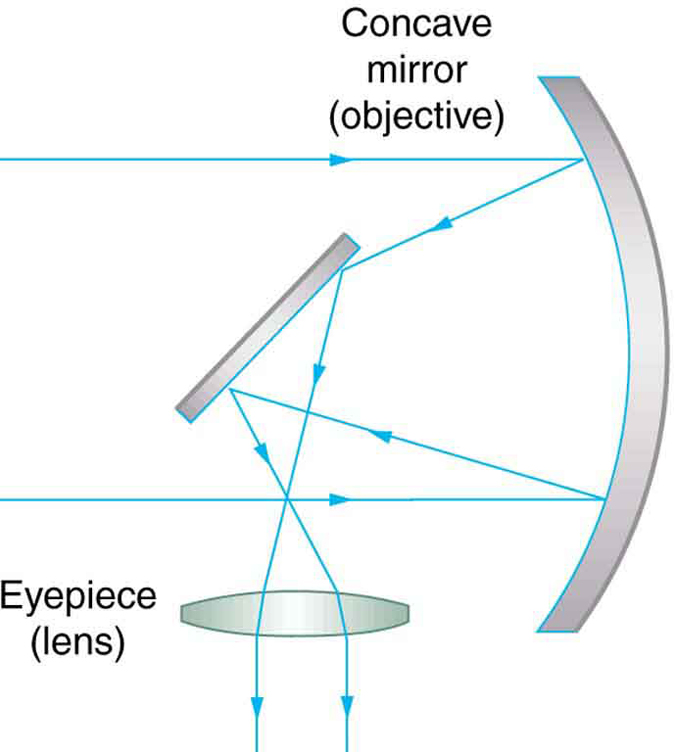
Many modern telescopes replace the objective lens with a large concave mirror. A concave mirror focuses parallel light rays in exactly the same way that a convex lens does, but it offers several important advantages.
Large mirrors are much easier to manufacture than equally large lenses because they require only one precisely shaped optical surface. Mirrors also eliminate chromatic aberration, the color distortion that occurs because different wavelengths of light refract by different amounts in lenses.
Most importantly, mirrors can be made much larger than lenses. Since the amount of light collected is proportional to the area of the objective, larger mirrors allow astronomers to observe much fainter and more distant objects.
Did You Know?
The largest research telescopes in the world—including the Keck Observatory, the Very Large Telescope (VLT), and the James Webb Space Telescope—are all reflecting telescopes. Their mirrors range from several meters to more than 10 meters in diameter and collect millions of times more light than the human eye.
Section Summary
- A telescope is an optical instrument designed to observe distant objects by collecting light and increasing their apparent angular size.
- Simple refracting telescopes use an objective lens to form a real intermediate image and an eyepiece to magnify that image for the observer.
- The angular magnification of a simple telescope is
- Here, [latex]\theta[/latex] is the angle subtended by the object when viewed with the unaided eye, [latex]\theta'[/latex] is the angle subtended through the telescope, [latex]f_{\mathrm{o}}[/latex] is the focal length of the objective, and [latex]f_{\mathrm{e}}[/latex] is the focal length of the eyepiece.
- A longer focal-length objective and a shorter focal-length eyepiece produce greater angular magnification.
- Reflecting telescopes use mirrors instead of large objective lenses, allowing larger apertures, improved light collection, and elimination of chromatic aberration.
- Modern telescopes observe the universe across the entire electromagnetic spectrum, including radio waves, visible light, infrared radiation, ultraviolet radiation, X rays, and gamma rays.
- Adaptive optics uses computer-controlled mirrors to compensate for atmospheric distortions and produce sharper astronomical images.
Conceptual Questions
- If you wanted a microscope or telescope to project a real image onto a screen instead of producing a virtual image for direct viewing, how would you change the position of the eyepiece relative to the objective? Explain your reasoning.
Problems & Exercises
- Unless otherwise stated, assume the lens-to-retina distance is 2.00 cm. A telescope has a 100 cm focal-length objective and a 2.50 cm focal-length eyepiece. What is its angular magnification?
- For the telescope described in Problem 33, determine the distance that should separate the objective and eyepiece lenses so that the final image is formed at infinity, allowing relaxed viewing.
- A large reflecting telescope has a concave primary mirror with a radius of curvature of 10.0 m. If the eyepiece has a focal length of 3.00 cm, what is the telescope's angular magnification?
- A reflecting telescope has a concave objective mirror with a radius of curvature of 2.00 m and a 4.00 cm focal-length eyepiece.
- Determine the telescope's angular magnification.
- A sunspot has a diameter of 25,000 km. What angle does it subtend when viewed with the unaided eye?
- What angle does the telescopic image subtend?
- A pair of 7.5× binoculars produces an angular magnification of [latex]-7.50[/latex]. (Prisms are used internally to produce an upright image.) If the binoculars have objective lenses with focal lengths of 75.0 cm, what is the focal length of each eyepiece?
- Construct Your Own Problem. Design a problem involving a Galilean telescope consisting of a convex objective lens and a concave eyepiece (see Figure 76.1a). Specify the focal lengths, lens separation, and the size and distance of the object. Calculate the image location, image size, and angular magnification, and verify that the telescope increases the apparent angular size of the object.
Glossary
- adaptive optics
- A technology that uses computer-controlled mirrors or lenses to compensate for distortions caused by Earth's atmosphere or other optical imperfections, producing sharper images.
- angular magnification
- The factor by which a telescope increases the apparent angular size of a distant object. For a simple telescope,
[latex]M=-\frac{f_{\mathrm{o}}}{f_{\mathrm{e}}}[/latex]
where [latex]f_{\mathrm{o}}[/latex] is the focal length of the objective and [latex]f_{\mathrm{e}}[/latex] is the focal length of the eyepiece.
A technology that uses computer-controlled mirrors or lenses to compensate for distortions caused by Earth's atmosphere or other optical imperfections, producing sharper images.
The factor by which a telescope increases the apparent angular size of a distant object. For a simple telescope,
[latex]M=-\frac{f_{\mathrm{o}}}{f_{\mathrm{e}}}[/latex]
where [latex]f_{\mathrm{o}}[/latex] is the focal length of the objective and [latex]f_{\mathrm{e}}[/latex] is the focal length of the eyepiece.
