
Radioactivity, Nuclear Physics and its Medical Applications
126 Medical Imaging and Diagnostics
Learning Objectives
- Explain what a radiopharmaceutical is and why radioactive isotopes are useful in medicine.
- Describe how radiopharmaceuticals are used to image organs and evaluate physiological function.
- Identify several common medical applications of nuclear medicine.
- Explain why technetium-99m is the most widely used radioisotope in diagnostic imaging.
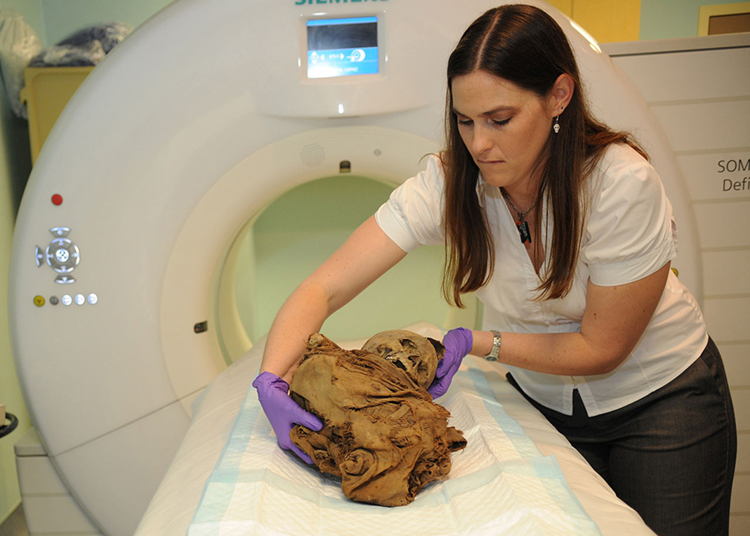
Throughout this book we have explored the structure of the atomic nucleus, radioactive decay, nuclear reactions, and the interactions between radiation and matter. These concepts form the scientific foundation of nuclear medicine, one of the fastest-growing fields in modern healthcare. Every day, physicians use radioactive materials to diagnose disease, evaluate organ function, guide treatment decisions, and monitor a patient's response to therapy.
Unlike many imaging techniques that primarily reveal the anatomy of the body, nuclear medicine provides information about how organs and tissues function. Changes in physiology often occur before visible structural changes develop, allowing nuclear medicine studies to detect disease at an early stage. This ability makes nuclear medicine especially valuable in oncology, cardiology, neurology, endocrinology, and many other medical specialties.
The principles of nuclear medicine are surprisingly simple. A patient receives a very small quantity of a radioactive substance that has been designed to travel to a particular organ or participate in a specific biological process. As the radioisotope decays, it emits radiation that escapes from the body and is detected by specialized imaging equipment. A computer then reconstructs these signals into images that reveal where the radioactive material has accumulated.
Healthcare Connection
Nuclear medicine images show function rather than simply structure. For example, an x-ray or CT scan may reveal the size and shape of the heart, while a nuclear medicine scan can show whether the heart muscle is receiving enough blood during exercise or whether parts of the heart have been permanently damaged after a heart attack. Physicians often combine anatomical and functional imaging to obtain the most complete understanding of a patient's condition.
Radiopharmaceuticals: Radioactivity with a Purpose
The key component of every nuclear medicine examination is a radiopharmaceutical. A radiopharmaceutical consists of two parts:
- a radioisotope, which emits detectable radiation, and
- a biologically active molecule, which carries the radioisotope to a specific organ, tissue, or physiological process.
The biologically active molecule determines where the compound travels within the body, while the radioisotope allows physicians to determine where the compound is located by detecting the emitted radiation outside the body.
The process of attaching a radioactive isotope to a biologically active molecule is called tagging, and the radioactive isotope is often referred to as a radiotracer. Because the radioactive atom behaves chemically like its stable counterpart, the body generally processes the radiopharmaceutical in the same way it would process the nonradioactive compound.
For example, iodine is naturally concentrated in the thyroid gland because thyroid cells require iodine to produce hormones. If a radioactive isotope of iodine is administered to a patient, it follows the same biological pathways as ordinary iodine. Detecting the emitted radiation allows physicians to evaluate thyroid function and identify abnormalities such as hyperthyroidism, hypothyroidism, or certain thyroid cancers.
Different radiopharmaceuticals have been developed to target different organs and physiological processes. Some accumulate in bone, where they help identify fractures and metastatic cancer. Others concentrate in heart muscle to evaluate blood flow, while still others highlight regions of increased glucose metabolism that may indicate rapidly growing tumors.
Choosing the Right Radioisotope
Not every radioactive isotope is suitable for medical imaging. An ideal diagnostic radioisotope should satisfy several important criteria:
- emit radiation that can escape the body and be detected efficiently,
- deliver the lowest practical radiation dose to the patient,
- have a half-life long enough to complete the examination but short enough to minimize unnecessary radiation exposure,
- be chemically compatible with compounds that target specific organs or tissues, and
- be readily available for routine clinical use.
Gamma-ray emitters are especially useful because gamma rays can penetrate the body's tissues with relatively little absorption. This allows detectors outside the body to determine where the radiopharmaceutical is located. In contrast, alpha particles and most beta particles travel only short distances in tissue and are generally unsuitable for external imaging, although they may be extremely useful for targeted radiation therapy, as discussed later in this chapter.
Examples of Common Nuclear Medicine Studies
| Examination | What it Evaluates |
|---|---|
| Bone scan | Fractures, bone infections, and metastatic cancer |
| Cardiac perfusion scan | Blood flow to the heart muscle during rest and exercise |
| Thyroid scan | Thyroid function and abnormal nodules |
| Renal scan | Kidney function and urinary drainage |
| PET scan | Tumor metabolism, brain activity, and heart viability |
Although dozens of radioactive isotopes are available for medical use, one isotope has become the workhorse of diagnostic nuclear medicine because of its exceptionally favorable physical properties. In the next section, we examine why technetium-99m is used in approximately 80% of all nuclear medicine imaging procedures worldwide.
Technetium-99m: The Workhorse of Nuclear Medicine
Although many radioactive isotopes are used in medicine, no isotope has had a greater impact on diagnostic imaging than technetium-99m (Tc-99m). Approximately 80% of all nuclear medicine diagnostic procedures worldwide use radiopharmaceuticals labeled with Tc-99m. Its widespread use results from a combination of favorable physical properties, convenient production, and remarkable chemical versatility.
Technetium-99m is a metastable nuclear state, indicated by the letter "m" in its name. Rather than undergoing beta decay, Tc-99m returns to its ground state by emitting a single gamma ray with an energy of approximately 140 keV. This gamma ray has enough energy to escape the body and be detected efficiently, while still exposing the patient to a relatively low radiation dose.
Another major advantage is its short half-life of approximately 6 hours. This half-life is long enough to perform imaging procedures but short enough that most of the radioactivity disappears within a day, minimizing unnecessary radiation exposure after the examination.
Equally important, technetium can be incorporated into many different chemical compounds. By attaching Tc-99m to different molecules, physicians can image a wide variety of organs and physiological processes using essentially the same imaging equipment.
Healthcare Connection
The ideal diagnostic radioisotope balances image quality with patient safety. If the half-life is too short, the isotope may decay before the examination is complete. If it is too long, the patient receives unnecessary radiation after the study. Likewise, gamma rays that are too low in energy may never escape the body, whereas very high-energy gamma rays are more difficult to detect efficiently. Tc-99m provides an excellent compromise between these competing requirements.
Producing Technetium-99m
Because Tc-99m has such a short half-life, it cannot simply be manufactured at a distant facility and shipped around the world. Instead, hospitals typically obtain Tc-99m from a device known as a technetium generator.
The generator contains molybdenum-99 (Mo-99), a radioactive isotope with a half-life of about 66 hours. As Mo-99 undergoes beta decay, it continuously produces fresh Tc-99m.
The newly produced Tc-99m can be chemically separated from the generator several times each day, much like drawing liquid from a coffee maker. This convenient system allows hospitals to prepare fresh radiopharmaceuticals on demand without needing a nearby nuclear reactor.
Modern Diagnostic Radiopharmaceuticals
Different radiopharmaceuticals are designed to accumulate in different tissues or participate in specific physiological processes. Some evaluate organ function, while others identify regions of increased metabolism, inflammation, or abnormal blood flow. Table 126.1 summarizes several of the most common radiopharmaceuticals used in modern clinical practice.
| Radiopharmaceutical | Primary Clinical Application | Typical Imaging Technique | Typical Administered Activity |
|---|---|---|---|
| Tc-99m MDP | Bone imaging, fractures, bone metastases | SPECT | 20–25 mCi |
| Tc-99m Sestamibi | Cardiac perfusion and some tumor imaging | SPECT | 10–30 mCi |
| Tc-99m MAG3 | Kidney function and urinary drainage | SPECT | 5–10 mCi |
| Tc-99m HIDA | Gallbladder and biliary function | SPECT | 2–10 mCi |
| Tc-99m HMPAO (brain scan) | Cerebral blood flow imaging | SPECT | 7.50 mCi |
| I-123 Sodium Iodide | Thyroid imaging and thyroid function | SPECT | 70 µCi |
| I-131 Sodium Iodide | Thyroid imaging and function (diagnostic dose) | SPECT | 50 µCi |
| F-18 Fluorodeoxyglucose (FDG) | Cancer imaging, brain metabolism, cardiac viability | PET | 10–15 mCi |
| Ga-68 DOTATATE | Neuroendocrine tumors | PET | 2–5.4 mCi |
| Rb-82 Chloride | Myocardial perfusion | PET | 30–60 mCi (generator-eluted) |
Although different radiopharmaceuticals target different organs and diseases, they all operate according to the same basic principle: the biological molecule determines where the compound travels, while the radioactive isotope allows physicians to determine where it is located by detecting the emitted radiation.
From Radiation to an Image
Once a radiopharmaceutical has accumulated in the tissue of interest, the emitted gamma rays must be detected and converted into a useful medical image. This task is performed by specialized radiation detectors that record the location and intensity of the emitted radiation. The simplest and most widely used detector for gamma-emitting radiopharmaceuticals is the gamma camera, also known as the Anger camera, named after its inventor, Hal Anger.
In the next section, we examine how the gamma camera converts individual gamma-ray interactions into detailed images that physicians use to diagnose disease.
The Gamma (Anger) Camera
After a radiopharmaceutical has accumulated in the organ being studied, it begins emitting gamma rays in all directions. These gamma rays leave the patient's body and carry information about the location of the radioactive tracer. The challenge is to detect enough of these gamma rays to reconstruct an image that accurately represents the distribution of the radiopharmaceutical.
The instrument most commonly used for this purpose is the gamma camera, also known as the Anger camera after its inventor, Hal Anger. Since its introduction in the late 1950s, the Anger camera has become one of the most important medical imaging devices in nuclear medicine. Modern SPECT scanners are built upon the same fundamental design.
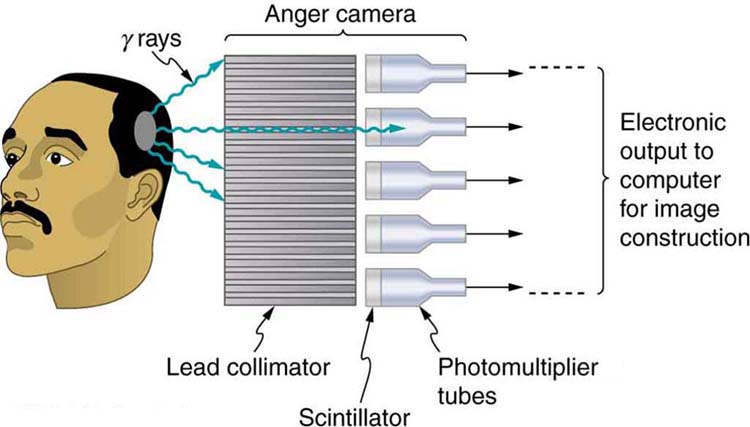
Although modern gamma cameras contain sophisticated electronics and computer systems, their basic operating principle can be understood in four simple steps:
- The patient emits gamma rays from the radiopharmaceutical.
- The gamma rays are detected by the camera.
- The detector converts the gamma rays into electrical signals.
- A computer reconstructs an image showing where the radioactive material is located.
Step 1: The Lead Collimator
The first component encountered by the gamma rays is a thick plate of lead called a collimator. The collimator contains thousands of small, parallel holes that allow only gamma rays traveling in certain directions to reach the detector.
Without the collimator, gamma rays arriving from many different directions would strike the detector simultaneously, making it impossible to determine where they originated. The collimator therefore acts much like the aperture of a camera, improving image quality by rejecting unwanted radiation.
Physics Connection
A collimator improves image resolution by sacrificing sensitivity. Because most gamma rays are absorbed by the lead rather than passing through the holes, only a small fraction reach the detector. Consequently, nuclear medicine studies require careful optimization of image quality, examination time, and patient radiation dose.
Step 2: The Scintillation Crystal
After passing through the collimator, the gamma ray enters a large scintillation crystal, which is typically made of sodium iodide containing a small amount of thallium, written as NaI(Tl).
When a gamma ray deposits its energy within the crystal, the crystal emits a tiny flash of visible light. This process is called scintillation. Each gamma ray produces a brief pulse of light whose intensity is approximately proportional to the energy deposited by the gamma ray.
Although each flash lasts only a few hundred nanoseconds, it contains enough photons to be detected by highly sensitive electronic devices.
Step 3: Photomultiplier Tubes
Behind the scintillation crystal is an array of photomultiplier tubes (PMTs). These devices detect the tiny flashes of light produced in the crystal and convert them into electrical signals.
A photomultiplier tube is remarkably sensitive—it can detect extremely small amounts of light and amplify the resulting electrical signal millions of times. By comparing the signals produced in many neighboring photomultiplier tubes, the imaging system can determine where inside the crystal the gamma ray interacted.
This process allows the system to estimate the location at which each gamma ray entered the detector.
Step 4: Computer Image Reconstruction
A single detected gamma ray provides only one point of information. During a typical nuclear medicine examination, however, hundreds of thousands or even millions of gamma rays are detected.
A computer records the position of every detected event and gradually builds an image showing the distribution of the radiopharmaceutical throughout the patient's body. Regions that emit many gamma rays appear brighter because they contain a higher concentration of the radioactive tracer.
Clinical Interpretation
The brightness of a nuclear medicine image reflects the concentration of the radiopharmaceutical rather than the density of the tissue. For example, a bone scan highlights regions where bone cells are especially active, while a cardiac perfusion study reveals areas of heart muscle receiving adequate blood flow. Physicians therefore interpret nuclear medicine images as maps of physiological function, not simply anatomical structure.
Limitations of the Gamma Camera
A conventional gamma camera produces a two-dimensional projection image. Gamma rays emitted from different depths within the body can strike the same location on the detector, making it impossible to determine exactly where along that line the radiation originated.
This limitation is similar to taking a photograph of a three-dimensional object: depth information is lost when the scene is projected onto a flat image.
To overcome this problem, modern nuclear medicine systems acquire images from many different angles around the patient. Computers then combine these projections to reconstruct a three-dimensional representation of the radiopharmaceutical distribution. This technique is known as single-photon emission computed tomography (SPECT), which is the subject of the next section.
Three-Dimensional Nuclear Imaging
A conventional gamma camera produces a two-dimensional projection of the radiopharmaceutical distribution. While this provides valuable diagnostic information, structures located at different depths overlap in the final image, making it difficult to determine the exact location of abnormal activity.
To overcome this limitation, modern nuclear medicine systems collect images from many different angles around the patient. Computer algorithms combine these multiple projections to reconstruct a three-dimensional representation of the radioactive tracer inside the body, much like computed tomography (CT) reconstructs three-dimensional anatomical images from multiple x-ray projections.
Two of the most important tomographic imaging techniques are single-photon emission computed tomography (SPECT) and positron emission tomography (PET). Although both produce three-dimensional images, they detect radiation in different ways and are used for somewhat different clinical applications.
Single-Photon Emission Computed Tomography (SPECT)
SPECT extends the capabilities of the conventional gamma camera by acquiring images from many different viewing angles. During the examination, one or more gamma cameras slowly rotate around the patient while recording gamma rays emitted by the radiopharmaceutical.
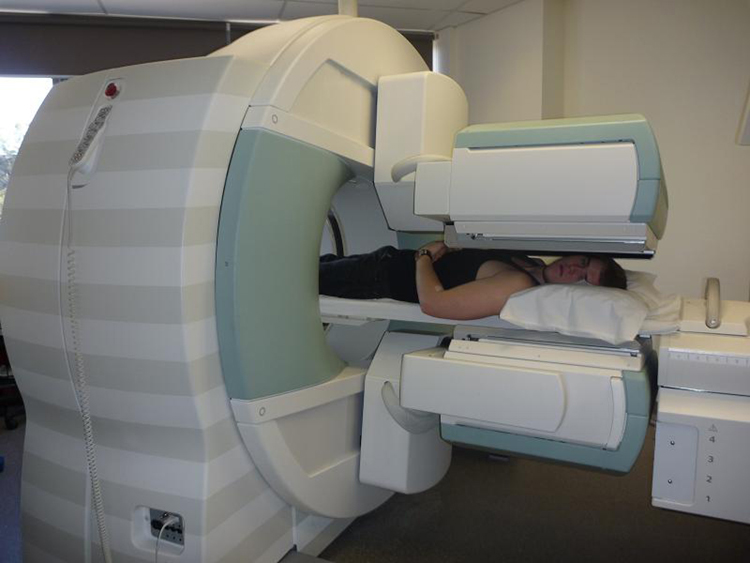
Each image acquired by the rotating detector is similar to a conventional gamma-camera image. However, after collecting dozens or hundreds of projections, a computer reconstructs a three-dimensional map of the radiopharmaceutical concentration throughout the body.
Because SPECT detects individual gamma rays emitted directly by the radioisotope, it is ideally suited for radiopharmaceuticals labeled with gamma-emitting isotopes such as Tc-99m or I-123.
Common Clinical Uses of SPECT
- Evaluating blood flow to the heart during stress and rest
- Detecting bone metastases and stress fractures
- Assessing kidney function and urinary drainage
- Evaluating thyroid function
- Identifying certain neurological disorders
Although SPECT provides excellent information about organ function, its spatial resolution is generally lower than that of CT or MRI because the gamma rays originate within the patient's body and must pass through surrounding tissues before reaching the detector.
Healthcare Connection
A patient with chest pain may have a normal CT scan showing no obvious structural abnormalities but still experience reduced blood flow to part of the heart muscle. A SPECT myocardial perfusion scan can identify these poorly perfused regions, helping physicians diagnose coronary artery disease and determine whether additional treatment is needed.
Positron Emission Tomography (PET)
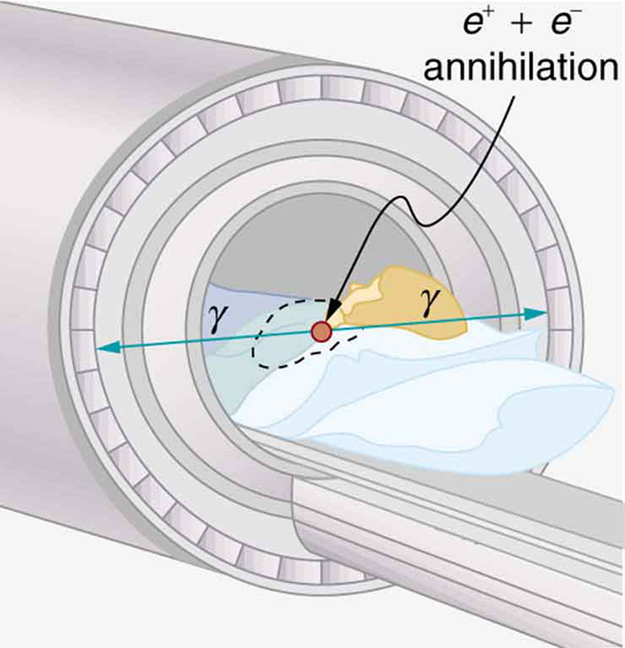
PET uses a fundamentally different detection method. Instead of imaging gamma rays emitted directly from a radioactive nucleus, PET detects pairs of gamma rays produced when a positron encounters an electron.
Certain radioactive isotopes decay by positron emission, also known as beta-plus (β+) decay. The emitted positron travels only a short distance through surrounding tissue before colliding with an electron.
Because matter and antimatter have opposite electric charge but identical mass, the electron and positron annihilate one another. Their mass is converted into energy according to Einstein's famous relationship
[latex]E = mc^2[/latex]
The annihilation produces two gamma rays, each with an energy of 511 keV. Conservation of momentum requires these gamma rays to travel in nearly opposite directions (approximately 180° apart).
[latex]e^- + e^+ \rightarrow 2\gamma[/latex]
Coincidence Detection
PET scanners surround the patient with a ring of radiation detectors. When two detectors located opposite one another record 511-keV gamma rays at nearly the same instant, the system concludes that both photons originated from a single annihilation event somewhere along the straight line connecting the detectors.
This process, called coincidence detection, allows the computer to determine the probable location of the radioactive tracer with much greater accuracy than is possible using a conventional gamma camera.
By recording millions of these annihilation events, sophisticated reconstruction algorithms generate detailed three-dimensional images of the radiopharmaceutical distribution within the body.
Fluorine-18 FDG: The Most Common PET Tracer
The radiopharmaceutical used most frequently in PET imaging is fluorine-18 fluorodeoxyglucose (F-18 FDG). FDG closely resembles glucose, the body's primary energy source. Cells absorb FDG in much the same way they absorb glucose, making it an excellent indicator of metabolic activity.
Rapidly growing cancer cells often consume glucose at much higher rates than normal tissues. As a result, tumors frequently accumulate larger amounts of FDG and appear as bright regions on PET images. Increased FDG uptake can also occur in areas of inflammation or infection, so physicians always interpret PET images together with other clinical information.
Major Clinical Applications of PET
- Detection and staging of many cancers
- Monitoring response to chemotherapy or radiation therapy
- Evaluation of Alzheimer's disease and other neurological disorders
- Assessment of heart muscle viability after a heart attack
- Identification of epileptic seizure foci before surgery
Because PET images reveal metabolic activity while CT and MRI provide detailed anatomical information, modern imaging systems often combine these techniques into a single examination.
Hybrid Imaging: PET/CT and PET/MRI
Today, most PET scanners are integrated with either a CT scanner or, less commonly, an MRI scanner. These hybrid systems combine the strengths of multiple imaging modalities in a single examination.
A PET image reveals where physiological activity is occurring, while CT and MRI reveal exactly where that activity is located anatomically. By digitally combining both datasets, physicians can determine not only that abnormal metabolic activity exists but also the precise organ or tissue responsible.
Clinical Example
A PET scan may reveal an area of increased glucose metabolism suggesting the presence of a tumor. The accompanying CT scan precisely identifies the affected lymph node or organ, allowing physicians to stage the cancer accurately, guide biopsy procedures, and monitor treatment response over time.
Hybrid imaging has become the standard of care in many areas of oncology because it combines the functional information provided by nuclear medicine with the excellent anatomical detail of CT or MRI. This combination enables earlier diagnosis, more accurate treatment planning, and improved patient outcomes.
Comparing Medical Imaging Techniques
Modern medicine offers a wide variety of imaging techniques, each based on different physical principles and designed to answer different clinical questions. No single imaging method is best for every situation. Instead, physicians choose the technique that provides the most useful information while minimizing risk to the patient.
Some imaging methods, such as x-ray radiography and computed tomography (CT), produce detailed pictures of anatomical structures. Others, including SPECT and PET, provide information about how organs function or how actively tissues are using energy. Magnetic resonance imaging (MRI), discussed in the following section, uses an entirely different physical principle based on the magnetic properties of atomic nuclei and does not use ionizing radiation.
| Imaging Technique | Primary Radiation Source | Main Information Obtained | Common Clinical Applications |
|---|---|---|---|
| X-ray Radiography | External x-rays | Two-dimensional anatomy | Bone fractures, chest imaging, dental examinations |
| Computed Tomography (CT) | External x-rays | Three-dimensional anatomy | Trauma, stroke, cancer, internal injuries |
| SPECT | Gamma rays emitted by a radiopharmaceutical | Organ function and blood flow | Cardiac perfusion, bone imaging, thyroid and kidney studies |
| PET | Gamma rays produced by positron annihilation | Cellular metabolism and physiological activity | Cancer imaging, neurology, cardiology |
| MRI | Radio-frequency electromagnetic waves in a magnetic field | Soft tissue anatomy and tissue composition | Brain, spinal cord, joints, muscles, abdominal organs |
| Ultrasound | High-frequency sound waves | Real-time anatomy and blood flow | Pregnancy, heart imaging, abdominal organs, vascular studies |
Healthcare Connection
Patients often undergo several imaging examinations during the diagnosis and treatment of a single disease. For example, a patient with suspected lung cancer may first receive a chest x-ray, followed by a CT scan to define the anatomy, a PET/CT scan to determine whether the tumor has spread, and MRI to evaluate possible involvement of the brain or spinal cord. Each imaging technique contributes different information that helps physicians make informed clinical decisions.
Choosing the Appropriate Imaging Technique
When selecting an imaging study, physicians consider several factors, including the clinical question being asked, the patient's age, pregnancy status, previous imaging results, radiation exposure, cost, and the availability of equipment.
In general, imaging techniques that use ionizing radiation should be performed only when the expected medical benefit outweighs the potential risk. This principle reflects the radiation protection philosophy introduced in earlier chapters and follows the ALARA (As Low As Reasonably Achievable) principle. Healthcare providers seek to obtain the necessary diagnostic information while minimizing unnecessary radiation exposure.
Which Imaging Technique Would You Choose?
| Clinical Situation | Likely Imaging Study | Reason |
|---|---|---|
| Suspected wrist fracture | X-ray | Excellent visualization of bone with a low radiation dose. |
| Possible pulmonary embolism | CT angiography or ventilation-perfusion (V/Q) scan | Evaluates blood flow through the lungs. |
| Evaluation of coronary artery disease | SPECT or PET myocardial perfusion imaging | Measures blood flow to the heart muscle during stress and rest. |
| Cancer staging | PET/CT | Combines metabolic information with detailed anatomy. |
| Suspected torn ligament | MRI | Provides excellent visualization of soft tissues without ionizing radiation. |
| Pregnancy monitoring | Ultrasound | Uses sound waves instead of ionizing radiation. |
The Future of Nuclear Medicine
Nuclear medicine continues to evolve rapidly as researchers develop new radiopharmaceuticals that target increasingly specific biological processes. Rather than simply locating disease, many modern radiotracers identify the molecular changes that occur before structural damage becomes visible on conventional imaging studies.
An exciting area of current research is theranostics, an approach that combines diagnosis and therapy using closely related radioactive compounds. One radioisotope is used to locate diseased tissue, while a chemically similar radioisotope delivers therapeutic radiation directly to the same target. This strategy allows physicians to personalize treatment, improving effectiveness while reducing damage to healthy tissues.
Advances in detector technology, computer reconstruction algorithms, and artificial intelligence are also improving image quality while reducing both scanning time and radiation dose. These developments continue to expand the role of nuclear physics in modern healthcare.
Chapter Review
Nuclear medicine demonstrates one of the most important applications of nuclear physics in healthcare. By combining carefully selected radioactive isotopes with biologically active molecules, physicians can observe physiological processes that cannot be seen with conventional anatomical imaging alone. Gamma cameras, SPECT, and PET scanners convert radiation emitted within the patient's body into detailed images that assist in the diagnosis of cardiovascular disease, neurological disorders, cancer, and many other conditions.
Although these techniques rely on ionizing radiation, careful selection of radioisotopes, optimized imaging protocols, and adherence to radiation safety principles ensure that the medical benefits of these procedures greatly outweigh the associated risks for appropriately selected patients.
Section Summary
- Nuclear medicine uses radiopharmaceuticals, compounds containing radioactive isotopes attached to biologically active molecules, to diagnose disease and evaluate organ function.
- Radiopharmaceuticals accumulate in specific tissues, allowing physicians to visualize physiological processes such as blood flow, metabolism, and organ function.
- Technetium-99m is the most widely used diagnostic radioisotope because it emits a suitable gamma ray, has a short half-life, and can be incorporated into many different pharmaceutical compounds.
- The gamma (Anger) camera detects gamma rays emitted by radiopharmaceuticals and converts them into electrical signals that are reconstructed into medical images.
- SPECT acquires gamma-camera images from multiple angles to reconstruct three-dimensional images of radiopharmaceutical distribution.
- PET detects pairs of gamma rays produced during positron-electron annihilation, allowing highly accurate localization of metabolic activity.
- Hybrid imaging systems such as PET/CT combine functional information from nuclear medicine with detailed anatomical information from CT.
- Modern nuclear medicine plays a central role in diagnosing cancer, cardiovascular disease, neurological disorders, and many other medical conditions.
Conceptual Questions
- In terms of radiation dose, what is the major difference between medical diagnostic uses of radiation and medical therapeutic uses?
- One of the methods used to limit radiation dose to the patient in medical imaging is to employ isotopes with short half-lives. How would this limit the dose?
Problems & Exercises
- A neutron generator uses an [latex]\alpha[/latex] source, such as radium, to bombard beryllium, inducing the reaction [latex]{}^{4}\text{He}+{}^{9}\text{Be}\to {}^{\text{12}}\text{C}+n[/latex]. Such neutron sources are called RaBe sources, or PuBe sources if they use plutonium to get the [latex]\alpha[/latex] s. Calculate the energy output of the reaction in MeV.
- Neutrons from a source (perhaps the one discussed in the preceding problem) bombard natural molybdenum, which is 24 percent [latex]{}^{\text{98}}\text{Mo}[/latex]. What is the energy output of the reaction [latex]{}^{\text{98}}\text{Mo}+n\to {}^{\text{99}}\text{Mo}+\gamma[/latex] ? The mass of [latex]{}^{\text{98}}\text{Mo}[/latex] is given in Appendix A: Atomic Masses, and that of [latex]{}^{\text{99}}\text{Mo}[/latex] is 98.907711 u.
- The purpose of producing [latex]{}^{\text{99}}\text{Mo}[/latex] (usually by neutron activation of natural molybdenum, as in the preceding problem) is to produce [latex]{}^{\text{99m}}\text{Tc.}[/latex] Using the rules, verify that the [latex]{\beta }^{-}[/latex] decay of [latex]{}^{\text{99}}\text{Mo}[/latex] produces [latex]{}^{\text{99m}}\text{Tc}[/latex]. (Most [latex]{}^{\text{99m}}\text{Tc}[/latex] nuclei produced in this decay are left in a metastable excited state denoted [latex]{}^{\text{99m}}\text{Tc}[/latex].)
- (a) Two annihilation [latex]\gamma[/latex] rays in a PET scan originate at the same point and travel to detectors on either side of the patient. If the point of origin is 9.00 cm closer to one of the detectors, what is the difference in arrival times of the photons? (This could be used to give position information, but the time difference is small enough to make it difficult.) (b) How accurately would you need to be able to measure arrival time differences to get a position resolution of 1.00 mm?
- Table 126.1 indicates that 7.50 mCi of [latex]{}^{\text{99m}}\text{Tc}[/latex] is used in a brain scan. What is the mass of technetium?
- The activities of [latex]{}^{\text{131}}\text{I}[/latex] and [latex]{}^{\text{123}}\text{I}[/latex] used in thyroid scans are given in Table 126.1to be 50 and [latex]\text{70 μ}Ci[/latex], respectively. Find and compare the masses of [latex]{}^{\text{131}}\text{I}[/latex] and [latex]{}^{\text{123}}\text{I}[/latex] in such scans, given their respective half-lives are 8.04 d and 13.2 h. The masses are so small that the radioiodine is usually mixed with stable iodine as a carrier to ensure normal chemistry and distribution in the body.
- (a) Neutron activation of sodium, which is 100%[latex]{}^{\text{23}}\text{Na}[/latex], produces [latex]{}^{\text{24}}\text{Na}[/latex], which is used in some heart scans, as seen in Table 126.1. The equation for the reaction is [latex]{}^{\text{23}}\text{Na}+n\to {}^{\text{24}}\text{Na}+\gamma[/latex]. Find its energy output, given the mass of [latex]{}^{\text{24}}\text{Na}[/latex] is 23.990962 u. (b) What mass of [latex]{}^{\text{24}}\text{Na}[/latex] produces the needed 5.0-mCi activity, given its half-life is 15.0 h?
Glossary
- Anger camera
- A medical imaging device, also called a gamma camera, that detects gamma rays emitted by radiopharmaceuticals and converts them into images.
- coincidence detection
- The simultaneous detection of two gamma rays emitted during positron-electron annihilation, allowing PET scanners to determine the line along which the annihilation occurred.
- collimator
- A thick lead plate containing many small holes that allows only gamma rays traveling in selected directions to reach the detector, improving image resolution.
- fluorodeoxyglucose (FDG)
- A glucose analog labeled with fluorine-18 that is widely used in PET imaging to identify tissues with high metabolic activity.
- gamma camera
- Another name for an Anger camera.
- metastable state
- An excited nuclear state with a measurable lifetime before it decays to a lower-energy state by emitting gamma radiation.
- photomultiplier tube (PMT)
- An electronic device that detects tiny flashes of light produced in a scintillation crystal and amplifies them into measurable electrical signals.
- positron emission tomography (PET)
- A nuclear imaging technique that detects pairs of gamma rays produced by positron-electron annihilation to create detailed three-dimensional images of physiological activity.
- PET/CT
- A hybrid imaging technique that combines the functional information obtained from PET with the detailed anatomical images produced by computed tomography (CT).
- radiopharmaceutical
- A biologically active compound that contains a radioactive isotope and is used for diagnostic imaging or targeted radiation therapy.
- radiotracer
- A radioactive isotope incorporated into a molecule that allows its distribution within the body to be monitored using radiation detectors.
- scintillation
- The emission of visible light by certain materials after they absorb ionizing radiation.
- single-photon emission computed tomography (SPECT)
- A three-dimensional nuclear imaging technique that reconstructs images from gamma rays emitted directly by a radiopharmaceutical.
- tagging
- The process of attaching a radioactive isotope to a biologically active molecule to create a radiopharmaceutical.
- technetium generator
- A device containing molybdenum-99 that continuously produces fresh technetium-99m for use in nuclear medicine.
- technetium-99m (Tc-99m)
- A metastable radioactive isotope that emits a 140-keV gamma ray and is the most widely used radioisotope in diagnostic nuclear medicine.
A medical imaging device, also called a gamma camera, that detects gamma rays emitted by radiopharmaceuticals and converts them into images.
The simultaneous detection of two gamma rays emitted during positron-electron annihilation, allowing PET scanners to determine the line along which the annihilation occurred.
A thick lead plate containing many small holes that allows only gamma rays traveling in selected directions to reach the detector, improving image resolution.
A glucose analog labeled with fluorine-18 that is widely used in PET imaging to identify tissues with high metabolic activity.
Another name for an Anger camera.
An excited nuclear state with a measurable lifetime before it decays to a lower-energy state by emitting gamma radiation.
An electronic device that detects tiny flashes of light produced in a scintillation crystal and amplifies them into measurable electrical signals.
A nuclear imaging technique that detects pairs of gamma rays produced by positron-electron annihilation to create detailed three-dimensional images of physiological activity.
A hybrid imaging technique that combines the functional information obtained from PET with the detailed anatomical images produced by computed tomography (CT).
A biologically active compound that contains a radioactive isotope and is used for diagnostic imaging or targeted radiation therapy.
A radioactive isotope incorporated into a molecule that allows its distribution within the body to be monitored using radiation detectors.
The emission of visible light by certain materials after they absorb ionizing radiation.
A three-dimensional nuclear imaging technique that reconstructs images from gamma rays emitted directly by a radiopharmaceutical.
The process of attaching a radioactive isotope to a biologically active molecule to create a radiopharmaceutical.
A device containing molybdenum-99 that continuously produces fresh technetium-99m for use in nuclear medicine.
A metastable radioactive isotope that emits a 140-keV gamma ray and is the most widely used radioisotope in diagnostic nuclear medicine.
