
Particle Physics and Frontiers of Physics
130 Introduction to Particle Physics
Learning Objectives
- Describe the hierarchy of matter from molecules to elementary particles.
- Explain the goals of particle physics and how it differs from atomic and nuclear physics.
- Recognize the role of particle accelerators in studying the fundamental structure of matter.
- Appreciate how discoveries in particle physics influence medicine, technology, and our understanding of the universe.
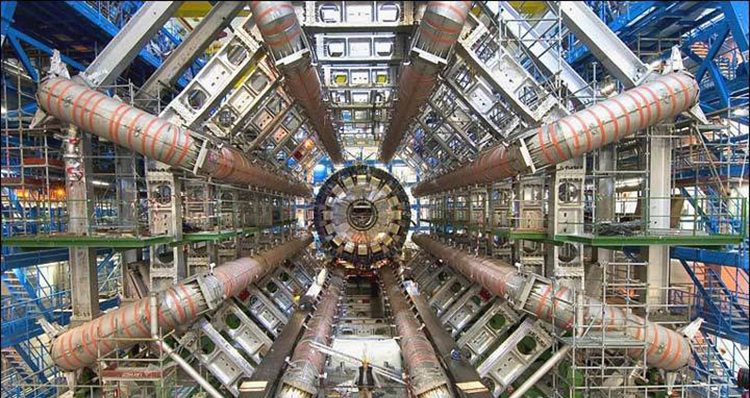
Throughout this textbook, we have explored matter on progressively smaller scales. We began by studying the motion of everyday objects, then examined atoms, electric charge, atomic nuclei, and radioactive decay. In this final chapter, we take one more step inward to investigate the particles that make up protons, neutrons, electrons, and ultimately all known matter.
Particle physics, also called high-energy physics, seeks to identify the most fundamental particles in nature and understand the forces through which they interact. While atomic physics focuses on atoms and nuclear physics studies atomic nuclei, particle physics investigates whether those particles themselves are composed of even smaller constituents.
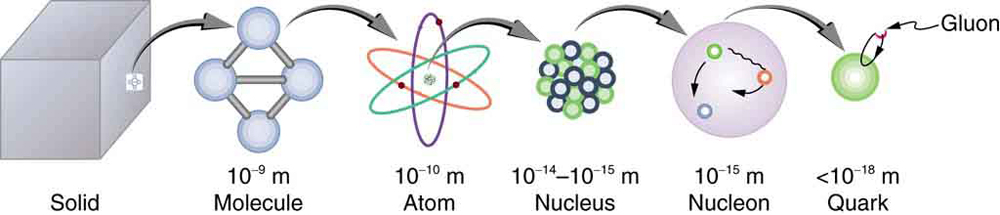
Over the past century, scientists have repeatedly discovered that objects once thought to be fundamental were actually made of smaller components. Molecules are composed of atoms, atoms contain electrons surrounding a nucleus, and protons and neutrons are themselves made of even smaller particles called quarks. Whether quarks and other elementary particles truly represent the deepest level of matter remains one of the biggest unanswered questions in modern physics.
Studying particles much smaller than atoms requires extraordinary experimental tools. Modern particle accelerators, such as the Large Hadron Collider, accelerate particles to nearly the speed of light before allowing them to collide. By analyzing the particles produced in these collisions, physicists can probe distances far smaller than those accessible with ordinary microscopes and test theories describing the fundamental laws of nature.
Healthcare Connection
Particle physics has applications far beyond understanding the universe. Technologies originally developed for particle accelerators have contributed to medical imaging, radiation therapy, cancer treatment, and the production of radioactive isotopes used in nuclear medicine. Advances in fundamental physics often lead to innovations that improve healthcare and benefit society.
Although many questions remain unanswered, particle physics has developed a remarkably successful framework known as the Standard Model, which describes the known elementary particles and three of the four fundamental forces of nature. In this chapter, we introduce the basic concepts of particle physics and explore how studying the smallest known particles helps us better understand everything from the structure of atoms to the evolution of the universe.
