
Particle Physics and Frontiers of Physics
136 The Standard Model and the Unification of Forces
Learning Objectives
- Describe the goals of Grand Unified Theories (GUTs) and explain why physicists seek a unified description of the fundamental forces.
- Explain how electroweak theory unifies the electromagnetic and weak interactions.
- Describe the role of gluons in transmitting the strong interaction.
- Explain the basic principles of quantum chromodynamics (QCD).
- Describe the Standard Model of particle physics and its current limitations.
One of the greatest goals of modern physics is to explain nature using a single, unified framework. Throughout history, phenomena that once appeared unrelated have often been shown to arise from the same underlying physical principles. In the nineteenth century, electricity and magnetism were unified into a single electromagnetic theory by James Clerk Maxwell. During the twentieth century, physicists discovered that the weak nuclear force and the electromagnetic force are closely related and can be described together by the electroweak theory.
Today, physicists continue to search for an even more complete description of nature. A Grand Unified Theory (GUT) would combine the strong, weak, and electromagnetic interactions into a single force that existed under the extremely high-energy conditions present shortly after the Big Bang. An even more ambitious goal, often called a Theory of Everything (TOE), would also incorporate gravity into this unified description. Although these ideas remain active areas of theoretical research, they have inspired decades of experimental discoveries and continue to guide the development of particle physics.
This chapter explores the evidence supporting the unification of forces, introduces the particles that carry the strong interaction, and describes the Standard Model, the remarkably successful theory that explains nearly all known elementary particles and three of the four fundamental forces. While the Standard Model has passed countless experimental tests, important questions remain unanswered, including the nature of dark matter, the origin of neutrino masses, and how gravity fits into a unified description of the universe.
Electroweak Theory
One of the most important achievements in modern physics was the realization that the electromagnetic and weak interactions are different manifestations of a single underlying force. Under ordinary conditions these interactions appear very different. The electromagnetic force acts over infinite distances and is responsible for familiar phenomena such as electric circuits, magnets, and chemical bonding. The weak interaction has an extremely short range and is responsible for processes such as beta decay, which play an essential role in radioactive decay and many biological imaging and medical applications.
Despite these differences, theoretical work in the 1960s by Steven Weinberg, Sheldon Glashow, and Abdus Salam showed that the electromagnetic and weak interactions become indistinguishable at sufficiently high energies. Their theory, known as the electroweak theory, predicted the existence of three previously unknown force-carrying particles: the [latex]W^+[/latex], [latex]W^-[/latex], and [latex]Z^0[/latex] bosons.
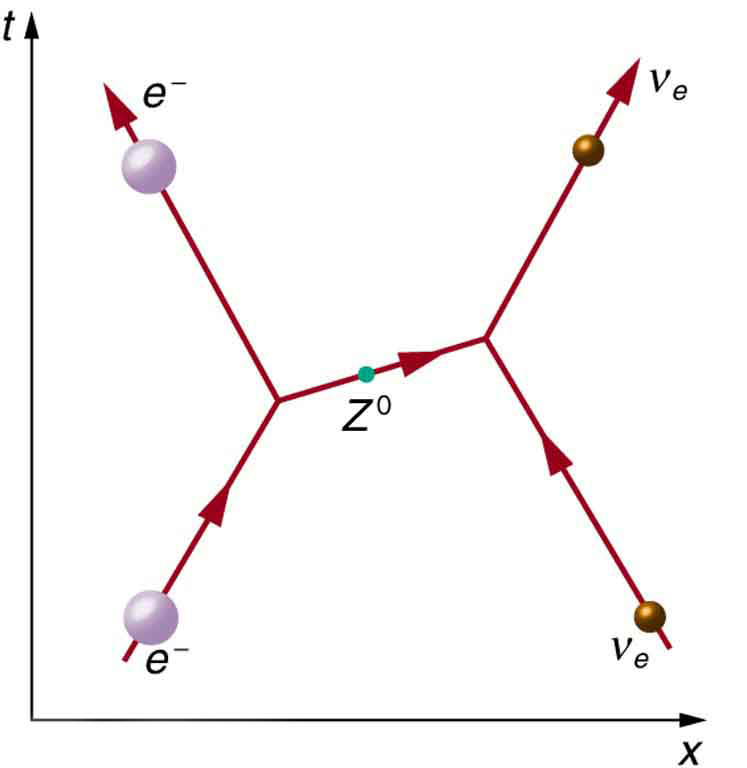
The theory made quantitative predictions for the properties of these particles, including their masses. In 1983, experiments at CERN observed the [latex]W^\pm[/latex] and [latex]Z^0[/latex] bosons with properties that closely matched the theoretical predictions. This discovery provided strong confirmation of electroweak theory and marked one of the greatest successes of modern particle physics.
Electroweak theory also predicted the existence of the Higgs boson, which plays a key role in explaining why the [latex]W^\pm[/latex] and [latex]Z^0[/latex] bosons have mass while the photon remains massless. In 2012, experiments at CERN's Large Hadron Collider discovered a particle consistent with the Higgs boson, providing another major confirmation of the Standard Model.
Physics in Healthcare
The weak interaction is responsible for radioactive beta decay, making it fundamental to many medical technologies. Radioactive isotopes used in positron emission tomography (PET), single-photon emission computed tomography (SPECT), and radiation therapy undergo weak-interaction processes. Although these medical applications occur at energies far below those studied in particle accelerators, they rely on the same fundamental interaction described by electroweak theory.
Although the weak interaction acts over distances smaller than approximately [latex]10^{-18}\text{ m}[/latex], its effects can still be measured with remarkable precision. Careful measurements of atomic spectra, particle decays, and high-energy collisions continue to test electroweak theory. To date, its predictions have agreed extraordinarily well with experimental observations, making it one of the most thoroughly tested theories in all of physics.
Gluons and Quantum Chromodynamics
Just as photons are the force carriers of the electromagnetic interaction, the strong interaction is transmitted by particles called gluons, symbolized by [latex]g[/latex]. Gluons act between quarks and are responsible for binding them together to form hadrons, including protons and neutrons. Without the strong interaction, atomic nuclei could not exist.
Unlike photons, which carry no electric charge, gluons carry a property known as color charge. This allows gluons not only to interact with quarks but also with one another, making the strong interaction considerably more complex than electromagnetism. According to the theory of quantum chromodynamics (QCD), there are eight types of gluons, all of which are massless particles with spin 1.
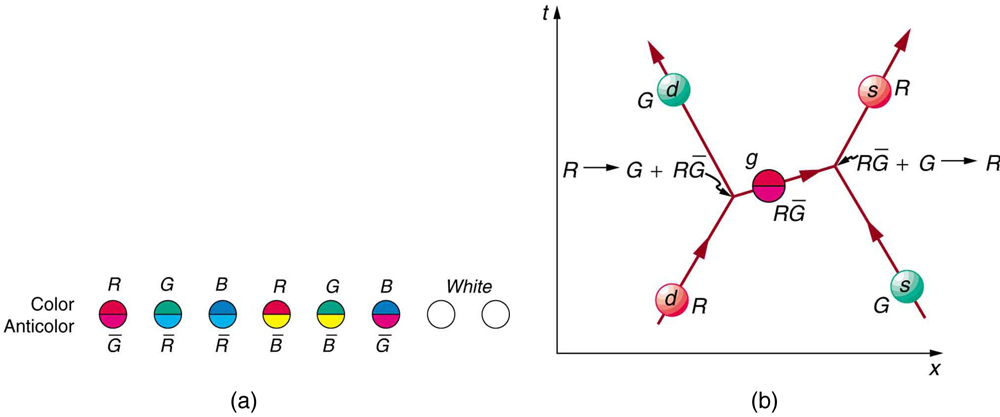
Color charge should not be confused with the colors we perceive with our eyes. Instead, it is a quantum property analogous to electric charge. Quarks can carry one of three color charges, conventionally labeled red, green, and blue. Antiquarks carry the corresponding anticolors. Observable particles always have a net color charge of zero, a condition known as color neutrality.
When a gluon is exchanged between two quarks, it transfers color charge from one quark to another. For example, a red quark can emit a gluon carrying red and antigreen color, causing the emitting quark to become green while the receiving green quark becomes red. Although the colors of the individual quarks change, the total color of the hadron remains unchanged.
Color Neutrality
All observable particles must be color neutral. Baryons, such as protons and neutrons, contain one red, one green, and one blue quark, whose combined colors produce a neutral ("white") state. Mesons consist of one quark and one antiquark with matching color and anticolor. This requirement explains why isolated quarks have never been observed experimentally.
Evidence for gluons comes from high-energy scattering experiments. When electrons are accelerated to extremely high energies and directed at protons, the scattering patterns reveal that the proton's momentum is shared among its quarks and other constituents. The measured momentum carried by the quarks is consistently smaller than expected if quarks were the only particles inside the proton. The remaining momentum is attributed primarily to gluons, providing strong indirect evidence for their existence.
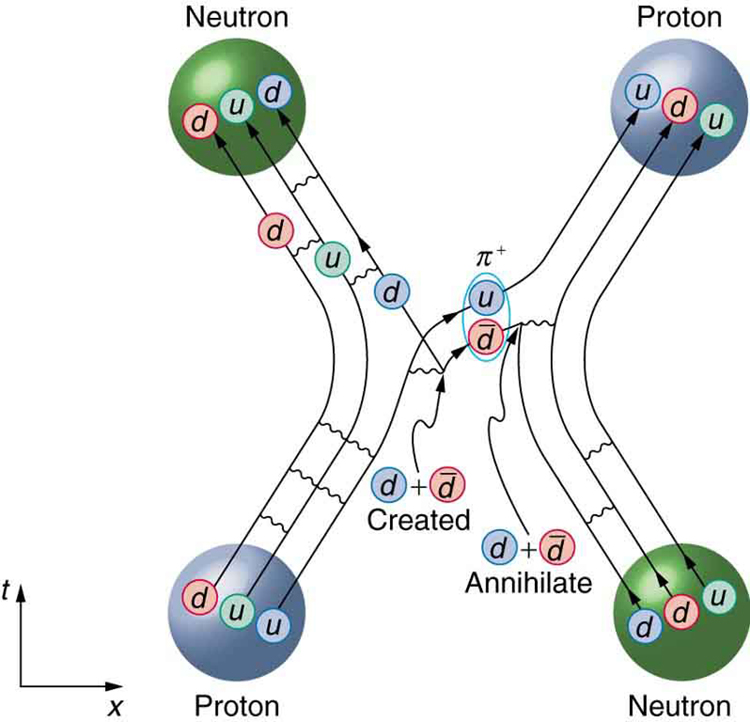
Although the strong interaction between quarks is fundamental, the force that binds protons and neutrons together inside atomic nuclei is actually a residual strong interaction. It arises from the interactions among the quarks inside neighboring nucleons and is often described as the exchange of virtual mesons, especially pions. Figure 136.3 illustrates how gluons and quarks underlie this effective nuclear force.
Quantum chromodynamics provides a remarkably successful mathematical description of the strong interaction. It explains why quarks are permanently confined inside hadrons, why gluons cannot normally be observed as free particles, and why the strong interaction behaves differently at very short distances than at larger distances. Together with the electroweak theory, QCD forms the foundation of the Standard Model of particle physics.
The Standard Model and the Search for Unification
Quantum chromodynamics and electroweak theory together form the Standard Model of particle physics, the framework that describes all known elementary particles and three of the four fundamental interactions: the electromagnetic, weak, and strong interactions. The Standard Model has been extraordinarily successful, accurately predicting the outcomes of thousands of experiments over several decades.
The Standard Model classifies matter particles into two broad groups: quarks, which combine to form hadrons such as protons and neutrons, and leptons, which include electrons and neutrinos. These matter particles interact by exchanging gauge bosons, the force-carrying particles of the Standard Model. The photon carries the electromagnetic interaction, the [latex]W^\pm[/latex] and [latex]Z^0[/latex] bosons carry the weak interaction, and gluons carry the strong interaction. The Higgs boson, discovered in 2012, is associated with the Higgs field, which gives mass to many elementary particles.
The Standard Model at a Glance
- Matter particles: Six quarks and six leptons.
- Force carriers: Photons, eight gluons, and the [latex]W^\pm[/latex] and [latex]Z^0[/latex] bosons.
- Higgs boson: Associated with the Higgs field, which explains why many elementary particles have mass.
- Not included: Gravity is not part of the Standard Model.
Despite its remarkable success, the Standard Model is known to be incomplete. It does not include gravity, does not explain the nature of dark matter or dark energy, and cannot fully account for the tiny masses of neutrinos or why the universe contains much more matter than antimatter. These unanswered questions motivate the search for theories that extend beyond the Standard Model.
Grand Unified Theories
One approach to extending the Standard Model is the development of Grand Unified Theories (GUTs). These theories propose that the strong, weak, and electromagnetic interactions are different manifestations of a single fundamental force. According to GUTs, immediately after the Big Bang, when the universe was extraordinarily hot and dense, these three interactions would have been unified. As the universe expanded and cooled, they separated into the distinct forces observed today.
Historical Perspective
The unification of forces has been one of the recurring themes of physics. Isaac Newton showed that the same gravitational force governs falling objects on Earth and the motion of the Moon. James Clerk Maxwell unified electricity and magnetism into electromagnetism. Electroweak theory later demonstrated that the electromagnetic and weak interactions are two aspects of the same force at sufficiently high energies. Grand Unified Theories seek to continue this progression by including the strong interaction within a single framework.
Experiments show that the strengths of the fundamental interactions change with energy. At the low energies encountered in everyday life, gravity is by far the weakest interaction, followed by the weak interaction, the electromagnetic interaction, and finally the strong interaction. As particle energies increase, however, the strengths of these interactions gradually become more similar. Electroweak theory predicts that the electromagnetic and weak interactions merge at energies of about 100 GeV, a prediction confirmed by experiments at CERN.
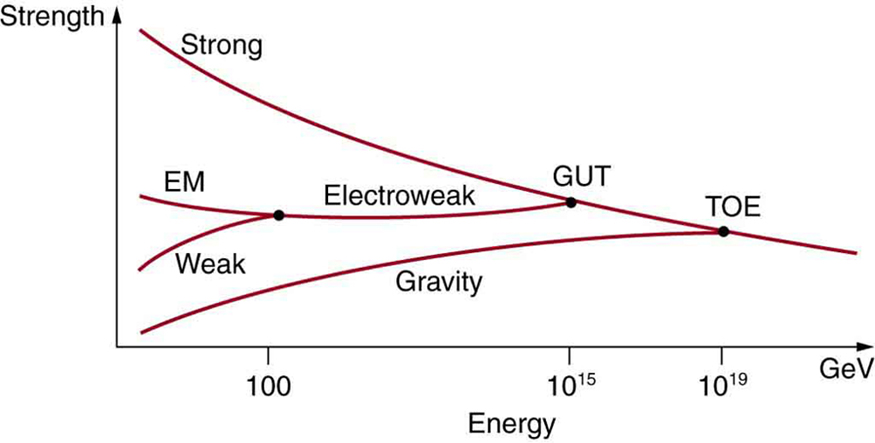
The energies required to test Grand Unified Theories directly are enormous—many trillions of times greater than those produced by today's most powerful accelerators. Consequently, physicists look for indirect evidence, such as extremely rare particle decays or signatures left over from the earliest moments of the universe. Observations in particle physics, astrophysics, and cosmology all contribute to testing these ideas.
Proton Decay and the Search for New Physics
One of the most important predictions of many Grand Unified Theories is that the proton is not perfectly stable. In the Standard Model, the proton is effectively stable because baryon number is conserved. Many GUTs, however, predict that baryon number conservation can be violated under extremely high-energy conditions, allowing protons to decay after an extraordinarily long time.
A commonly proposed decay mode is
In this reaction, the proton decays into a neutral pion and a positron. Such a decay would violate baryon number conservation and, therefore, cannot occur within the Standard Model. Its observation would provide compelling evidence for new physics beyond the Standard Model and would strongly support the idea of force unification.
Why Is Proton Decay So Important?
Many proposed extensions of the Standard Model predict new particles that can transform quarks into leptons. If proton decay were observed, it would demonstrate that quarks and leptons are more closely related than they appear in the Standard Model and would provide direct evidence for a Grand Unified Theory.
Although a proton lifetime of more than [latex]10^{30}[/latex] years may seem impossibly long, experiments can still search for proton decay because they monitor enormous numbers of protons simultaneously. A detector containing thousands of metric tons of water, for example, contains roughly [latex]10^{33}[/latex] protons. Even an extremely rare decay might therefore be observed if enough protons are monitored for a sufficiently long time.
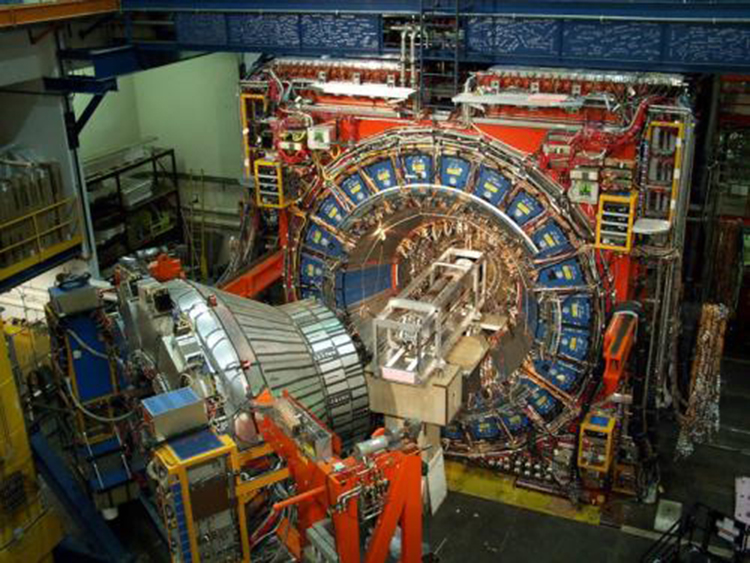
Modern experiments have not detected proton decay despite decades of searching. Instead, they have established lower limits on the proton's lifetime that exceed [latex]10^{34}[/latex] years for several proposed decay modes. These results rule out many early Grand Unified Theories while helping physicists refine newer models that remain consistent with experimental observations.
Beyond Grand Unified Theories
Some physicists seek an even more comprehensive framework that unifies all four fundamental interactions, including gravity. Such a framework is often called a Theory of Everything (TOE). Developing such a theory remains one of the greatest challenges in modern physics.
Several candidate theories have been proposed. One of the best known is string theory, which suggests that elementary particles are not point-like objects but tiny vibrating strings whose different patterns of vibration produce the various particles observed in nature. Other approaches, including loop quantum gravity and several related theories, also attempt to reconcile quantum mechanics with general relativity. At present, however, none of these proposals has been experimentally confirmed.
The Limits of Current Experiments
The energies at which the strong, weak, electromagnetic, and gravitational interactions might become fully unified are many orders of magnitude beyond the capabilities of existing particle accelerators. Because direct tests are currently impossible, physicists search for indirect evidence through high-precision particle experiments, astronomical observations, and studies of the early universe.
The universe itself provides a natural laboratory for studying these extreme conditions. During the first tiny fraction of a second after the Big Bang, temperatures and energies were vastly higher than anything achievable on Earth. Measurements of the cosmic microwave background, the distribution of galaxies, gravitational waves, and other astronomical observations help scientists test ideas about how the fundamental interactions behaved during the earliest moments of cosmic history.
Looking Ahead
The Standard Model remains one of the most successful scientific theories ever developed, yet it is clearly incomplete. Discoveries related to dark matter, dark energy, neutrino properties, or proton decay could provide the first direct evidence of physics beyond the Standard Model and move scientists closer to a unified description of the fundamental interactions.
Section Summary
- Electroweak theory unifies the electromagnetic and weak interactions, showing that they are different manifestations of a single force at sufficiently high energies. The successful prediction and subsequent discovery of the [latex]W^\pm[/latex], [latex]Z^0[/latex], and Higgs bosons provide strong experimental support for this theory.
- Gluons are the force-carrying particles of the strong interaction. According to quantum chromodynamics (QCD), eight types of gluons transmit forces between quarks by exchanging color charge while preserving the overall color neutrality of observable particles.
- Quantum chromodynamics and electroweak theory together form the Standard Model of particle physics. The Standard Model successfully describes all known elementary particles and three of the four fundamental interactions, but it does not include gravity and cannot fully explain phenomena such as dark matter, dark energy, or the origin of neutrino masses.
- Grand Unified Theories (GUTs) propose that the strong, weak, and electromagnetic interactions become a single unified force at extremely high energies, such as those that existed shortly after the Big Bang. Although these theories are well motivated, direct experimental tests remain beyond the reach of current particle accelerators.
- Many Grand Unified Theories predict that protons are ultimately unstable and may decay after extraordinarily long lifetimes. Modern experiments have not observed proton decay, placing stringent lower limits on the proton's lifetime and helping constrain proposed theories beyond the Standard Model.
- The search for a unified description of nature continues through experiments in particle physics, astrophysics, and cosmology. Discoveries involving proton decay, dark matter, neutrinos, or other new particles could provide evidence for physics beyond the Standard Model.
Conceptual Questions
- If a Grand Unified Theory (GUT) is eventually shown to be correct and the four fundamental interactions are unified, would it still be correct to say that the Moon orbits Earth because of gravity? Explain your reasoning.
- The Higgs boson is associated with the Higgs field, which gives mass to many elementary particles. Does this mean that the Higgs boson is the ultimate carrier of the weak interaction? Explain.
- Gluons and photons are massless particles. Does this imply that the [latex]W^+[/latex], [latex]W^-[/latex], and [latex]Z^0[/latex] bosons are not the fundamental carriers of the weak interaction? Explain your answer.
Problems & Exercises
- Integrated ConceptsAn extremely energetic cosmic ray enters Earth's atmosphere with an energy of [latex]10^{10}\,\text{GeV}[/latex]. As it collides with atmospheric nuclei, it produces a shower of secondary particles, as illustrated in Figure 136.6. Suppose the cosmic ray's energy is converted into particles with an average mass of [latex]200\,\text{MeV}/c^2[/latex].
- Approximately how many particles are produced?
- If the particle shower spreads uniformly over an area of [latex]1.00\,\text{km}^2[/latex], how many particles strike each square meter?
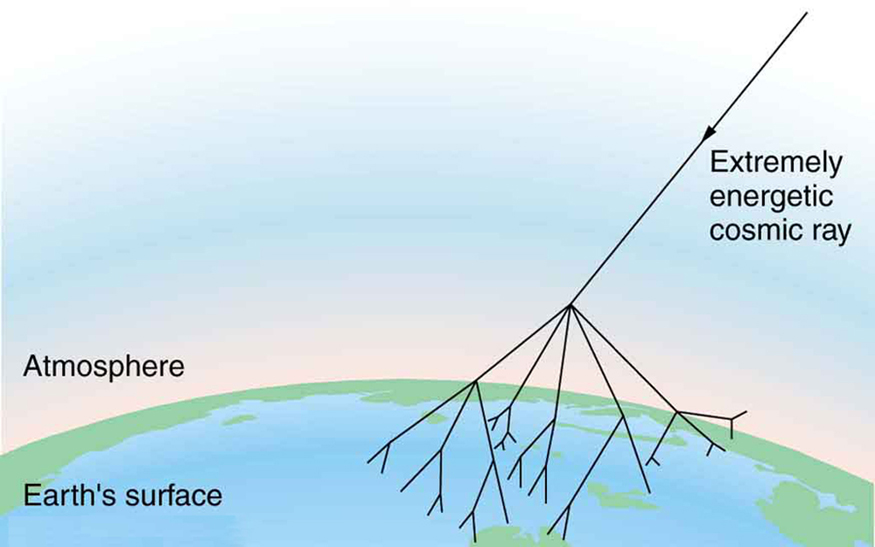
Figure 136.6 An ultrahigh-energy cosmic ray striking Earth's atmosphere produces a cascade of secondary particles that can spread over several square kilometers before reaching the ground. - Integrated ConceptsAssuming conservation of momentum, determine the energy of each [latex]\gamma[/latex] ray produced in the decay of a neutral pion at rest:
[latex]\pi^0 \rightarrow \gamma + \gamma.[/latex]
- Integrated ConceptsAn electron is accelerated to an energy of 50 GeV at the Stanford Linear Accelerator Center (SLAC). What is its de Broglie wavelength? What does this wavelength imply about the smallest structures that can be resolved using such an electron beam?
- Integrated ConceptsA proton at Fermilab has a total energy of 1.00 TeV.
- Calculate its relativistic factor [latex]\gamma=\frac{1}{\sqrt{1-v^2/c^2}}[/latex].
- If the proton produces a [latex]\pi^+[/latex] traveling at the same speed, what is the pion's lifetime as measured in the laboratory?
- How far does the pion travel before decaying?
- Integrated ConceptsThe primary decay mode of the negative pion is
[latex]\pi^- \rightarrow \mu^-+\bar{\nu}_\mu.[/latex]
- Determine the energy released in this decay (in MeV).
- Assuming the pion is initially at rest, use conservation of momentum to determine the energy of each decay product. You may assume the muon antineutrino is massless and that [latex]p=E/c[/latex].
- Integrated ConceptsA proposed accelerator would produce a secondary beam of kaons ([latex]K[/latex] mesons) with a kinetic energy of 500 MeV for studies of the strong interaction.
- Calculate the relativistic factor [latex]\gamma[/latex] for these particles.
- Determine their average lifetime in the laboratory frame.
- How far do they travel, on average, before decaying?
- Integrated ConceptsSuppose you are designing an experiment to search for proton decay and your detector can observe 50% of all decay events.
- Assuming a proton lifetime of [latex]10^{31}[/latex] years, how many kilograms of water would be required to observe one proton decay per month, on average?
- What volume of water does this correspond to (in cubic meters)?
- If the actual proton lifetime is [latex]10^{33}[/latex] years, how long would you expect to wait, on average, to observe a single decay?
- Integrated ConceptsLarge numbers of neutrinos were produced during Supernova 1987A in the Large Magellanic Cloud, approximately 120,000 light-years from Earth.
- Assume a neutrino has a mass of [latex]7\,\text{eV}/c^2[/latex] and a kinetic energy of 700 keV. Calculate its relativistic factor [latex]\gamma[/latex].
- If the neutrino and a photon leave the supernova simultaneously, how much earlier would the photon arrive at Earth? (Hint: Because [latex]\gamma[/latex] is extremely large, a series expansion may be useful when determining the neutrino's speed.)
- Construct Your Own ProblemConsider an ultrahigh-energy cosmic ray entering Earth's atmosphere. Construct a problem in which you calculate the energy of the original cosmic ray from measurements of the resulting particle shower. Your problem should include reasonable assumptions about the average particle mass, the number of particles detected per square meter, and the total area covered by the shower. Express the final energy in both electron volts and joules.
- Construct Your Own ProblemImagine you are designing an experiment to search for the extremely rare decay of an electron or another hypothetical unstable elementary particle. Construct a problem in which you estimate the amount of detector material required to observe a specified number of decay events over a given period of time. Consider the particle's assumed lifetime, the number of particles contained in the detector material, and the desired detection rate.
Glossary
- electroweak theory
- The theory that unifies the electromagnetic and weak interactions, showing that they are different manifestations of a single fundamental force at sufficiently high energies.
- Grand Unified Theory (GUT)
- A class of theoretical models proposing that the strong, weak, and electromagnetic interactions become a single unified force at extremely high energies.
- gluon
- A massless spin-1 gauge boson that carries the strong interaction between quarks. According to quantum chromodynamics, there are eight types of gluons.
- Higgs boson
- An elementary particle discovered in 2012 that is associated with the Higgs field, which gives mass to many elementary particles in the Standard Model.
- quantum chromodynamics (QCD)
- The theory describing the strong interaction between quarks and gluons through the exchange of color charge.
- Standard Model
- The current theory of particle physics that describes all known elementary particles and three of the four fundamental interactions: the electromagnetic, weak, and strong interactions.
- string theory
- A proposed framework in which elementary particles are modeled as tiny vibrating strings rather than point-like particles. It is one of several approaches being explored in the search for a unified theory that includes gravity.
The theory that unifies the electromagnetic and weak interactions, showing that they are different manifestations of a single fundamental force at sufficiently high energies.
A class of theoretical models proposing that the strong, weak, and electromagnetic interactions become a single unified force at extremely high energies.
A massless fundamental particle that carries the strong interaction between quarks. Gluons also carry color charge and therefore interact with one another.
An elementary particle discovered in 2012 that is associated with the Higgs field, which gives mass to many elementary particles in the Standard Model.
The theory describing the strong interaction between quarks and gluons through the exchange of color charge.
The current theory of particle physics that describes all known elementary particles and three of the four fundamental interactions: the electromagnetic, weak, and strong interactions.
A proposed framework in which elementary particles are modeled as tiny vibrating strings rather than point-like particles. It is one of several approaches being explored in the search for a unified theory that includes gravity.
