
Radioactivity, Nuclear Physics and its Medical Applications
119 Fusion
Learning Objectives
- Define nuclear fusion and explain why fusion reactions can release energy.
- Relate nuclear fusion to the binding energy per nucleon of atomic nuclei.
- Describe the challenges involved in producing practical fusion energy on Earth.
In the previous chapters, we explored radioactive decay and nuclear fission, both of which release energy because the products are more tightly bound than the original nuclei. In this chapter, we examine the complementary process of nuclear fusion, in which two light nuclei combine to form a heavier nucleus. Fusion powers the Sun and other stars and has the potential to provide a nearly limitless source of energy if it can be controlled on Earth.
Imagine relaxing in the warmth of the summer Sun while reading about the latest advances in fusion energy research. You may also remember hearing about the controversial claims of cold fusion. These topics are related because they all involve attempts to harness the same process that powers the Sun. Thermonuclear power refers to the production of energy through controlled nuclear fusion at extremely high temperatures. Although remarkable progress has been made, achieving practical fusion power remains a major scientific and engineering challenge. By contrast, the widely publicized claims of room-temperature "cold fusion" have never been independently verified and are not accepted by the scientific community.

Nuclear Fusion and Binding Energy
Nuclear fusion is a nuclear reaction in which two light atomic nuclei combine, or fuse, to form a heavier nucleus. Like nuclear fission, fusion releases energy because of differences in binding energy. As discussed in the previous chapter, the mass of a nucleus is always less than the combined masses of the protons and neutrons that make it up. This missing mass, called the mass defect, corresponds to the nuclear binding energy through Einstein's relation
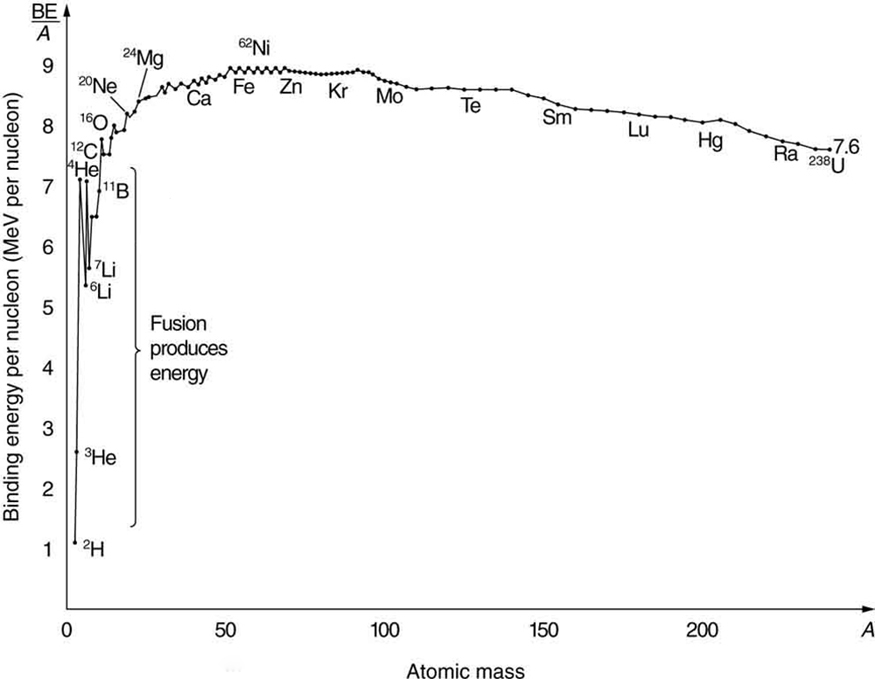
The binding energy per nucleon, written as [latex]\mathrm{BE}/A[/latex], measures how tightly nucleons are bound within a nucleus. As shown in Figure 119.2, this quantity increases rapidly for light nuclei, reaches a maximum near iron (Fe), and then slowly decreases for heavier nuclei.
This trend explains why both fusion and fission can release energy. When light nuclei fuse, the resulting nucleus has a larger binding energy per nucleon than the original nuclei. Because the product nucleus is more tightly bound, its total mass is slightly smaller than the combined masses of the reactants. The missing mass is converted into energy according to [latex]E=mc^2[/latex]. Although the exact energy released depends on the particular nuclei involved, the fusion of light elements generally produces substantial amounts of energy.
Healthcare Connection
Fusion reactions are not currently used to generate electricity for hospitals, but the physics of fusion has important medical applications. Research on fusion plasmas has contributed to technologies for producing medical isotopes, developing neutron sources for cancer treatments such as boron neutron capture therapy (BNCT), and advancing high-power laser systems used in biomedical research.
Overcoming the Coulomb Barrier
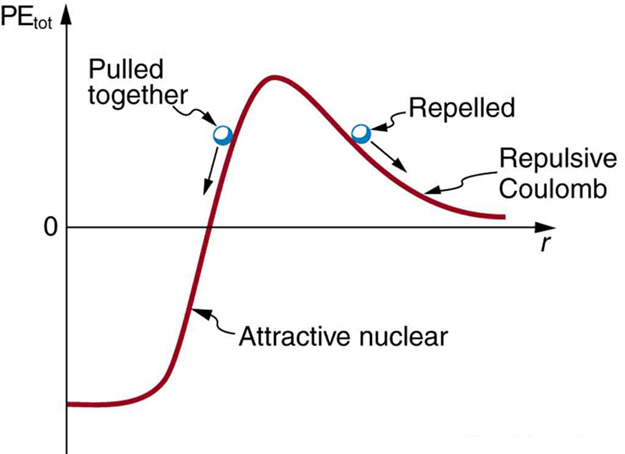
The greatest obstacle to nuclear fusion is the Coulomb repulsion between positively charged nuclei. Because like charges repel one another, two nuclei naturally push apart as they approach. In contrast, the strong nuclear force, which binds protons and neutrons together inside nuclei, acts only over extremely short distances. As a result, nuclei must come within about a femtometer ([latex]10^{-15}[/latex] m) of one another before the attractive nuclear force can overcome their electrical repulsion and allow fusion to occur.
Figure 119.3 illustrates how the potential energy between two nuclei changes as the distance between them decreases. At large separations, the Coulomb force dominates, creating a potential energy barrier that prevents the nuclei from approaching each other. Once the nuclei come close enough, however, the attractive nuclear force becomes much stronger than the electrical repulsion, causing the nuclei to bind together and release energy.
A useful analogy is a ball rolling toward a hill. The ball must first climb the hill before it can roll down into a deep valley. Likewise, two nuclei must acquire enough kinetic energy to overcome—or nearly overcome—the Coulomb barrier before they can enter the region where the strong nuclear force pulls them together. One way to increase the nuclei's kinetic energy is to heat the fusion fuel to extremely high temperatures.
Quantum Tunneling Makes Stellar Fusion Possible
At first glance, it might seem that fusion inside the Sun should be impossible. Calculations show that temperatures of approximately [latex]10^8\ \text{K}[/latex] would be needed for hydrogen nuclei to overcome the Coulomb barrier through thermal motion alone. However, the temperature at the Sun's core is only about [latex]1.5\times10^7\ \text{K}[/latex], far below this value.
The solution comes from quantum mechanical tunneling. In quantum mechanics, particles do not always behave like tiny classical objects. Instead, there is a finite probability that a particle can penetrate an energy barrier even when it does not have enough energy to pass over it. This phenomenon, known as quantum tunneling, makes fusion possible in the Sun and plays an essential role in nearly all practical fusion reactions.
The probability of tunneling depends strongly on how close the nuclei come to one another. As temperature increases, the nuclei move faster and can approach each other more closely before being repelled. Although they may still lack enough energy to overcome the Coulomb barrier completely, the remaining barrier becomes thinner, greatly increasing the probability that tunneling will occur. Consequently, even relatively small increases in temperature produce large increases in the fusion rate.
Because temperatures and pressures are highest at the centers of stars, fusion occurs primarily in their cores. Likewise, any practical fusion reactor on Earth must heat its fuel to extremely high temperatures to maximize the probability of fusion reactions.
Connection to Medical Physics
Quantum tunneling is not unique to nuclear fusion. The same quantum phenomenon is responsible for alpha decay, discussed in the previous chapter, and is fundamental to many modern technologies, including scanning tunneling microscopes and some semiconductor devices used in medical instrumentation.
The Proton–Proton Cycle
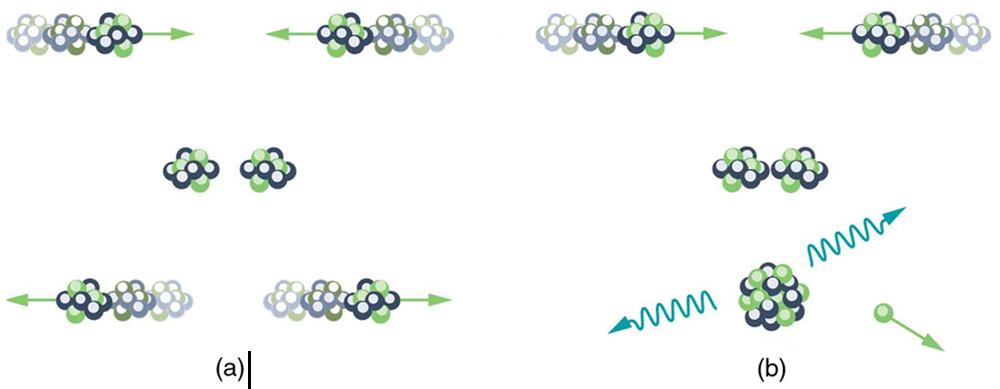
The Sun generates its energy through a series of nuclear fusion reactions that convert hydrogen into helium. Because hydrogen nuclei (protons) are by far the most abundant nuclei in the Sun, the dominant energy-producing process is known as the proton–proton (pp) cycle. In this sequence of reactions, four hydrogen nuclei are ultimately transformed into one helium nucleus, releasing energy that powers the Sun and other Sun-like stars.
The proton–proton cycle proceeds through three primary reactions:
In these equations, [latex]e^{+}[/latex] represents a positron, the antimatter counterpart of the electron, and [latex]\nu_e[/latex] represents an electron neutrino. The values shown in parentheses indicate the energy released by each reaction.
Although only three reactions are listed, the complete cycle requires the first two reactions to occur twice before the third can take place. As a result, six hydrogen nuclei are initially consumed, but two are returned in the final step. The two positrons produced during the cycle quickly encounter electrons in the solar plasma. Each positron-electron pair annihilates, producing two gamma rays. Taking these annihilation events into account, the overall proton–proton cycle can be summarized as
Thus, the net result of the proton–proton cycle is the conversion of four hydrogen nuclei into one helium nucleus while releasing approximately 26.7 MeV of energy. This energy is shared among gamma rays, neutrinos, and the kinetic energy of the reaction products.
How Energy Leaves the Sun
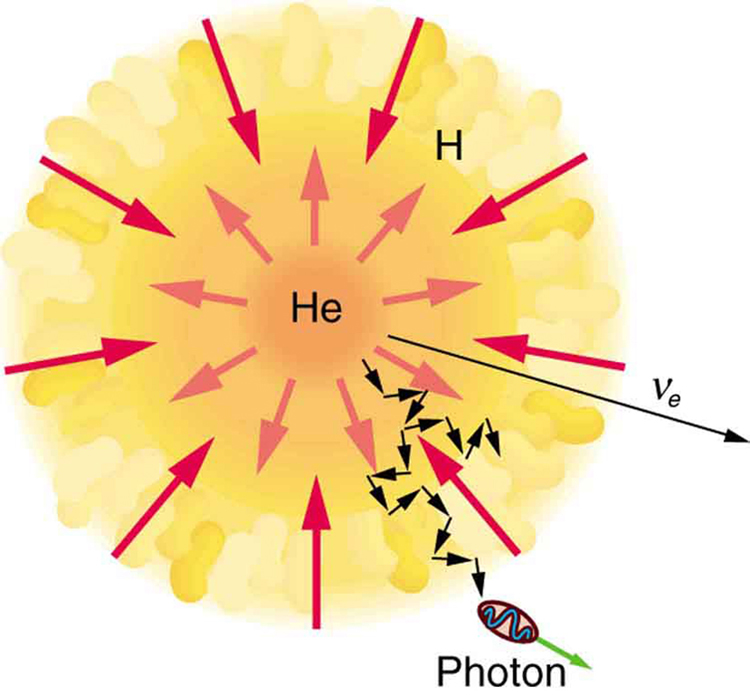
Fusion reactions occur deep within the Sun's core, where the temperature and density are highest. Once produced, most of the energy is carried outward by photons. However, photons do not travel directly to the Sun's surface. Instead, they are repeatedly absorbed and re-emitted by the dense solar material, taking on the order of tens of thousands of years to gradually diffuse outward before finally escaping into space as sunlight.
Neutrinos behave very differently. Because they interact only through the weak nuclear force and gravity, they pass through the Sun almost without interacting with matter. Most neutrinos produced in the core escape into space in less than two seconds, carrying away a small fraction of the energy generated by fusion.
Why Solar Neutrinos Are Important
Unlike light, which requires thousands of years to reach the Sun's surface, neutrinos provide scientists with an almost instantaneous view of the fusion reactions occurring in the solar core. Detecting these neutrinos allows astronomers to study the Sun's interior directly and test models of stellar energy production.
The Sun as a Natural Thermostat
The Sun maintains a remarkably stable energy output through a process of negative feedback. If the core temperature increases slightly, fusion reactions occur more rapidly, producing additional energy. This extra energy causes the Sun to expand slightly, lowering the core temperature and slowing the fusion rate.
Conversely, if the core cools slightly, gravity causes the Sun to contract. Compression increases the temperature and density of the core, accelerating fusion reactions until the energy output returns to its previous level. This self-regulating process has allowed the Sun to remain stable for billions of years while gradually converting hydrogen into helium.
Solar Neutrinos and Evidence for Fusion
Our understanding of how the Sun produces energy is based on theoretical models developed during the twentieth century. Beginning in 1938, the German-born American physicist Hans Bethe (1906–2005) developed the theory of the proton–proton cycle and other nuclear reactions that power stars. For this pioneering work, he was awarded the 1967 Nobel Prize in Physics.
One of the strongest pieces of evidence supporting these theories comes from the detection of solar neutrinos. Because neutrinos interact only very weakly with matter, they escape almost immediately from the Sun's core and travel directly to Earth. By detecting these particles, scientists can observe the nuclear reactions taking place deep inside the Sun, providing a unique window into its interior.
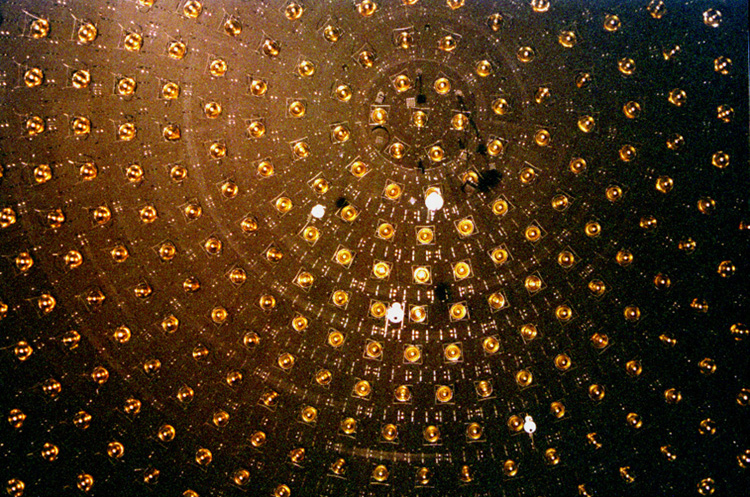
Large underground detectors have been built to measure these elusive particles (Figure 119.6). Despite the enormous number of neutrinos passing through Earth every second, only a tiny fraction interact with detector materials, making their detection extremely challenging.
The Solar Neutrino Problem
Early experiments consistently detected fewer solar neutrinos than theoretical models predicted. For many years, scientists debated whether this discrepancy indicated that models of the Sun were incomplete or whether some property of neutrinos had not yet been discovered. This discrepancy became known as the solar neutrino problem.
The puzzle was eventually resolved through a combination of theoretical and experimental advances. Physicists discovered that neutrinos have a small, nonzero mass and exist in three different types, or flavors. As neutrinos travel from the Sun to Earth, they can change from one flavor to another through a process called neutrino oscillation. Early detectors were sensitive to only one flavor of neutrino, explaining why fewer neutrinos were observed than expected. Modern detectors can account for all three flavors, confirming that the Sun's energy is indeed produced by nuclear fusion as predicted.
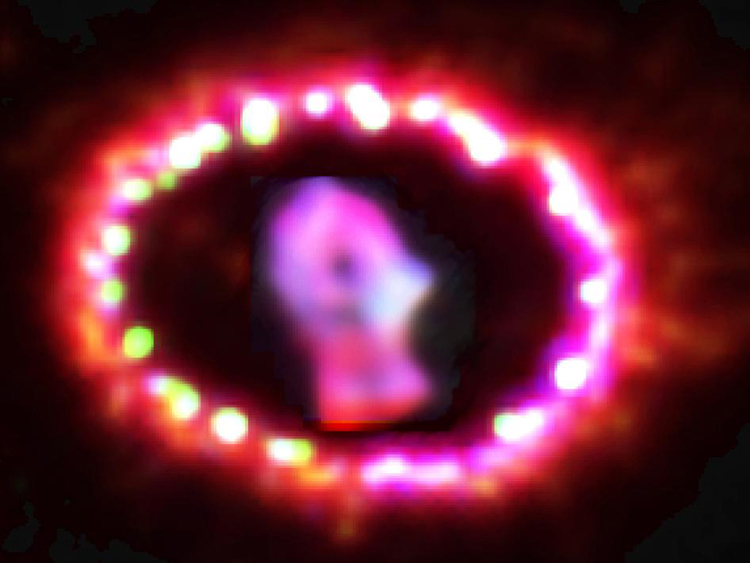
Neutrinos have also been detected from exploding stars, including Supernova 1987A. These observations provided valuable information about both stellar explosions and the properties of neutrinos.
Connection to Medical Imaging
The photomultiplier tubes used in neutrino detectors are closely related to those employed in nuclear medicine and medical imaging. Similar light-detection technologies are found in positron emission tomography (PET) scanners and gamma cameras, where they convert tiny flashes of light into electrical signals that can be used to form medical images.
Fusion Reactions for Energy Production on Earth
Although the proton–proton cycle powers the Sun, it is not a practical source of energy on Earth. The first reaction in the cycle,
has an extremely low probability of occurring. This slow reaction is actually beneficial for stars because it allows the Sun to produce energy steadily over a lifetime of about 10 billion years. For a fusion power plant, however, the reaction rate is far too low to generate useful amounts of energy.
Instead, researchers focus on fusion reactions involving the hydrogen isotopes deuterium ([latex]{}^{2}\text{H}[/latex]) and tritium ([latex]{}^{3}\text{H}[/latex]), which occur much more readily at achievable plasma temperatures. Some of the most important reactions are
Deuterium makes up approximately 0.015% of naturally occurring hydrogen, meaning that Earth's oceans contain an enormous supply of potential fusion fuel. Tritium is radioactive and occurs only in very small quantities naturally, but it can be produced in nuclear reactors or generated within future fusion reactors. Together, these fuels offer the possibility of producing large amounts of energy with much less long-lived radioactive waste than conventional nuclear fission.
The deuterium–tritium (D–T) reaction is currently the leading candidate for practical fusion power because it has the highest reaction probability at attainable temperatures. Most of the released energy appears as the kinetic energy of the helium nucleus and neutron.
Healthcare Connection
Neutrons produced in deuterium–tritium fusion are also valuable in medicine and research. Neutron beams are used in applications such as boron neutron capture therapy (BNCT), materials testing for medical devices, and the production of certain medical radioisotopes.
Some fusion reactions also produce neutrons that can participate in additional nuclear reactions, helping to generate new fuel or release additional energy. For example, neutron capture by hydrogen produces deuterium and a gamma ray:
Reactions such as this, together with reactions that emit energetic gamma rays directly, release much of their energy as high-energy electromagnetic radiation. Although gamma rays carry substantial energy, converting that energy efficiently into electricity is considerably more challenging than harnessing the kinetic energy of charged particles.
Requirements for Practical Fusion
Producing useful amounts of fusion energy requires satisfying three key conditions:
- High temperature, so that nuclei have enough kinetic energy to approach closely enough for fusion.
- High fuel density, increasing the likelihood that nuclei will collide.
- Sufficient confinement time, allowing the hot plasma to remain together long enough for a large number of fusion reactions to occur.
These three quantities—temperature, density, and confinement time—are closely related. Improving one can partially compensate for limitations in another, a relationship commonly known as the Lawson criterion.
Two important milestones are used to evaluate fusion experiments:
- Break-even occurs when a fusion plasma produces as much fusion power as the external heating power supplied to it.
- Ignition occurs when the fusion reactions generate enough energy to sustain the plasma without requiring continued external heating.
Although remarkable progress has been made, producing continuous, economically practical fusion power remains one of the major engineering challenges of modern science.
Approaches to Controlled Fusion
Two complementary approaches dominate current fusion research: magnetic confinement and inertial confinement. Both seek to keep extremely hot plasma together long enough for significant numbers of fusion reactions to occur.
Magnetic Confinement
Magnetic confinement uses strong magnetic fields to trap the electrically charged particles that make up a plasma. Because charged particles spiral around magnetic field lines, carefully designed magnetic fields can keep the plasma away from the reactor walls, preventing both excessive heat loss and damage to the containment vessel.
The most widely studied magnetic confinement device is the tokamak, shown in Figure 119.8. A tokamak uses powerful toroidal and poloidal magnetic fields to confine plasma in a doughnut-shaped chamber. Decades of research have demonstrated that this design can produce the temperatures and confinement times required for fusion research.
The largest current international fusion project is ITER, being constructed in southern France. Rather than serving as a commercial power plant, ITER is an experimental reactor designed to demonstrate that controlled fusion can produce far more energy than is required to heat the plasma. The knowledge gained from ITER is expected to guide the development of future fusion power plants.
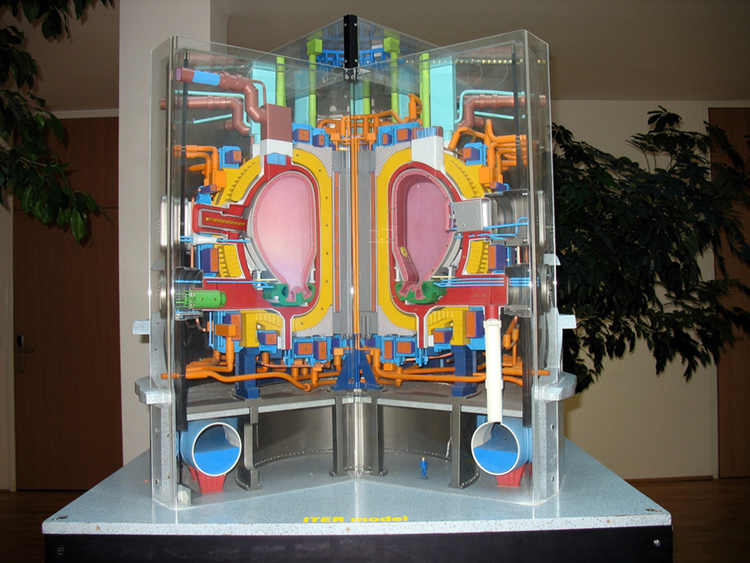 Figure 119.8: ITER is an international magnetic-confinement fusion experiment under construction in southern France. The tokamak design uses powerful magnetic fields to confine an extremely hot plasma while researchers investigate the feasibility of controlled fusion as a future energy source. (Credit: Stephan Mosel, Flickr)
Inertial Confinement
A second major approach is inertial confinement fusion. In this technique, powerful laser beams are focused simultaneously onto a tiny fuel pellet containing deuterium and tritium. The outer layer of the pellet rapidly vaporizes, and the resulting outward explosion compresses the remaining fuel inward to extremely high density and temperature.
Because the compressed fuel remains together only for a tiny fraction of a second, fusion must occur before the plasma has time to expand. The fuel's own inertia provides this brief period of confinement, giving the technique its name.
The best-known inertial confinement facility is the National Ignition Facility (NIF) at Lawrence Livermore National Laboratory in California (Figure 119.9). NIF uses 192 high-powered laser beams to compress a small fuel capsule. In recent years, NIF achieved important milestones by demonstrating fusion ignition in laboratory experiments, representing a significant scientific achievement. However, substantial engineering advances are still required before inertial confinement fusion can become a practical source of commercial electricity.
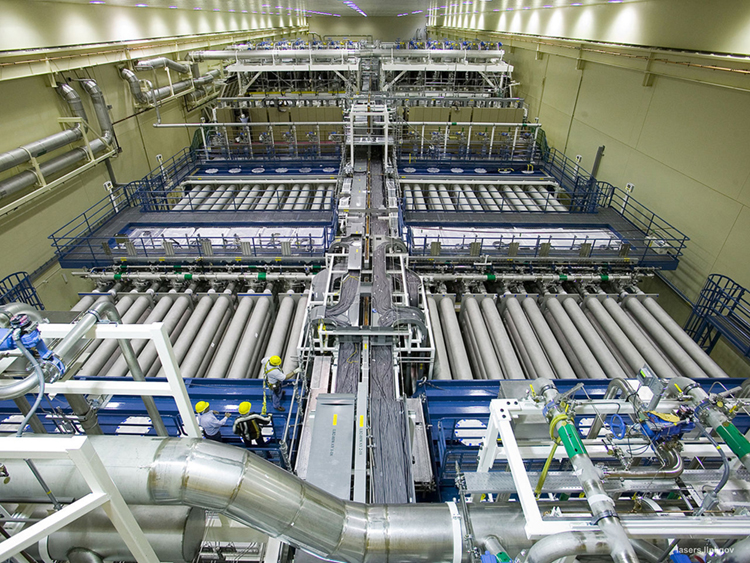 Figure 119.9: The National Ignition Facility (NIF) uses 192 synchronized high-energy laser beams to compress and heat a tiny deuterium–tritium fuel capsule. This inertial confinement approach has demonstrated fusion ignition in laboratory experiments and continues to advance fusion science. (Credit: Lawrence Livermore National Laboratory, Lawrence Livermore National Security, LLC, and the U.S. Department of Energy)
Example 119.1: Calculating Energy and Power from Fusion
-
-
- Calculate the energy released when a 1.00-kg mixture of deuterium and tritium undergoes fusion to produce helium. The mixture contains equal numbers of deuterium and tritium nuclei.
- Suppose this energy is released continuously over one year. What is the average power output?
-
Strategy
Each deuterium–tritium fusion reaction is
and releases 17.59 MeV of energy. To determine the total energy released, we must first calculate how many deuterium–tritium pairs are present in 1.00 kg of fuel. Each pair can undergo one fusion reaction.
The combined molar mass of one mole of deuterium nuclei and one mole of tritium nuclei is approximately 5.03 g. We can therefore determine the number of moles of reacting pairs and then use Avogadro’s number to find the total number of reactions.
For part (b), average power is calculated by dividing the total energy released by the elapsed time:
Solution for (a)
The atomic mass of deuterium is 2.014102 u, and the atomic mass of tritium is 3.016049 u. The combined mass associated with one reacting pair is therefore
Thus, one mole of deuterium–tritium pairs has a mass of approximately 5.03 g. The number of moles of reacting pairs in 1.00 kg is
The corresponding number of fusion reactions is
Each reaction releases 17.59 MeV. Using
the total energy released is
Therefore, the fusion of 1.00 kg of deuterium–tritium fuel releases
Solution for (b)
One year contains approximately
The average power output is therefore
Thus, the average power output is
Discussion
This example illustrates the enormous energy density of nuclear fusion. Only 1.00 kg of deuterium–tritium fuel can release approximately [latex]3.37\times10^{14}\ \text{J}[/latex] of energy. If released steadily over one year, this corresponds to a thermal power output of about 10.7 MW.
The calculated value represents the total fusion energy produced, not the electrical power delivered to users. A power plant must convert thermal energy into electrical energy, and that conversion is never 100% efficient. For example, if a plant converted one-third of the fusion energy into electricity, the average electrical output from this amount of fuel would be approximately
A commercial power plant would therefore need to fuse fuel continuously at a substantially higher rate. In addition, a complete energy analysis must include the power required to heat and confine the plasma, operate magnets or lasers, produce or breed tritium, cool the reactor, and run the plant’s supporting systems.
Section Summary
- Nuclear fusion is a process in which two light nuclei combine to form a heavier nucleus. Fusion releases energy when the products have a greater binding energy per nucleon than the reactants, causing a small amount of mass to be converted into energy according to [latex]E=mc^2[/latex].
- The largest obstacle to fusion is the Coulomb repulsion between positively charged nuclei. Extremely high temperatures increase the kinetic energy of the nuclei, while quantum tunneling allows some nuclei to penetrate the Coulomb barrier even when they do not have enough energy to overcome it classically.
- The Sun and other Sun-like stars produce energy primarily through the proton–proton cycle:
[latex]{}^{1}\text{H}+{}^{1}\text{H}\rightarrow{}^{2}\text{H}+e^{+}+\nu_e\qquad(0.42\ \text{MeV})[/latex][latex]{}^{1}\text{H}+{}^{2}\text{H}\rightarrow{}^{3}\text{He}+\gamma\qquad(5.49\ \text{MeV})[/latex][latex]{}^{3}\text{He}+{}^{3}\text{He}\rightarrow{}^{4}\text{He}+{}^{1}\text{H}+{}^{1}\text{H}\qquad(12.86\ \text{MeV})[/latex]
- The net result of the proton–proton cycle is
[latex]2e^{-}+4{}^{1}\text{H}\rightarrow{}^{4}\text{He}+2\nu_e+6\gamma\qquad(26.7\ \text{MeV}),[/latex]
where four hydrogen nuclei are converted into one helium nucleus while releasing approximately 26.7 MeV of energy.
- Solar neutrinos escape directly from the Sun's core and provide important experimental evidence that nuclear fusion powers the Sun. Measurements of solar neutrinos also led to the discovery that neutrinos have mass and can change between different flavors.
- Practical fusion power on Earth focuses on reactions involving deuterium and tritium, particularly the deuterium–tritium (D–T) reaction, because these reactions occur much more readily than proton–proton fusion.
- Successful fusion requires simultaneously achieving sufficiently high temperature, fuel density, and confinement time. These three quantities together determine whether a fusion plasma can produce useful amounts of energy.
- Break-even occurs when a fusion plasma produces as much fusion power as the external heating power supplied to it. Ignition occurs when the fusion reactions become self-sustaining without continued external heating.
- The two leading approaches to controlled fusion are:
- Magnetic confinement, which uses powerful magnetic fields to confine hot plasma in devices such as tokamaks.
- Inertial confinement, which uses intense laser pulses to rapidly compress and heat small fuel pellets until fusion occurs.
Conceptual Questions
- Why does the fusion of light nuclei into heavier nuclei release energy?
- Why does fusing medium-mass nuclei, such as iron or cobalt, into heavier nuclei require an input of energy instead of releasing energy?
- When considering fusion as a practical energy source, what advantage does the reaction
[latex]{}^{2}\text{H}+{}^{3}\text{H}\rightarrow{}^{4}\text{He}+n[/latex]
have over the reaction
[latex]{}^{2}\text{H}+{}^{2}\text{H}\rightarrow{}^{3}\text{He}+n[/latex]? - Explain why the energy released by the reaction
[latex]{}^{2}\text{H}+{}^{2}\text{H}\rightarrow{}^{4}\text{He}+\gamma[/latex]
is more difficult to capture and convert into useful electrical energy than the energy released by many other fusion reactions.
Problems & Exercises
- Verify that the total number of nucleons, total charge, and electron family number are conserved for each of the following fusion reactions in the proton–proton cycle. List the value of each conserved quantity before and after each reaction.
-
[latex]{}^{1}\text{H}+{}^{1}\text{H}\rightarrow{}^{2}\text{H}+e^{+}+\nu_e[/latex]
-
[latex]{}^{1}\text{H}+{}^{2}\text{H}\rightarrow{}^{3}\text{He}+\gamma[/latex]
-
[latex]{}^{3}\text{He}+{}^{3}\text{He}\rightarrow{}^{4}\text{He}+{}^{1}\text{H}+{}^{1}\text{H}[/latex]
-
- Calculate the energy output in each of the fusion reactions in the proton–proton cycle, and verify the values given in the Section Summary.
- Show that the total energy released in the proton–proton cycle is 26.7 MeV. Consider the overall effect of the following reactions, and be certain to include the electron–positron annihilation energy:
[latex]{}^{1}\text{H}+{}^{1}\text{H}\rightarrow{}^{2}\text{H}+e^{+}+\nu_e[/latex][latex]{}^{1}\text{H}+{}^{2}\text{H}\rightarrow{}^{3}\text{He}+\gamma[/latex][latex]{}^{3}\text{He}+{}^{3}\text{He}\rightarrow{}^{4}\text{He}+{}^{1}\text{H}+{}^{1}\text{H}[/latex]
- Verify that the total number of nucleons, total charge, and electron family number are conserved in the overall proton–proton cycle. List each quantity before and after the reaction.
[latex]2e^{-}+4{}^{1}\text{H}\rightarrow{}^{4}\text{He}+2\nu_e+6\gamma[/latex]
- The energy produced by the fusion of a 1.00-kg mixture of deuterium and tritium was calculated in Example 119.1. Approximately how many kilograms of this fuel would be required to supply the annual energy use of the United States?
- Tritium is naturally rare but can be produced by the reaction
[latex]n+{}^{2}\text{H}\rightarrow{}^{3}\text{H}+\gamma.[/latex]
How much energy, in MeV, is released in this neutron-capture reaction?
- Two fusion reactions are
[latex]n+{}^{3}\text{He}\rightarrow{}^{4}\text{He}+\gamma[/latex]
and
[latex]n+{}^{1}\text{H}\rightarrow{}^{2}\text{H}+\gamma.[/latex]Both reactions release energy, but the second reaction also creates more fusion fuel. Confirm that the energies released are 20.58 MeV and 2.22 MeV, respectively. Comment on which product nucleus is more tightly bound: [latex]{}^{4}\text{He}[/latex] or [latex]{}^{2}\text{H}[/latex].
-
- Calculate the number of grams of deuterium in an 80,000-L swimming pool, given that deuterium accounts for 0.0150% of natural hydrogen.
- Find the energy released in joules if this deuterium undergoes fusion through the reaction
[latex]{}^{2}\text{H}+{}^{2}\text{H}\rightarrow{}^{3}\text{He}+n.[/latex]
- Could the neutrons produced in this reaction be used to generate additional energy?
- Compare the amount of fusion energy available from the deuterium in the swimming pool with the energy available from a gallon of gasoline. Also consider that water is much more abundant than gasoline.
- How many kilograms of water are needed to obtain 198.8 mol of deuterium, assuming that deuterium accounts for 0.01500% by number of natural hydrogen?
- The power output of the Sun is
[latex]4\times10^{26}\ \text{W}.[/latex]
- If 90% of this power is supplied by the proton–proton cycle, how many protons are consumed per second?
- How many neutrinos from this process should pass through each square meter at Earth every second? This enormous number illustrates how rarely neutrinos interact with matter, because even large detectors observe very few each day.
- Another sequence of reactions that fuses hydrogen into helium in the Sun, and especially in hotter stars, is called the carbon cycle:
[latex]\begin{aligned} {}^{12}\text{C}+{}^{1}\text{H}&\rightarrow{}^{13}\text{N}+\gamma,\\ {}^{13}\text{N}&\rightarrow{}^{13}\text{C}+e^{+}+\nu_e,\\ {}^{13}\text{C}+{}^{1}\text{H}&\rightarrow{}^{14}\text{N}+\gamma,\\ {}^{14}\text{N}+{}^{1}\text{H}&\rightarrow{}^{15}\text{O}+\gamma,\\ {}^{15}\text{O}&\rightarrow{}^{15}\text{N}+e^{+}+\nu_e,\\ {}^{15}\text{N}+{}^{1}\text{H}&\rightarrow{}^{12}\text{C}+{}^{4}\text{He}. \end{aligned}[/latex]
Write the overall effect of the carbon cycle, as was done for the proton–proton cycle:
[latex]2e^{-}+4{}^{1}\text{H}\rightarrow{}^{4}\text{He}+2\nu_e+6\gamma.[/latex]Note the number of protons required, and assume that the positrons annihilate with electrons to form additional gamma rays.
-
- Find the total energy released, in MeV, during each carbon cycle described in the previous problem. Include the electron–positron annihilation energy.
- How does this energy compare with the energy released by the proton–proton cycle?
- Verify that the total number of nucleons, total charge, and electron family number are conserved for each reaction in the carbon cycle given in the preceding problems. List the value of each conserved quantity before and after each reaction.
- Integrated Concepts. A laser system used for inertial confinement can produce a 100-kJ pulse with a duration of only 1.00 ns.
- What is the power output of the laser system during the pulse?
- How many photons are contained in the pulse if their wavelength is [latex]1.06\ \mu\text{m}[/latex]?
- What is the total momentum of all the photons?
- How does the total photon momentum compare with the momentum of a single 1.00-MeV deuterium nucleus?
- Integrated Concepts. Find the amount of energy given to the [latex]{}^{4}\text{He}[/latex] nucleus and to the gamma ray in the reaction
[latex]n+{}^{3}\text{He}\rightarrow{}^{4}\text{He}+\gamma.[/latex]
Use conservation of momentum and assume that the reactants are initially at rest. Your result should confirm that most of the released energy is carried by the gamma ray.
- Integrated Concepts.
- What gas temperature would be required for atoms to move fast enough to bring two [latex]{}^{3}\text{He}[/latex] nuclei into contact? Because both nuclei are moving, assume that the average kinetic energy of each nucleus needs to equal only one-half of the electric potential energy of the two doubly charged nuclei when they are just in contact.
- Does this extremely high temperature present practical difficulties for controlled fusion? Explain.
- Integrated Concepts.
- Estimate how many years the deuterium in Earth's oceans could supply the world's energy needs. Assume that:
- World energy consumption is ten times the annual energy consumption of the United States.
- The annual energy consumption of the United States is [latex]8\times10^{19}\ \text{J/y}[/latex].
- The deuterium in the oceans can be converted to useful energy with an efficiency of 32%.
- Deuterium accounts for 0.015% of natural hydrogen.
- The approximate fusion energy yield is [latex]3.37\times10^{14}\ \text{J/kg}[/latex] of deuterium fuel.
You must estimate or look up the total amount of water in Earth's oceans and use the deuterium concentration to determine the available mass of deuterium.
- Comment on the magnitude of this time compared with human history or civilization. The result is not unreasonable, only impressive.
- Estimate how many years the deuterium in Earth's oceans could supply the world's energy needs. Assume that:
Glossary
- break-even
- The condition in which a fusion plasma produces as much fusion power as the external heating power supplied to it.
- ignition
- The condition in which a fusion reaction produces enough energy to sustain itself without continued external heating.
- inertial confinement
- A fusion approach that uses powerful laser or particle beams to rapidly compress and heat a tiny fuel pellet to the temperatures and densities required for nuclear fusion.
- magnetic confinement
- A fusion approach that uses strong magnetic fields to confine hot, electrically charged plasma and keep it away from the walls of the reactor.
- nuclear fusion
- A nuclear reaction in which two light atomic nuclei combine to form a heavier nucleus, releasing energy when the products have a greater binding energy per nucleon than the reactants.
- proton–proton cycle
- The sequence of fusion reactions that powers the Sun and other Sun-like stars by converting hydrogen into helium while releasing energy, gamma rays, and neutrinos.
- quantum tunneling
- A quantum mechanical phenomenon that allows particles to pass through an energy barrier even when they do not have enough energy to overcome it classically. Tunneling enables nuclear fusion to occur in the Sun at temperatures lower than would otherwise be required.
The condition in which a fusion plasma produces as much fusion power as the external heating power supplied to it.
The condition in which a fusion reaction produces enough energy to sustain itself without continued external heating.
A fusion approach that uses powerful laser or particle beams to rapidly compress and heat a tiny fuel pellet to the temperatures and densities required for nuclear fusion.
A fusion approach that uses strong magnetic fields to confine hot, electrically charged plasma and keep it away from the walls of the reactor.
A nuclear reaction in which two light atomic nuclei combine to form a heavier nucleus, releasing energy when the products have a greater binding energy per nucleon than the reactants.
The sequence of fusion reactions that powers the Sun and other Sun-like stars by converting hydrogen into helium while releasing energy, gamma rays, and neutrinos.
A quantum mechanical phenomenon that allows particles to pass through an energy barrier even when they do not have enough energy to overcome it classically. Tunneling enables nuclear fusion to occur in the Sun at temperatures lower than would otherwise be required.
