
Magnetism
38 Force on a Moving Charge in a Magnetic Field: Examples and Applications
Learning Objectives
- Describe how a magnetic field affects the motion of a moving charged particle.
- Explain why magnetic forces can produce circular or helical motion without changing a particle's speed.
- Calculate the radius of curvature of a charged particle moving in a uniform magnetic field.
In the previous section, you learned that a magnetic field exerts a force on a moving electric charge. Because this force is always perpendicular to the particle's velocity, it changes the direction of motion without changing the particle's speed. This property allows magnetic fields to guide charged particles along curved paths.
Charged particles moving through magnetic fields are found throughout nature and modern technology. High-energy particles from space often follow spiral paths as they interact with Earth's magnetic field. In research laboratories, powerful electromagnets keep beams of protons and other particles traveling along curved paths inside particle accelerators. Similar principles are used in medical technology, including proton therapy systems and mass spectrometers that identify biological molecules by measuring the paths of charged ions.
Circular Motion in a Magnetic Field
Why does a magnetic field produce circular motion? Recall that the magnetic force on a moving charge is always perpendicular to the particle's velocity. Since work is done only by the component of force parallel to displacement, the magnetic force does no work on the particle. The particle's kinetic energy and speed therefore remain constant, while the direction of its velocity changes continuously.
This is the same behavior observed in uniform circular motion, where speed remains constant but velocity changes direction. If a charged particle moves perpendicular to a uniform magnetic field, as shown in Figure 38.2, the magnetic force continuously points toward the center of the circular path. The magnetic force therefore acts as the centripetal force.
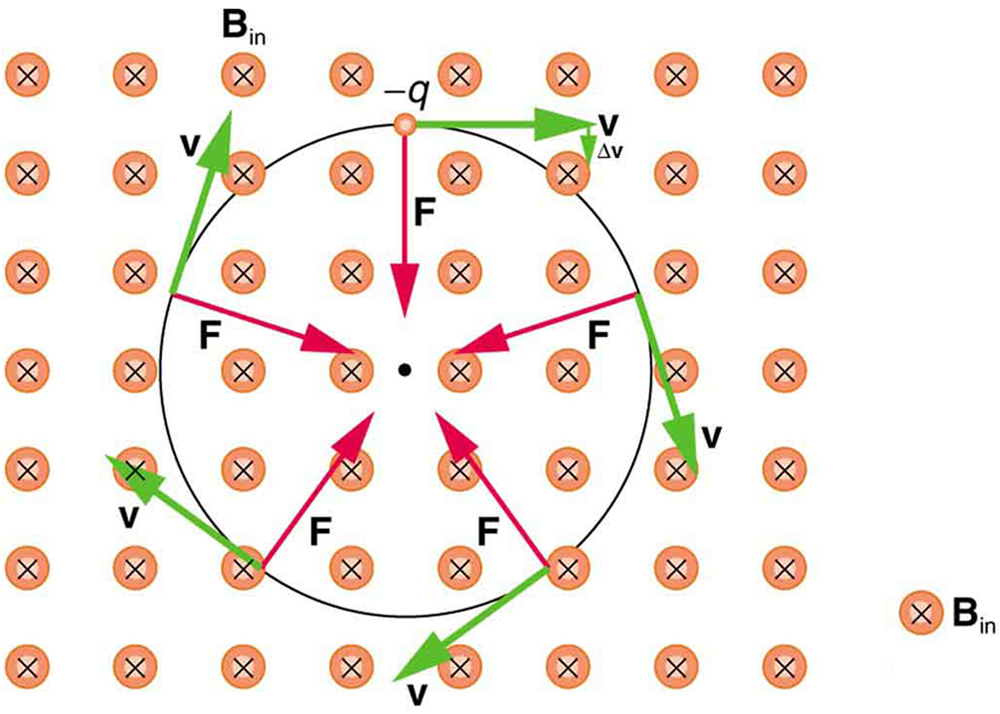
For motion perpendicular to the magnetic field, the angle between the velocity and magnetic field is [latex]90^\circ[/latex], so [latex]\sin\theta=1[/latex]. The magnetic force therefore has its maximum magnitude:
Equating the magnetic force to the centripetal force gives
Solving for the radius of the circular path yields
The magnitude of the charge, [latex]|q|[/latex], is used because the sign of the charge determines the direction of curvature, not the radius.
The radius of curvature depends on four quantities:
- Mass ([latex]m[/latex]): More massive particles are harder to bend and therefore follow paths with larger radii.
- Speed ([latex]v[/latex]): Faster particles also follow paths with larger radii.
- Charge magnitude ([latex]|q|[/latex]): Particles with larger charge magnitudes experience stronger magnetic forces and follow tighter curves.
- Magnetic field strength ([latex]B[/latex]): Stronger magnetic fields bend particle trajectories more sharply, producing smaller radii.
Example 38.1: Calculating the Radius of an Electron's Circular Path
One early application of magnetic deflection was in cathode-ray tube (CRT) televisions and computer monitors. These devices produced images by directing a beam of electrons onto a phosphorescent screen. A nearby magnet could bend the electron beam and distort the image. Modern LCD and OLED displays do not use electron beams and are not affected in this way.
An electron travels at [latex]6.00\times10^7\ \text{m/s}[/latex] and enters a uniform magnetic field of strength [latex]0.500\ \text{T}[/latex] perpendicular to its direction of motion. What is the radius of its circular path?
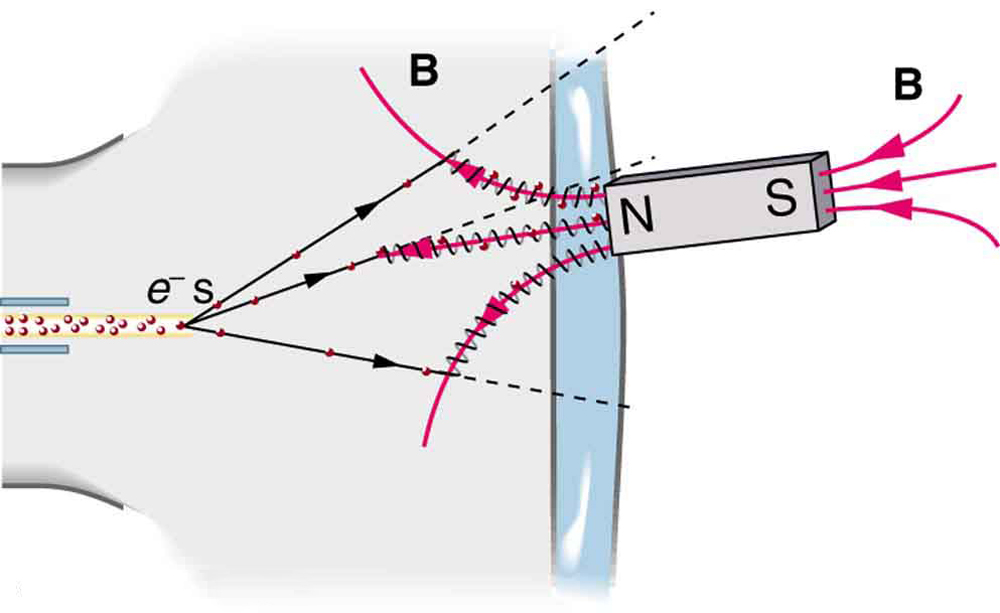
Strategy
Because the electron moves perpendicular to the magnetic field, the magnetic force provides the centripetal force. Use
The electron's mass and charge magnitude are known constants, and its speed and the magnetic field strength are given.
Solution
Substitute the known values:
Therefore,
Discussion
The calculated radius is less than one millimeter, showing that even a moderately strong magnetic field can dramatically change the path of an electron.
The same principle is used to steer charged particles in particle accelerators, separate ions in mass spectrometers, and guide proton beams in some forms of cancer therapy. In each case, the radius depends on the particle's mass, charge, speed, and the magnetic field strength.
Helical Motion and Magnetic Mirrors
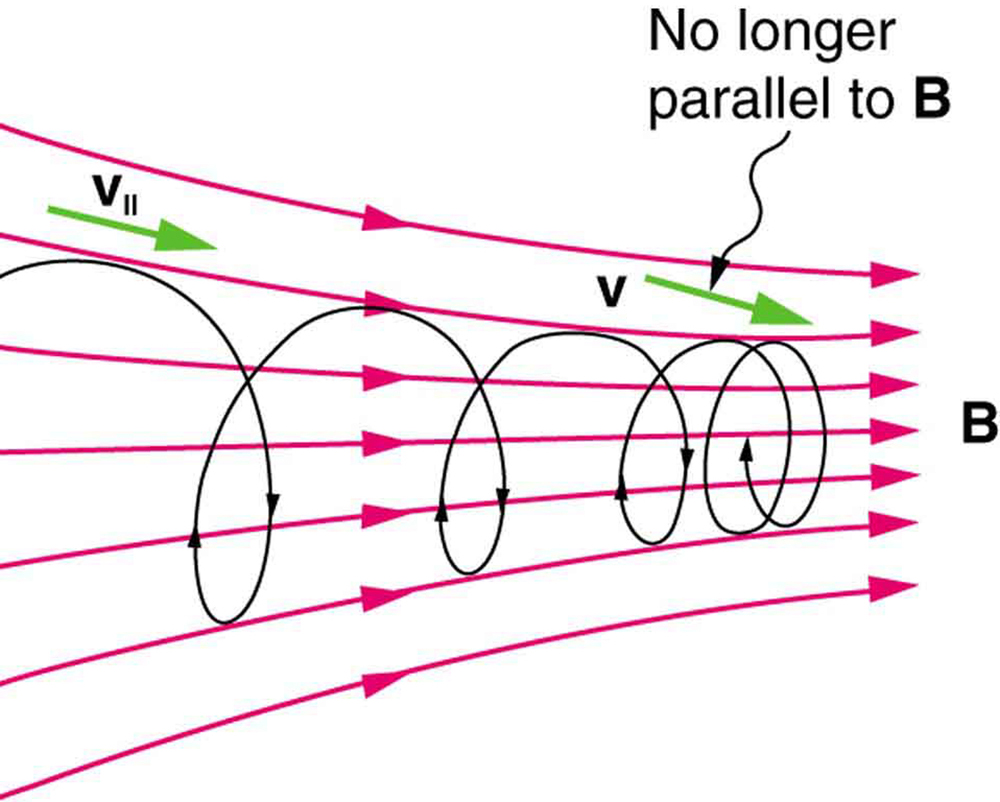
The circular-path equation applies when a particle's velocity is perpendicular to the magnetic field. If the velocity also has a component parallel to the field, that component experiences no magnetic force and remains unchanged. The perpendicular component produces circular motion, while the parallel component carries the particle forward along the magnetic field. The combined motion is a helical path.
The radius of the helical path depends on the perpendicular component of velocity:
If the particle enters a region where the magnetic field becomes stronger, the spiral becomes tighter. Under appropriate conditions, the particle's motion parallel to the field can reverse, causing the particle to travel back along the field line. This phenomenon is called a magnetic mirror and is important in space physics and fusion research.
Charged Particles in Earth's Magnetic Field
The motion of charged particles in magnetic fields explains many natural phenomena. Energetic charged particles emitted by the Sun and arriving from deep space interact continuously with Earth's magnetic field. Rather than traveling directly through the atmosphere, many spiral along magnetic field lines toward the polar regions.
When these particles collide with atoms and molecules in the upper atmosphere, they transfer energy that is later emitted as visible light. This produces the aurora borealis in the Northern Hemisphere and the aurora australis in the Southern Hemisphere.
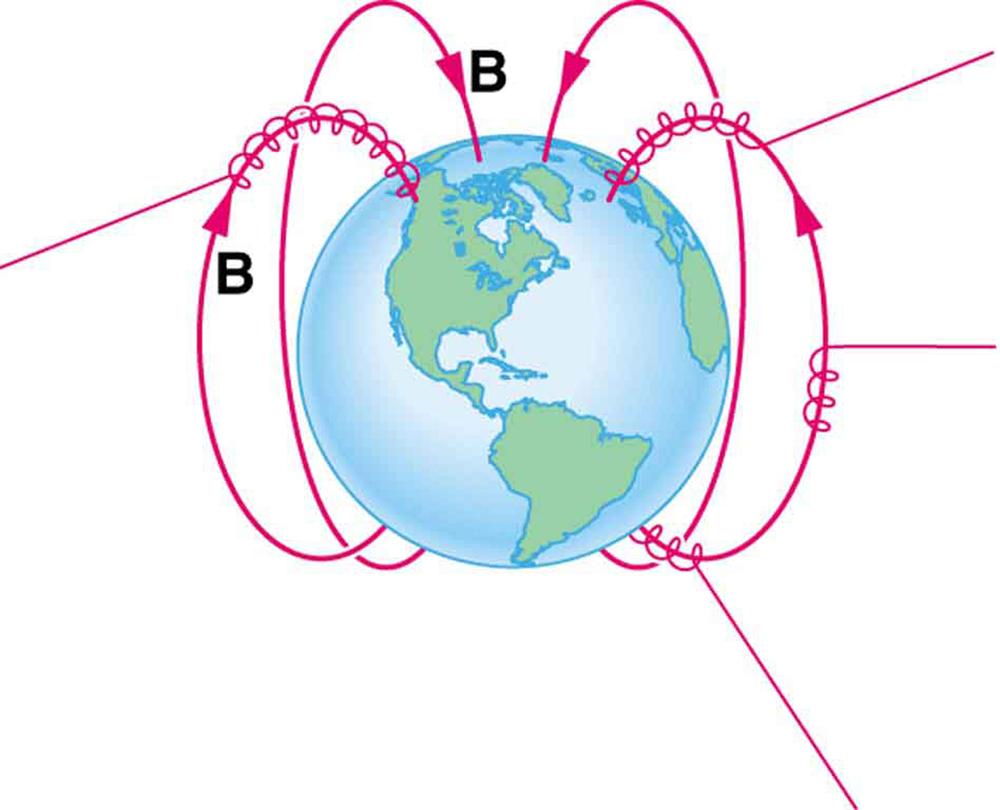
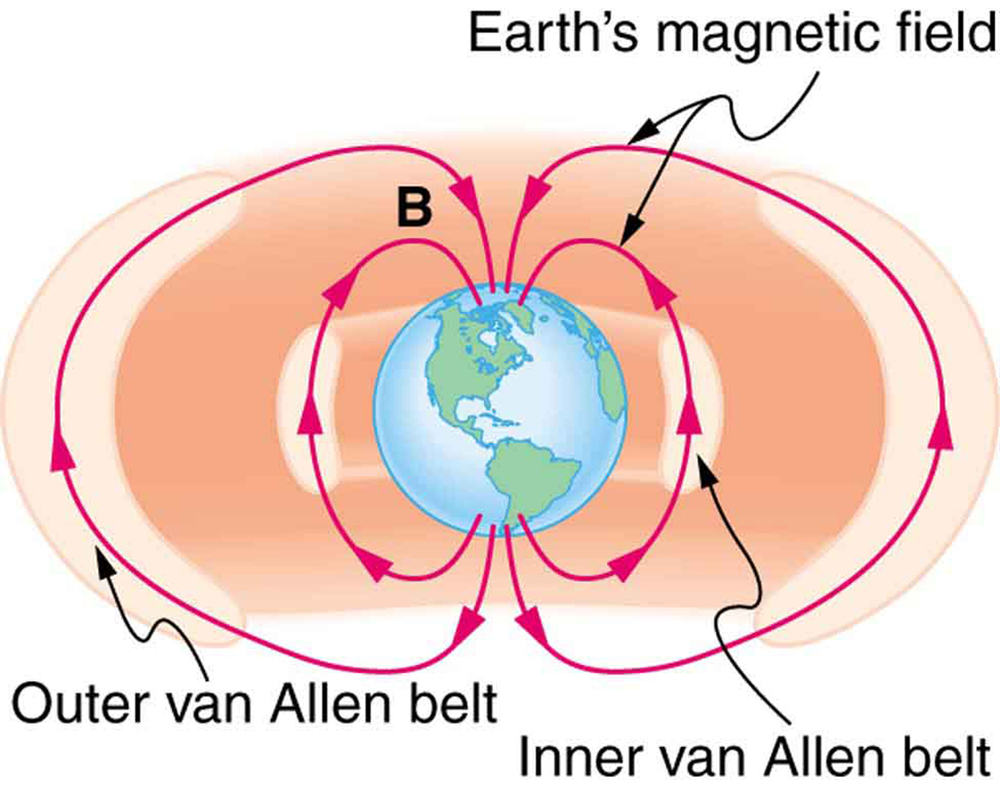
Some incoming particles become trapped for long periods within two toroidal regions surrounding Earth called the Van Allen radiation belts. Within these regions, charged particles spiral along field lines while repeatedly reflecting between the Northern and Southern Hemispheres because of the magnetic mirror effect.
The Van Allen belts contain radiation levels high enough to pose hazards to astronauts and spacecraft electronics. Satellites are therefore designed to withstand radiation exposure or placed in orbits that reduce the time spent inside the belts.
Controlling Charged Particles
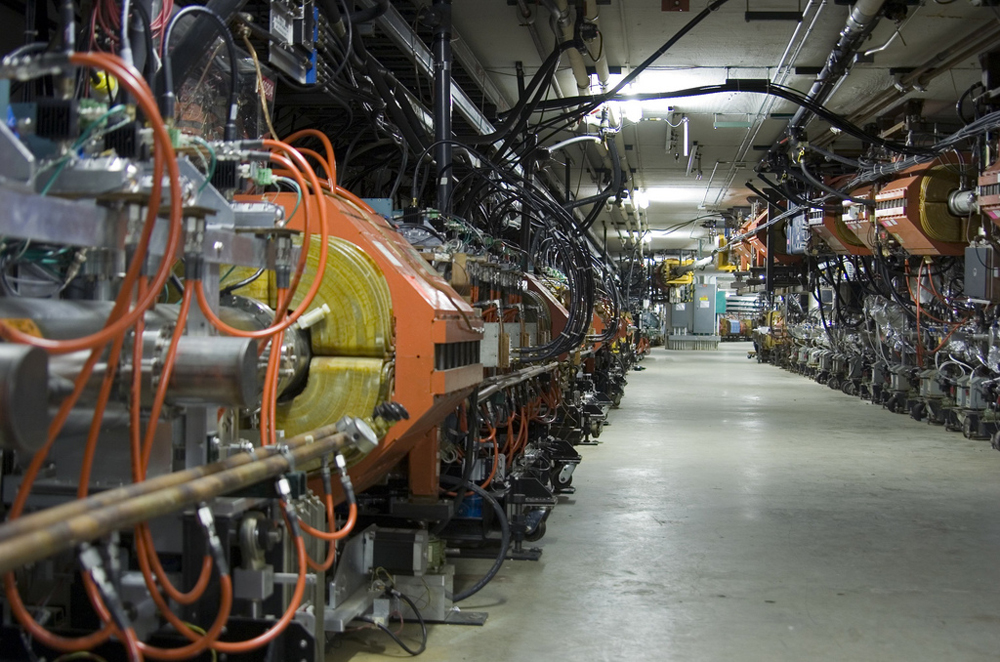
Scientists use magnetic fields to control charged particles in the laboratory. Particle accelerators employ carefully designed electromagnets to bend, focus, and steer beams of charged particles moving at high speeds. These machines have played a central role in discoveries about the particles and forces that make up matter.
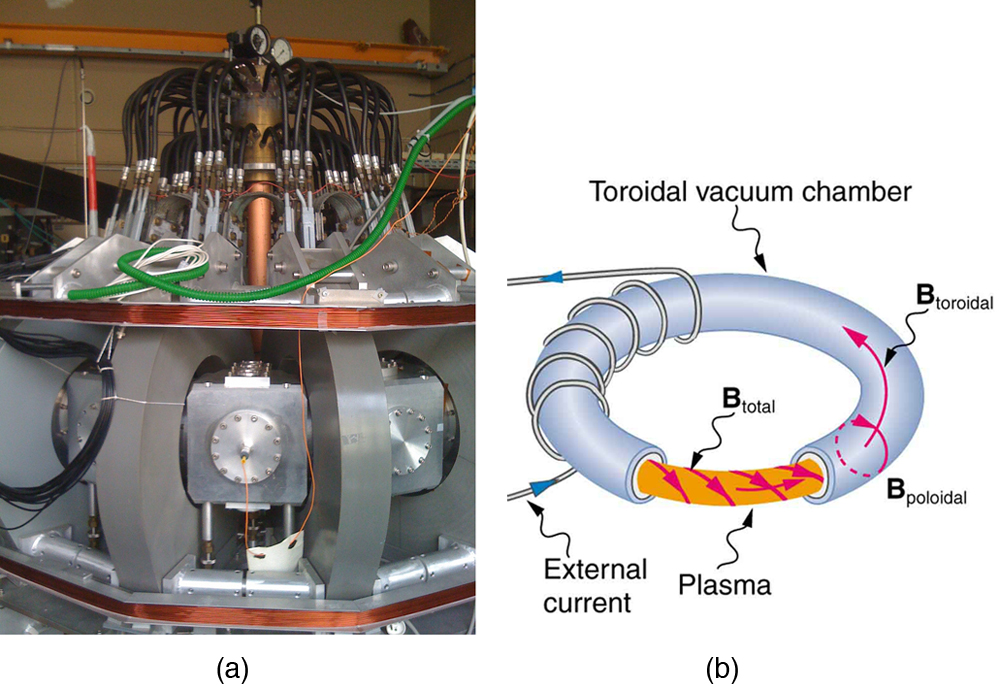
Magnetic confinement is also one approach to controlled nuclear fusion, the process that powers the Sun. In a device called a tokamak, an extremely hot electrically charged gas—or plasma—is confined by strong magnetic fields so that it does not touch the walls of the reactor.
Mass spectrometry, one of the most important practical applications of this principle, is discussed in detail in a following section: More Applications of Magnetism.
Section Summary
- A magnetic force is always perpendicular to the velocity of a moving charged particle, so it changes the direction of motion without changing the particle's speed or kinetic energy.
- For a charged particle moving perpendicular to a uniform magnetic field, the magnetic force provides the centripetal force:
[latex]|q|vB=\frac{mv^2}{r}[/latex]
- The radius of the circular path is
[latex]r=\frac{mv}{|q|B}[/latex]
where
- [latex]m[/latex] is the particle's mass,
- [latex]v[/latex] is its speed perpendicular to the magnetic field,
- [latex]|q|[/latex] is the magnitude of its charge, and
- [latex]B[/latex] is the magnetic field strength.
- The radius increases with mass and speed and decreases with charge magnitude and magnetic field strength.
- If a particle has both perpendicular and parallel velocity components, it follows a helical path along the magnetic field lines.
- Increasing magnetic field strength can cause a spiraling particle to reverse direction through the magnetic mirror effect.
- These principles are used in particle accelerators, mass spectrometers, magnetic-confinement fusion devices, and charged-particle cancer therapy.
Conceptual Questions
- How can the motion of a charged particle be used to distinguish between a magnetic field and an electric field?
- High-speed charged particles can damage biological cells and contribute to radiation exposure in research laboratories and outer space. How could a magnetic field help protect against these particles?
- A cosmic-ray proton approaches Earth along a path directed toward Earth's center in the plane of the equator.
- In what direction will Earth's magnetic field deflect the proton?
- How would the deflection differ for an electron moving along the same path?
- What would happen to a neutron?
- Determine the sign of the charge on each particle shown in Figure 38.9.
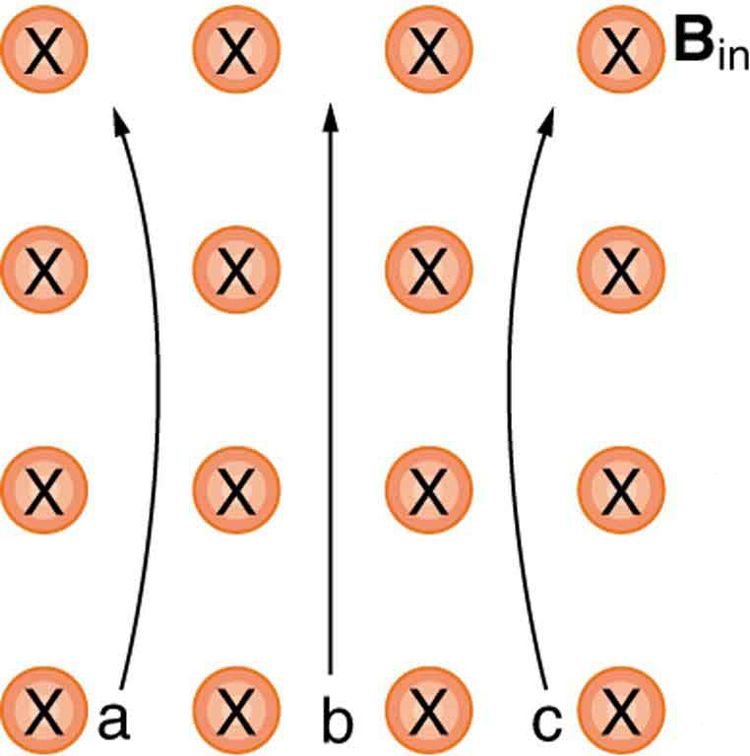
Figure 38.9: Trajectories of three particles moving through a uniform magnetic field directed into the page. - Assuming that the particles shown in Figure 38.10 have identical masses and charges, which particle has the greater speed? Explain.
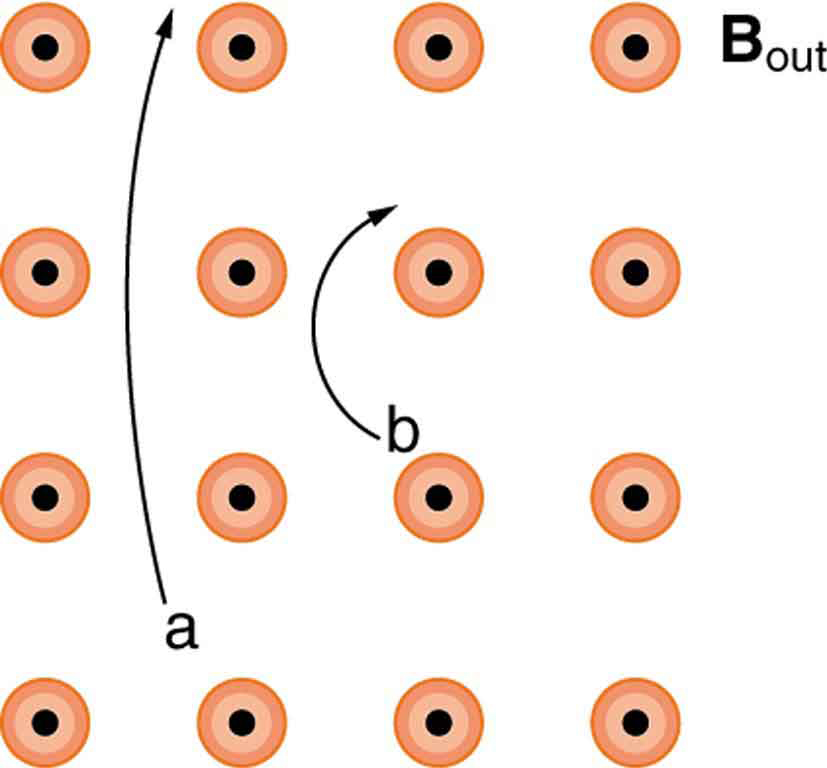
Figure 38.10: Two charged particles moving through the same magnetic field with different radii of curvature. - Assuming that the particles shown in Figure 38.10 have identical charges and speeds, which particle has the greater mass? Explain.
- During maintenance, a cathode-ray tube monitor is placed on its side while operating. The image becomes distorted and its colors shift slightly. Explain how Earth's magnetic field could produce these effects.
Problems & Exercises
If you need additional support, see the chapter More Applications of Magnetism.
- A cosmic-ray electron moves at [latex]7.50\times10^6\ \text{m/s}[/latex] perpendicular to Earth's magnetic field at an altitude where the field strength is [latex]1.00\times10^{-5}\ \text{T}[/latex]. What is the radius of the electron's circular path?
- A proton moves at [latex]7.50\times10^7\ \text{m/s}[/latex] perpendicular to a magnetic field. The field causes the proton to travel in a circular path of radius 0.800 m. What is the magnetic field strength?
- The Star Trek television series popularized the idea of antimatter propulsion.
- Suppose antiprotons moving at [latex]5.00\times10^7\ \text{m/s}[/latex] are stored in a vacuum chamber by forcing them to travel in a circular path of radius 2.00 m. What magnetic field strength is required? Antiprotons have the same mass as protons but the opposite charge.
- Is this magnetic field strength achievable with current technology, or would it require future advances?
- An oxygen-16 ion with a mass of [latex]2.66\times10^{-26}\ \text{kg}[/latex] travels at [latex]5.00\times10^6\ \text{m/s}[/latex] perpendicular to a 1.20-T magnetic field and follows a circular path with a radius of 0.231 m.
- What positive charge does the ion carry?
- What is the ratio of this charge to the magnitude of the electron's charge?
- Explain why the ratio found in part (b) should be an integer.
- What radius of circular path would an electron follow if it moved at the same speed and in the same magnetic field as the proton in Problem 13?
- A velocity selector in a mass spectrometer uses a magnetic field of 0.100 T.
- What electric field strength is needed to select particles moving at [latex]4.00\times10^6\ \text{m/s}[/latex]?
- If the plates are separated by 1.00 cm, what potential difference must be applied between them?
- An electron in a cathode-ray tube television moves at [latex]6.00\times10^7\ \text{m/s}[/latex] perpendicular to Earth's magnetic field, which has a strength of [latex]5.00\times10^{-5}\ \text{T}[/latex].
- What electric field strength must be applied perpendicular to Earth's magnetic field so that the electron travels in a straight line?
- If this field is produced between two plates separated by 1.00 cm, what potential difference must be applied?
Note: CRT televisions and monitors were commonly surrounded by ferromagnetic shielding to reduce distortion caused by external magnetic fields.
- Compare the motion of a proton with that of the electron in Problem 12.
- At what speed would the proton travel in a circular path with the same radius as the electron?
- What would the radius of the proton's path be if it had the same speed as the electron?
- What would the radius be if the proton had the same kinetic energy as the electron?
- What would the radius be if the proton had the same momentum as the electron?
- A mass spectrometer is used to separate oxygen-16 from the less abundant oxygen-18 in samples of ancient glacial ice. The relative abundance of these isotopes provides information about Earth's past climate. The mass ratio of oxygen-16 to oxygen-18 is 16:18. Oxygen-16 has a mass of [latex]2.66\times10^{-26}\ \text{kg}[/latex]. Both ions are singly charged and move at [latex]5.00\times10^6\ \text{m/s}[/latex] through a magnetic field of 1.20 T. What is the separation between the two ion paths after each ion travels through a semicircle before striking the detector?
- Triply ionized uranium-235 and uranium-238 are separated in a mass spectrometer. Uranium-235 is an isotope used as fuel in some nuclear reactors. The ion masses are [latex]3.90\times10^{-25}\ \text{kg}[/latex] and [latex]3.95\times10^{-25}\ \text{kg}[/latex], respectively. Both ions travel at [latex]3.00\times10^5\ \text{m/s}[/latex] through a magnetic field of 0.250 T.
- What is the separation between the paths of the ions after each travels through a semicircle before reaching the detector?
- Based on your result, discuss whether this separation appears large enough to make isotope separation practical.
Glossary
- right-hand rule 1 (RHR-1)
- a rule used to determine the direction of the magnetic force on a positive moving charge; point the fingers of the right hand in the direction of the particle's velocity and curl them toward the magnetic field, and the thumb indicates the force direction; for a negative charge, the force is in the opposite direction
- Lorentz force
- the combined electric and magnetic force experienced by a charged particle; when only a magnetic field is present, the force has magnitude [latex]F=|q|vB\sin\theta[/latex]
- tesla (T)
- the SI unit of magnetic field strength, defined by
[latex]1\ \text{T}=\frac{1\ \text{N}}{1\ \text{A}\cdot\text{m}}[/latex]
- magnetic force
- the force exerted on a moving electric charge by a magnetic field; it is perpendicular to both the particle's velocity and the magnetic field
- gauss (G)
- a non-SI unit of magnetic field strength, where
[latex]1\ \text{G}=10^{-4}\ \text{T}[/latex]
- radius of curvature
- the radius of the circular path followed by a charged particle moving perpendicular to a uniform magnetic field:
[latex]r=\frac{mv}{|q|B}[/latex]
- centripetal force
- the inward net force required to keep an object moving in a circular path; for a charged particle moving perpendicular to a magnetic field, the magnetic force provides the centripetal force
- magnetic mirror
- a magnetic-field configuration in which a charged particle moving into a region of stronger magnetic field reverses its motion along the field line
- Van Allen radiation belts
- regions surrounding Earth in which energetic charged particles are trapped by Earth's magnetic field
- mass spectrometer
- an instrument that measures the mass-to-charge ratios of ions by analyzing their motion in electric and magnetic fields
The force exerted on a moving electric charge by a magnetic field. The force is always perpendicular to both the particle's velocity and the magnetic field.
The radius of the circular path followed by a charged particle moving perpendicular to a uniform magnetic field, given by [latex]r=\frac{mv}{qB}[/latex].
A rule used to determine the direction of the magnetic force on a positive moving charge. Point your right thumb in the direction of the particle's velocity and your fingers in the direction of the magnetic field; your palm points in the direction of the magnetic force. For a negative charge, the force is in the opposite direction.
The magnetic force experienced by a charged particle moving through a magnetic field.
The SI unit of magnetic field strength, defined as [latex]1\,\text{T}=\frac{1\,\text{N}}{1\,\text{A}\cdot\text{m}}[/latex].
A non-SI unit of magnetic field strength commonly used in some scientific fields. One gauss is equal to [latex]10^{-4}\,\text{T}[/latex].
The inward force required to keep an object moving in a circular path. For a charged particle in a magnetic field, the magnetic force provides the centripetal force.
A region where an increasing magnetic field causes charged particles spiraling along field lines to slow, reverse direction, and become trapped.
Two regions surrounding the Earth where energetic charged particles are trapped by the Earth's magnetic field.
An instrument that measures the mass-to-charge ratio of ions by analyzing the curvature of their paths in electric and magnetic fields.
