
Radioactivity, Nuclear Physics and its Medical Applications
129 Food Irradiation
Learning Objectives
By the end of this section, you will be able to:
- Explain how ionizing radiation is used to improve food safety, delay spoilage, and control insects.
- Describe why irradiated food does not become radioactive.
- Compare gamma rays, x-rays, and electron beams used in food irradiation.
- Explain how radiation damages microorganisms through direct ionization and the production of free radicals.
- Distinguish among low-, medium-, and high-dose food irradiation applications.
- Evaluate the benefits and limitations of food irradiation in relation to foodborne illness, food quality, and food waste.
- Recognize the Radura symbol and explain how irradiated foods are labeled.
What Is Food Irradiation?
Food irradiation is the controlled exposure of food to ionizing radiation. The process can reduce harmful microorganisms, control insects, delay ripening or sprouting, and extend shelf life. It is used for products such as spices, fruits, vegetables, grains, meat, poultry, and seafood.
The process is sometimes compared with pasteurization because both treatments reduce microorganisms that can cause foodborne illness or spoilage. However, food irradiation does not rely primarily on heat. For this reason, it is sometimes described as cold pasteurization, although the food may warm slightly during processing.
Food irradiation is not intended to replace proper sanitation, refrigeration, cooking, or safe food handling. Instead, it provides an additional layer of protection. For example, irradiation may reduce disease-causing bacteria in meat or poultry, but the food must still be stored and prepared correctly.
Does Irradiation Make Food Radioactive?
No. The gamma rays, x-rays, and electrons used in food processing transfer energy to atoms and molecules in the food, but they do not remain inside the food. Their energies and operating conditions are selected so that they do not produce significant nuclear reactions in the food.
This is similar to a medical x-ray: the patient is exposed to radiation during the examination but does not become radioactive afterward. Irradiated food therefore contains no continuing source of radiation merely because it has undergone treatment.
How Ionizing Radiation Preserves Food
Ionizing radiation carries enough energy to remove electrons from atoms and molecules. When food is irradiated, this ionization damages cells within insects, parasites, bacteria, molds, and other organisms.
Radiation can affect microorganisms in two principal ways:
- Direct action: Radiation deposits energy directly in important biological molecules, including DNA. Damage to DNA can prevent a microorganism from reproducing.
- Indirect action: Radiation ionizes water and other molecules within a cell, producing chemically reactive fragments known as free radicals. These reactive species can damage DNA, proteins, and cell membranes.
Because most foods contain water, indirect effects are especially important. A simplified representation of the ionization of water is:
The resulting ions and electrons participate in additional reactions that can produce reactive species such as the hydroxyl radical, [latex]\mathrm{OH\boldsymbol{\cdot}}[/latex]. These species exist for only a very short time but can cause significant molecular damage before they react or disappear.
Healthcare Connection: Preventing Foodborne Illness
Foodborne illnesses can be especially serious for infants, older adults, pregnant patients, and people with weakened immune systems. By reducing pathogens such as Salmonella, Escherichia coli, and Listeria, irradiation can lower the risk that contaminated food will cause disease.
Irradiation does not make contaminated or spoiled food appear fresh, and it cannot reverse toxins that may already have been produced. It is therefore most effective when combined with hygienic processing, refrigeration, appropriate packaging, and safe preparation.
Radiation Sources and Processing Facilities
Commercial food irradiation uses three types of ionizing radiation:
- Gamma rays emitted by radioactive isotopes such as cobalt-60.
- X-rays generated electrically by directing high-energy electrons onto a metal target.
- Electron beams (e-beams) produced by particle accelerators.
Each radiation source has advantages depending on the type, size, and packaging of the food being treated. Gamma rays are highly penetrating and can treat large pallets of packaged food. X-rays also penetrate deeply but are generated electrically, eliminating the need for a radioactive source. Electron beams deliver high doses quickly but penetrate only a few centimeters, making them most suitable for relatively thin products.
Regardless of the radiation source, the goal is the same: to deliver a carefully controlled radiation dose that destroys microorganisms or insects while preserving the quality of the food.
Example: Choosing a Radiation Source
Suppose a food processing facility needs to sterilize sealed boxes of medical spices packaged on large pallets. Which radiation source would be most appropriate?
Because the radiation must penetrate the entire pallet, gamma rays from cobalt-60 or high-energy x-rays are generally preferred. Electron beams would not penetrate deeply enough to treat the entire package uniformly.
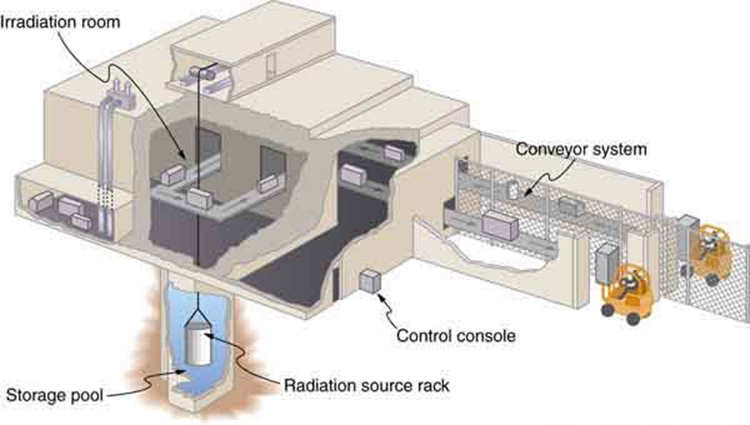
Commercial irradiation facilities are designed with multiple layers of safety. The radioactive source remains inside thick concrete shielding during operation, and workers are never present in the irradiation room while the source is exposed. When the facility is not operating, the cobalt-60 source is automatically lowered into a deep pool of water, where the water absorbs the gamma radiation and provides effective shielding.
Facilities that use x-rays or electron beams operate differently because they do not contain radioactive materials. Instead, radiation is produced only when the accelerator is switched on, much like a medical x-ray machine.
Dose Levels and Applications
The radiation dose used for food irradiation depends on the desired outcome. A relatively small dose may be sufficient to delay fruit ripening or eliminate insects, whereas much larger doses are required to destroy disease-causing bacteria or sterilize food intended for patients with severely weakened immune systems.

In general, simpler organisms are more resistant to radiation than complex organisms. Bacteria, fungi, and insect eggs often require much larger doses than would be harmful to human cells. The goal is to deliver enough radiation to damage microorganisms without significantly affecting the appearance, texture, flavor, or nutritional value of the food.
| Absorbed Dose | Typical Applications |
|---|---|
| Less than 1 kGy | Delay ripening, inhibit sprouting in potatoes and onions, and control insects in grains and fruits. |
| 1–10 kGy | Reduce harmful bacteria, parasites, and spoilage microorganisms in meat, poultry, seafood, fruits, vegetables, and spices. |
| Greater than 10 kGy | Sterilize foods for specialized medical diets, astronauts, and certain immunocompromised patients. |
Spices are among the foods most commonly treated with irradiation because they often contain microorganisms that survive conventional drying. Irradiation can greatly reduce bacterial contamination while preserving the flavor and aroma of the spices.
Example: Why Are Such Large Doses Used?
A dose of only a few grays delivered to the entire human body can cause severe radiation sickness, yet foods are routinely irradiated with doses of several thousand grays. Why is there such a large difference?
The radiation is intended to kill microorganisms rather than the food itself. Foods are composed primarily of stable molecules that can tolerate relatively large amounts of ionization before noticeable changes occur. Bacteria, molds, parasites, and insects are living organisms whose cells are much more easily damaged by radiation. Consequently, much higher doses are required to ensure food safety than would be acceptable for human exposure.
Healthcare Connection
Patients receiving chemotherapy, organ transplants, or treatments that suppress the immune system are especially vulnerable to foodborne infections. In some hospitals, sterilized foods produced using high-dose irradiation are provided as part of specialized diets to reduce the risk of infection.
Effects on Food Quality and Nutrition
Because ionizing radiation breaks chemical bonds, food irradiation causes small chemical changes within the treated food. Most of these changes result from the production of short-lived free radicals, which react rapidly with nearby molecules. Similar chemical changes also occur during cooking, freezing, drying, and other common methods of food preservation.
The extent of these changes depends on the radiation dose and the type of food. Foods with high water content produce more free radicals than dry foods, while high doses generally produce larger chemical changes than low doses.
At the low and medium doses commonly used for food preservation, changes in taste, texture, and appearance are usually small. Many fruits, vegetables, spices, meats, and seafood retain their nutritional quality while benefiting from reduced spoilage and lower levels of harmful microorganisms.
Some foods are less suitable for irradiation. For example, leafy vegetables and certain soft fruits may develop undesirable changes in texture after treatment. Food processors therefore select irradiation only when its benefits outweigh any effects on product quality.
Nutritional Effects
Like all food preservation methods, irradiation can reduce the concentration of certain nutrients. Vitamins that are particularly sensitive to oxidation, such as vitamins A, C, E, and some B vitamins, may decrease slightly depending on the food and the radiation dose.
For most foods, however, these nutritional losses are comparable to—or smaller than—those produced by other preservation methods such as cooking, canning, or dehydration. Proteins, carbohydrates, fats, and minerals are largely unaffected by the doses used for commercial food irradiation.
Healthcare Connection
Preserving food quality is especially important in healthcare settings. Hospitals, long-term care facilities, and emergency food programs must provide foods that are both microbiologically safe and nutritionally adequate. Food irradiation can reduce the risk of foodborne illness while maintaining much of the food's original nutritional value.
Safety, Regulation, and Labeling
Extensive scientific research has shown that food irradiated under approved conditions is safe to eat. Ionizing radiation destroys microorganisms and insects by damaging their DNA, but it does not make the food itself radioactive. The radiation passes through the food during processing and does not remain behind, just as a patient does not become radioactive after receiving a diagnostic x-ray.
Although irradiation produces small quantities of chemical compounds known as radiolytic products, these compounds are also formed during other food-processing methods such as cooking, roasting, and pasteurization. Their concentrations depend on the type of food and the radiation dose, and extensive studies have found no evidence that the approved levels used for food irradiation pose a health risk.
In the United States, food irradiation is regulated by the Food and Drug Administration (FDA), which evaluates the safety and effectiveness of approved irradiation processes. The U.S. Department of Agriculture (USDA) also oversees the irradiation of meat and poultry products. International organizations, including the World Health Organization (WHO) and the Food and Agriculture Organization (FAO), support the use of food irradiation when it is performed according to established safety standards.
Food Labeling
In many countries, irradiated foods sold to consumers must be identified with labeling that indicates the product has been treated with ionizing radiation. In the United States, qualifying packaged foods must display the Radura symbol (Figure 129.3) together with wording such as "Treated with radiation" or "Treated by irradiation."

Common Misconception
Myth: Irradiated food is radioactive.
Fact: Food irradiation uses gamma rays, x-rays, or electron beams to transfer energy into the food, damaging microorganisms and pests. The food does not become radioactive because the energies used in commercial food irradiation are not sufficient to induce significant nuclear reactions in the food itself.
Physics in Everyday Life
Most people encounter ionizing radiation through medical imaging or naturally occurring background radiation. Food irradiation is another practical application of the same physical principles. By carefully controlling the radiation dose, scientists can improve food safety, reduce waste, and help preserve food quality without leaving the food radioactive.
Section Summary
- Food irradiation is the controlled use of ionizing radiation to improve food safety, reduce spoilage, control insects, and extend shelf life.
- Commercial food irradiation uses gamma rays, x-rays, or electron beams. None of these methods make food radioactive because they do not produce significant nuclear reactions in the food.
- Ionizing radiation damages microorganisms through direct ionization of biological molecules and indirectly through the production of highly reactive free radicals.
- The radiation dose depends on the intended application. Low doses delay ripening and control insects, medium doses reduce harmful microorganisms, and high doses are used for specialized sterilization applications.
- At approved dose levels, food irradiation causes only small changes in taste, texture, and nutritional value. These changes are generally comparable to those produced by other food preservation methods such as cooking, freezing, or pasteurization.
- Food irradiation is regulated by national and international agencies to ensure that irradiated foods are safe for consumers and properly labeled when required.
- Food irradiation is one example of how the principles of nuclear physics are applied to improve public health by reducing foodborne illness and increasing food preservation.
Glossary
- Electron Beam (E-beam)
- A stream of high-energy electrons produced by a particle accelerator and used for food irradiation and sterilization.
- Food Irradiation
- The controlled exposure of food to ionizing radiation to reduce microorganisms, control insects, delay spoilage, or sterilize food products.
- Free Radical
- A highly reactive atom or molecule containing one or more unpaired electrons that can damage DNA, proteins, and cell membranes.
- Gamma Rays
- High-energy electromagnetic radiation emitted by radioactive isotopes such as cobalt-60 that is commonly used in commercial food irradiation.
- Low-Dose Irradiation
- Food irradiation using doses generally below 1 kGy to delay ripening, inhibit sprouting, and control insects.
- Medium-Dose Irradiation
- Food irradiation using doses of approximately 1–10 kGy to reduce harmful microorganisms and extend shelf life.
- High-Dose Irradiation
- Food irradiation using doses greater than 10 kGy for sterilization and specialized medical or commercial applications.
- Radiolytic Products
- Chemical compounds formed when ionizing radiation interacts with molecules in food. Similar compounds are also produced during other food processing methods such as cooking and pasteurization.
- Radura Symbol
- An internationally recognized symbol used on qualifying irradiated foods to indicate that the product has been treated with ionizing radiation.
- X-rays
- High-energy electromagnetic radiation generated electrically and used as an alternative to gamma rays for commercial food irradiation.
A stream of high-energy electrons produced by a particle accelerator and used for food irradiation and sterilization.
The controlled exposure of food to ionizing radiation to reduce microorganisms, control insects, delay spoilage, or sterilize food products.
A highly reactive atom or molecule produced by ionizing radiation that can damage cellular structures, including DNA.
High-energy electromagnetic radiation emitted from an excited atomic nucleus during radioactive decay.
Food irradiation using doses generally below 1 kGy to delay ripening, inhibit sprouting, and control insects.
Food irradiation using doses of approximately 1–10 kGy to reduce harmful microorganisms and extend shelf life.
Food irradiation using doses greater than 10 kGy for sterilization and specialized medical or commercial applications.
Chemical compounds formed when ionizing radiation interacts with molecules in food. Similar compounds are also produced during other food processing methods such as cooking and pasteurization.
An internationally recognized symbol used on qualifying irradiated foods to indicate that the product has been treated with ionizing radiation.
High-energy electromagnetic radiation generated electrically and used as an alternative to gamma rays for commercial food irradiation.
