
Magnetism
35 Ferromagnets and Electromagnets
Learning Objectives
- Define a ferromagnetic material.
- Explain how magnetic domains produce magnetization.
- Describe the significance of the Curie temperature.
- Explain the relationship between electricity and magnetism.
Ferromagnets
Most materials respond only weakly to magnetic fields. However, a small group of materials—including iron, cobalt, nickel, gadolinium, and several rare-earth alloys—can become strongly magnetized. These materials are called ferromagnetic materials, from the Latin word ferrum, meaning iron. Modern permanent magnets are often made from rare-earth alloys such as neodymium, which produce extremely strong magnetic fields despite their small size.
Ferromagnetic materials are essential in many modern technologies, including electric motors, generators, loudspeakers, magnetic sensors, computer storage devices, and medical equipment such as magnetic resonance imaging (MRI) scanners.
Unlike most materials, ferromagnets not only respond strongly to an external magnetic field, but they can also become magnetized. In other words, they can be converted into permanent magnets that continue producing a magnetic field even after the external magnet is removed.
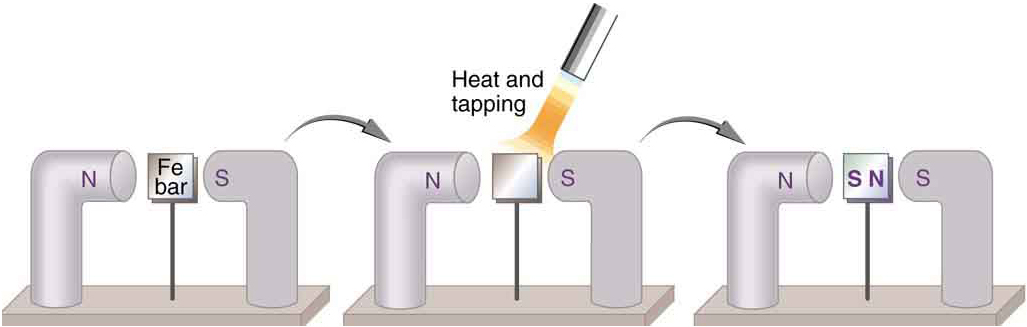
When a magnet is brought near an unmagnetized ferromagnetic material, it temporarily rearranges the material’s internal magnetic structure, producing opposite poles closest to the external magnet. This induced magnetization causes the object to be attracted toward the magnet.
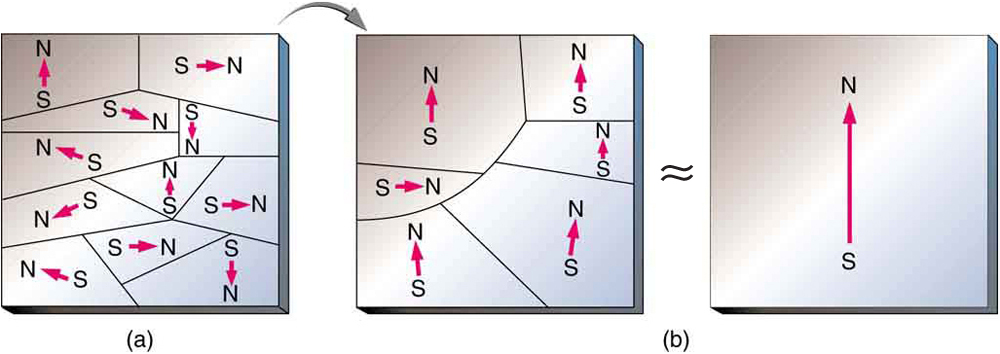
The microscopic origin of this process is illustrated in Figure 35.2. Ferromagnetic materials are divided into tiny regions called magnetic domains. Within each domain, the magnetic moments of enormous numbers of atoms point in nearly the same direction because of interactions between neighboring electrons. You can think of each domain as behaving like a tiny bar magnet.
In an unmagnetized material, these domains point in many different directions, so their magnetic effects largely cancel one another. When an external magnetic field is applied, domains already pointing in approximately the correct direction grow larger while others shrink. As more domains align, the material develops a stronger overall magnetic field.
If the material is heated and cooled or mechanically tapped while inside the external magnetic field, many of the aligned domains remain in place even after the external field is removed, producing a permanent magnet.
A permanent magnet can also lose its magnetization. Strong mechanical shocks or high temperatures disturb the alignment of the magnetic domains, reducing the material’s overall magnetic field.
Every ferromagnetic material has a characteristic Curie temperature, above which thermal motion becomes large enough to destroy the alignment of its magnetic domains. Above this temperature, the material no longer behaves as a ferromagnet, although it may still respond weakly to magnetic fields. For iron, the Curie temperature is approximately 1043 K (770° C), well above room temperature. Some specialized magnetic materials have much lower Curie temperatures and lose their ferromagnetic properties at relatively low temperatures.
Electromagnets
Until the early nineteenth century, electricity and magnetism were thought to be completely unrelated phenomena. That changed in 1820 when the Danish physicist Hans Christian Ørsted discovered that an electric current flowing through a wire deflected a nearby compass needle. This simple experiment provided the first clear evidence that moving electric charges produce magnetic fields, establishing the connection between electricity and magnetism.
An electromagnet is a magnet whose magnetic field is produced by an electric current. Unlike a permanent magnet, an electromagnet can be switched on and off simply by controlling the current, and its magnetic strength can be adjusted by changing the amount of current flowing through the wire. This controllability makes electromagnets indispensable in modern technology.
Electromagnets are used in countless applications, including electric motors, generators, relays, loudspeakers, magnetic locks, particle accelerators, and medical devices. One of the most familiar biomedical applications is magnetic resonance imaging (MRI), where extremely strong superconducting electromagnets produce the magnetic fields needed to generate detailed images of soft tissues without using ionizing radiation.

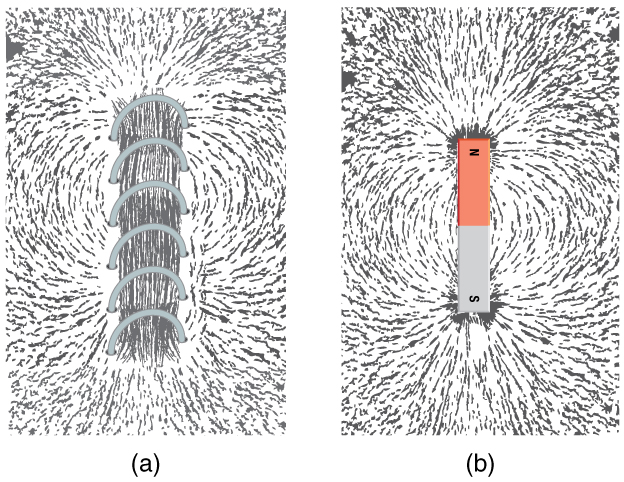
One of the first clues that electromagnets and permanent magnets produce the same type of magnetic field comes from the behavior of iron filings. As shown in Figure 35.4, the pattern formed around a current-carrying coil closely resembles that around a permanent bar magnet. In both cases, the filings align with the magnetic field, revealing its shape.
This similarity shows that electromagnets and permanent magnets share the same basic properties: both have north and south poles, like poles repel, unlike poles attract, and magnetic poles always occur in pairs.
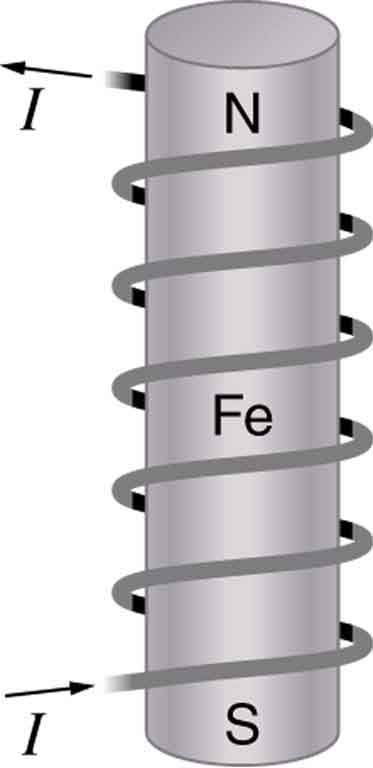
Electromagnets become much stronger when a ferromagnetic core, such as iron, is placed inside the coil. The magnetic field generated by the current aligns many of the magnetic domains within the core, greatly increasing the overall magnetic field. This combination of an electric current and a ferromagnetic material produces magnets that are far stronger than either component alone.
Large electromagnets with iron cores are used in scrapyard cranes, industrial machinery, research laboratories, and particle accelerators. When extremely strong magnetic fields are required, superconducting electromagnets are often used. Because superconductors have essentially zero electrical resistance, they can carry enormous currents without overheating, enabling magnetic fields far stronger than those produced by ordinary electromagnets.
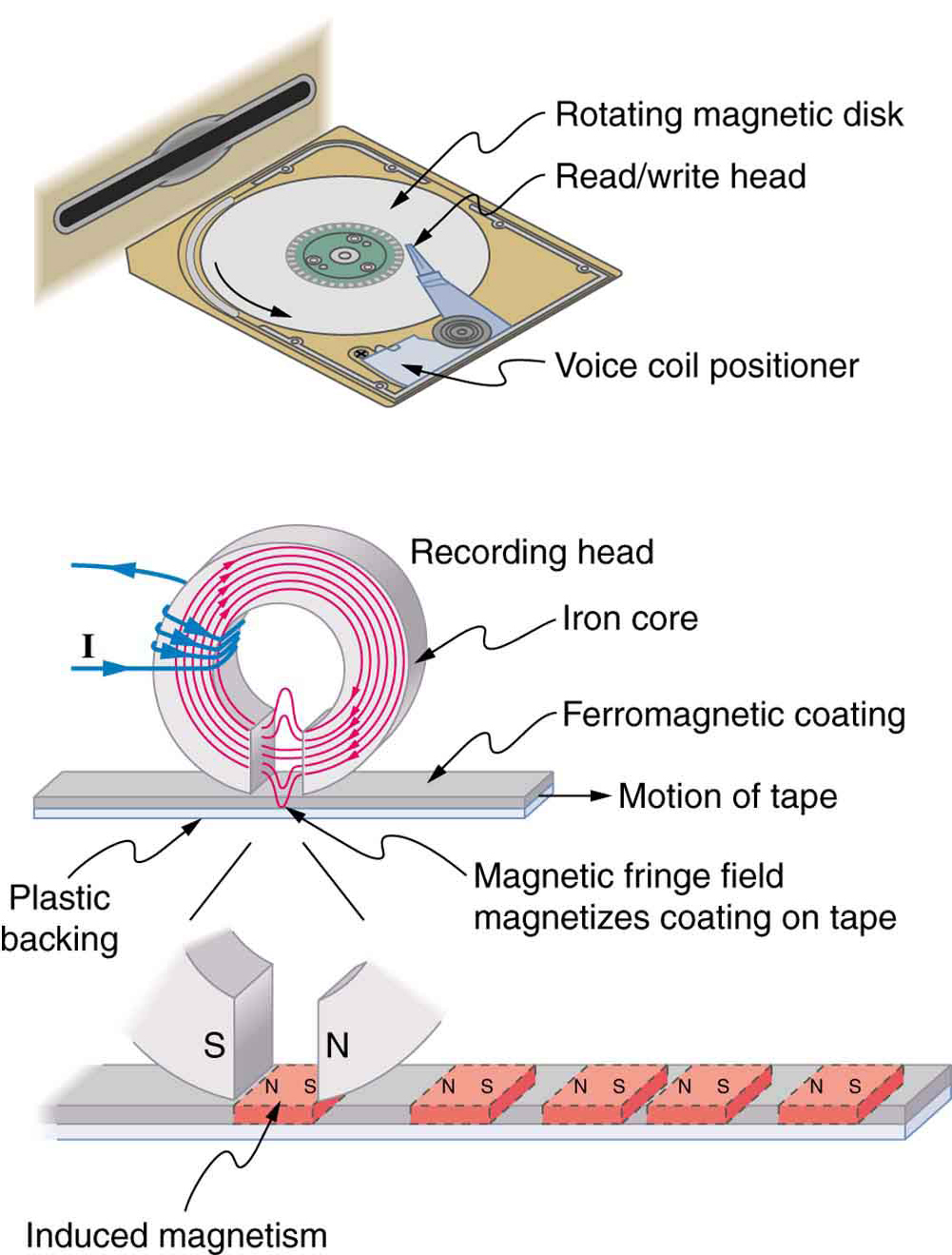
The combination of electromagnets and ferromagnetic materials is also essential for storing digital information. Tiny magnetic regions within specially designed materials can be magnetized in different directions to represent binary data (0s and 1s). Although modern solid-state drives are increasingly common, magnetic hard disk drives remain widely used because they provide inexpensive, high-capacity data storage.
Current: The Source of All Magnetism
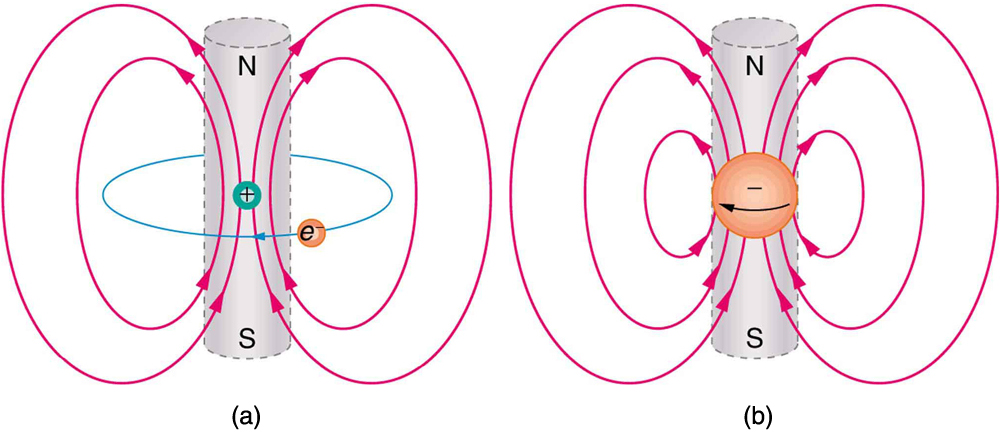
In the previous section, we learned that an electromagnet produces a magnetic field whenever an electric current flows through a wire. This naturally raises an important question: if permanent magnets produce magnetic fields without an obvious electric current, where does their magnetism come from?
The answer is that magnetism ultimately originates from the motion and intrinsic properties of electric charges. Inside every atom, electrons possess magnetic properties because they move around the nucleus and because they have an intrinsic property called spin. Each electron therefore behaves like a tiny magnetic dipole. In most materials, these tiny magnetic dipoles point in random directions, so their magnetic effects cancel. In ferromagnetic materials, however, many electron magnetic moments align within magnetic domains, producing a strong overall magnetic field.
Although the complete explanation requires quantum mechanics, the important idea for this course is simple: all magnetic fields ultimately arise from electric charges and their motion. This unifies electricity and magnetism into a single branch of physics known as electromagnetism.
One striking difference between electricity and magnetism is that electric charges can exist individually as positive or negative charges, whereas isolated north or south magnetic poles have never been observed. Every magnet that has ever been studied has both a north pole and a south pole. Even if a magnet is cut into smaller pieces, each piece becomes a new magnet with its own pair of poles.
Scientists have long searched for hypothetical particles called magnetic monopoles, which would behave as isolated north or south magnetic poles. Their discovery would profoundly change our understanding of electromagnetism. Although some modern theories predict that magnetic monopoles could exist, no experimental evidence for them has yet been found.
Key Concept
Magnetic fields are produced by moving electric charges and by the intrinsic magnetic properties of particles such as electrons. Permanent magnets owe their magnetism to the collective alignment of many electron magnetic moments within the material.
Interactive Exploration: Magnets and Electromagnets
Magnetic fields can be produced either by permanent magnets or by moving electric charges. In this simulation, you will explore both types of magnetism by observing how a compass responds to a bar magnet and by building an electromagnet using a battery and a coil of wire.
As you investigate, notice how the direction of the magnetic field changes around a magnet and how the strength of an electromagnet depends on the electric current flowing through the coil. These observations will help you understand the close relationship between electricity and magnetism introduced in this chapter.
Guided Exploration
As you interact with the simulation, investigate the following questions:
- Place a compass near the bar magnet. How does the compass needle indicate the direction of the magnetic field at different locations around the magnet?
- Move the compass farther away from the magnet. How does the magnetic field strength appear to change with distance?
- Build an electromagnet using the battery and the coil of wire. Before turning on the current, predict what will happen to the compass. Was your prediction correct?
- Increase the current through the coil. How does this affect the strength of the electromagnet?
- Reverse the direction of the current. What happens to the north and south poles of the electromagnet? How does the compass needle respond?
- Based on your observations, explain why electromagnets are more versatile than permanent magnets in many technological and medical applications.
After completing the exploration, compare your observations with the concepts presented in this section. You should find that electric currents generate magnetic fields and that a simple coil of wire can behave like a magnet. Unlike permanent magnets, electromagnets can be turned on and off, their strength can be adjusted by changing the current, and their polarity can be reversed by reversing the direction of the current. These properties make electromagnets indispensable in devices ranging from electric motors and loudspeakers to MRI scanners and particle accelerators.
Section Summary
- Ferromagnetic materials, such as iron, cobalt, nickel, and some rare-earth alloys, can become strongly magnetized.
- Ferromagnetic materials contain magnetic domains, microscopic regions in which many atomic magnetic moments are aligned in the same direction.
- In an unmagnetized material, the domains are randomly oriented. Applying an external magnetic field causes many domains to align, producing a stronger overall magnetic field.
- A material can become a permanent magnet if enough of its magnetic domains remain aligned after the external magnetic field is removed.
- Above the Curie temperature, thermal motion disrupts the alignment of magnetic domains, causing a ferromagnetic material to lose its strong magnetic properties.
- An electromagnet produces a magnetic field using an electric current. Its magnetic field can be turned on or off and controlled by changing the current.
- The magnetic properties of permanent magnets ultimately arise from the magnetic moments of electrons, while electromagnets produce magnetic fields through moving electric charges.
Glossary
- ferromagnetic
- Describes materials, such as iron, cobalt, nickel, gadolinium, and some rare-earth alloys, that can become strongly magnetized.
- magnetized
- The process by which a material becomes magnetic through the alignment of its magnetic domains.
- magnetic domains
- Microscopic regions within a ferromagnetic material in which many atomic magnetic moments are aligned in the same direction.
- Curie temperature
- The temperature above which a ferromagnetic material loses its strong magnetic properties because thermal motion disrupts the alignment of its magnetic domains.
- electromagnetism
- The branch of physics that studies the relationship between electric charges, electric currents, and magnetic fields.
- electromagnet
- A magnet whose magnetic field is produced by an electric current and can be controlled by changing or switching off the current.
- magnetic monopole
- A hypothetical isolated magnetic north or south pole. Although predicted by some theories, no magnetic monopole has ever been experimentally observed.
Describes materials, such as iron, cobalt, nickel, gadolinium, and some rare-earth alloys, that can become strongly magnetized.
Microscopic regions within a ferromagnetic material in which many atomic magnetic moments are aligned in the same direction.
The process by which a material becomes magnetic through the alignment of its magnetic domains.
The temperature above which a ferromagnetic material loses its strong magnetic properties because thermal motion disrupts the alignment of its magnetic domains.
The branch of physics that studies the relationship between electric charges, electric currents, and magnetic fields.
A magnet whose magnetic field is produced by an electric current and can be controlled by changing or switching off the current.
A hypothetical isolated magnetic north or south pole. Although predicted by some theories, no magnetic monopole has ever been experimentally observed.
