
Particle Physics and Frontiers of Physics
142 Complexity and Chaos
Learning Objectives
- Describe the characteristics of complex systems.
- Explain how chaos differs from randomness.
- Recognize examples of self-organization in natural and engineered systems.
Throughout this textbook, we have seen how relatively simple physical laws can explain an enormous range of natural phenomena. Newton’s laws describe planetary motion, Maxwell’s equations explain electricity and magnetism, and quantum mechanics describes the behavior of atoms and molecules. These fundamental laws are remarkably successful because many physical systems can be simplified enough to reveal clear mathematical relationships.
Many real-world systems, however, consist of enormous numbers of interacting components whose collective behavior cannot be understood by studying each part individually. Examples include Earth’s climate, ecosystems, the human brain, financial markets, social networks, and even living cells. These are known as complex systems.
The field of complexity science studies how large collections of interacting parts produce organized behavior, adapt to changing environments, and sometimes develop entirely new properties that are not apparent in their individual components. These properties are often called emergent behavior. Rather than replacing the laws of physics, complexity science builds upon them to understand systems that are difficult—or impossible—to predict exactly.
A related field is chaos theory, which investigates systems that are extremely sensitive to their initial conditions. In chaotic systems, tiny differences at the beginning can lead to dramatically different outcomes over time, even though the underlying physical laws remain completely deterministic. This sensitivity places practical limits on our ability to make long-term predictions.
Today, complexity science and chaos theory influence research across many disciplines, including physics, biology, medicine, engineering, economics, computer science, and artificial intelligence. Although these fields continue to develop rapidly, they illustrate an important lesson that extends throughout physics: simple laws can give rise to extraordinarily rich and sometimes unexpected behavior.
Complex Systems and Self-Organization
A complex system consists of many interacting components whose collective behavior cannot be understood simply by examining each component separately. Although the individual parts may follow relatively simple physical rules, their interactions can produce large-scale patterns that are often surprising and difficult to predict.
One of the defining characteristics of complex systems is emergence. An emergent property is a behavior or pattern that arises from interactions among many individual components but is not a property of any single component alone. For example, a single water molecule does not form a wave, and a single bird cannot create the coordinated motion of a flock. These large-scale behaviors emerge only when many individuals interact.
Another common feature is self-organization, in which ordered patterns develop without a central controller. Local interactions between neighboring components can spontaneously produce organized structures that remain stable over long periods of time.
Examples of self-organization occur throughout nature:
- Snowflakes develop intricate crystal structures as water molecules arrange themselves during freezing.
- Schools of fish and flocks of birds coordinate their movements without a leader directing every individual.
- Hurricanes organize from countless interactions among air, water vapor, pressure, and Earth’s rotation.
- Living cells maintain highly organized internal structures through the interactions of millions of molecules.
Healthcare Connection
The human body is itself a complex adaptive system. Cells communicate through chemical and electrical signals to maintain homeostasis, regulate body temperature, fight infections, and coordinate organ function. Diseases such as cancer, heart disease, and diabetes often arise from disruptions to these complex networks rather than from the failure of a single component. Modern medicine increasingly studies these interactions using systems biology and network analysis.
Complex systems often exhibit feedback, in which the output of a process influences its future behavior. Negative feedback tends to stabilize a system, while positive feedback amplifies changes. Many biological, physical, and engineering systems rely on a balance between these two types of feedback to remain stable while still adapting to changing conditions.
Because complex systems contain many interacting parts, predicting their long-term behavior is often difficult, even when the underlying physical laws are well understood. Instead of focusing on individual components, scientists frequently study statistical patterns, networks of interactions, and computer simulations to understand how complex behavior emerges.
Chaos and Sensitive Dependence on Initial Conditions
Although complex systems can be difficult to predict because they contain many interacting components, even relatively simple systems can exhibit behavior that appears unpredictable. This phenomenon is known as chaos.
A chaotic system is one whose behavior depends extremely sensitively on its initial conditions. Tiny differences in a system’s starting state—differences far too small to measure perfectly—can grow over time, eventually leading to dramatically different outcomes. Because no measurement is perfectly precise, long-term predictions of chaotic systems become impossible, even though the underlying physical laws remain completely deterministic.
This idea is often called sensitive dependence on initial conditions. It is sometimes popularly referred to as the “butterfly effect,” illustrating how a very small disturbance can ultimately influence the evolution of a much larger system.
Weather forecasting provides one of the best-known examples of chaos. Modern forecasting models accurately predict weather several days into the future, but small uncertainties in temperature, pressure, humidity, and wind speed grow with time. As a result, weather forecasts become progressively less reliable beyond about one to two weeks.
Other examples of chaotic systems include:
- the motion of a double pendulum,
- turbulent fluid flow,
- planetary systems over extremely long timescales,
- population dynamics in ecology, and
- certain patterns of electrical activity in the human heart.
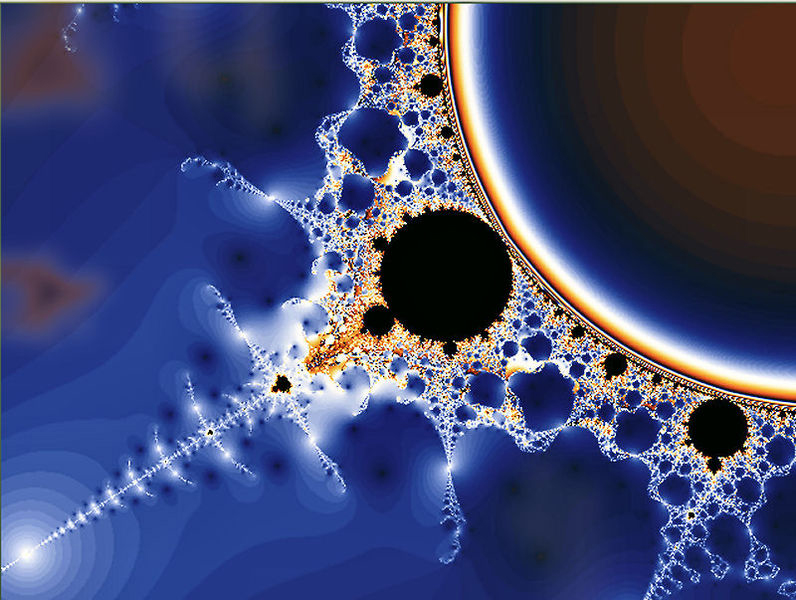
Many chaotic systems produce fractals, geometric patterns that exhibit self-similarity, meaning similar structures appear repeatedly at different magnifications. Fractals are found not only in mathematics but also in many natural systems, including coastlines, branching blood vessels, river networks, clouds, lightning, and snowflakes.

Healthcare Connection
Chaos theory has important medical applications. Small changes in heart rhythm, brain activity, or other physiological signals can sometimes indicate the onset of disease long before obvious symptoms appear. Researchers use mathematical tools from nonlinear dynamics and chaos theory to analyze electrocardiograms (ECGs), electroencephalograms (EEGs), and other physiological measurements to improve diagnosis and patient monitoring.
Chaos does not imply randomness. A chaotic system follows well-defined physical laws, but its sensitivity to initial conditions makes precise long-term prediction impossible. Understanding the distinction between deterministic laws and practical predictability has become one of the major achievements of modern physics and applied mathematics.
Complexity science and chaos theory demonstrate that even when the fundamental laws of physics are simple, the collective behavior of many interacting components can be remarkably rich. These fields continue to influence research in physics, biology, medicine, engineering, economics, and computer science, providing new ways to understand systems that are too complicated to describe using traditional analytical methods alone.
Section Summary
- Complex systems consist of many interacting components whose collective behavior cannot be understood simply by studying the individual parts.
- Many complex systems exhibit emergent behavior, in which large-scale patterns arise from simple interactions among many components.
- Self-organization occurs when ordered structures develop spontaneously without central control. Examples include crystal growth, hurricanes, biological systems, and animal swarms.
- Complex systems often contain feedback mechanisms that influence their stability and evolution.
- Chaos describes deterministic systems whose behavior is extremely sensitive to their initial conditions.
- Because tiny uncertainties grow over time, the long-term behavior of chaotic systems cannot be predicted precisely, even when the governing physical laws are known.
- Chaotic systems frequently exhibit fractals and other repeating patterns that reveal hidden order within seemingly unpredictable behavior.
- Complexity science and chaos theory have applications across physics, biology, medicine, engineering, economics, computer science, and many other disciplines.
Conceptual Questions
- What distinguishes a complex system from a simple physical system?
- Give an example of an emergent property that cannot be explained by examining a single component of a system.
- What is meant by self-organization? Describe a natural example.
- Why does chaos not imply randomness?
- Explain what is meant by sensitive dependence on initial conditions.
- Why do weather forecasts become less reliable as they extend further into the future?
- How can understanding complex systems improve research in medicine or biology?
Glossary
- chaos
- The behavior of a deterministic system that is extremely sensitive to its initial conditions, making long-term prediction difficult.
- complex system
- A system composed of many interacting components whose collective behavior cannot be understood simply by studying the individual parts.
- emergent behavior
- A large-scale property or pattern that arises from interactions among many components of a system.
- feedback
- A process in which the output of a system influences its future behavior, either amplifying or reducing changes.
- self-organization
- The spontaneous formation of organized structures or patterns without centralized control.
The behavior of a deterministic system that is extremely sensitive to its initial conditions, making long-term prediction difficult.
A system composed of many interacting components whose collective behavior cannot be understood simply by studying the individual parts.
A large-scale property or pattern that arises from interactions among many components of a system.
A process in which the output of a system influences its future behavior, either amplifying or reducing changes.
The spontaneous formation of organized structures or patterns without centralized control.
