
Radioactivity, Nuclear Physics and its Medical Applications
121 Binding Energy
Learning Objectives
- Define binding energy and explain its relationship to mass defect.
- Calculate the binding energy and binding energy per nucleon of a nucleus using atomic masses.
- Explain how binding energy provides insight into nuclear stability.
The stability of a nucleus depends on how strongly its protons and neutrons are bound together by the strong nuclear force. A tightly bound nucleus requires a large amount of energy to separate into its individual nucleons, whereas a weakly bound nucleus can be broken apart more easily. By studying how much energy is needed to separate different nuclei, physicists gain valuable insight into the nature of nuclear forces and the stability of matter.
The binding energy (BE) of a nucleus is defined as the energy required to completely separate the nucleus into its individual protons and neutrons. Binding energy can be determined from the nucleus's mass through Einstein's mass-energy relationship:
One of the remarkable consequences of this relationship is that a bound nucleus has a smaller mass than the combined masses of the free protons and neutrons from which it is made. The stronger the binding between the nucleons, the greater the missing mass. This difference in mass represents energy that was released when the nucleus formed.
Physics in Healthcare
The same mass-energy relationship that explains nuclear binding energy also underlies many medical technologies. The energy released during nuclear decay powers radioactive tracers used in diagnostic imaging, such as PET and SPECT scans, while the energy released in nuclear reactions is carefully harnessed to produce many of the medical isotopes used in modern healthcare.
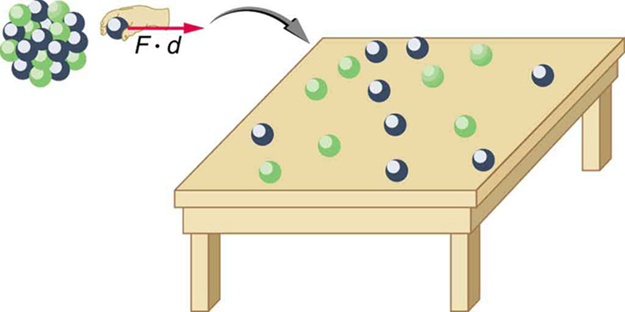
Imagine separating a nucleus into its individual protons and neutrons, as shown in Figure 121.1. Energy must be supplied to overcome the attractive nuclear force that holds the nucleus together. When the nucleons are finally separated and at rest, the added energy appears as an increase in the total rest mass of the system. By definition, this energy equals the binding energy of the nucleus.
The corresponding increase in mass is called the mass defect. It is the difference between the combined masses of the individual nucleons and the actual mass of the bound nucleus. For a nuclide [latex]{}^{A}X[/latex], containing [latex]Z[/latex] protons and [latex]N[/latex] neutrons, the mass defect is
Because mass and energy are equivalent, the binding energy is
Here, [latex]m_{\mathrm{tot}}[/latex] is the mass of the nucleus, [latex]m_p[/latex] is the proton mass, and [latex]m_n[/latex] is the neutron mass.
In practice, atomic masses are measured much more accurately than nuclear masses. Since tabulated atomic masses include the electrons surrounding the nucleus, it is convenient to rewrite the binding-energy equation using neutral atoms. Adding [latex]Z[/latex] electrons to both sides replaces the proton masses with the mass of hydrogen atoms, leading to the commonly used expression
In this equation, [latex]m\left({}^{A}X\right)[/latex] is the measured atomic mass of the nuclide, while [latex]m\left({}^{1}\mathrm{H}\right)[/latex] is the mass of a hydrogen atom. Using atomic masses greatly simplifies binding-energy calculations because accurate values are readily available in reference tables.
Atomic masses are commonly expressed in unified atomic mass units (u), where
This conversion factor makes it straightforward to convert a measured mass defect into the corresponding binding energy expressed in mega-electron volts (MeV).
Things Great and Small
Nuclear Decay Helps Explain Earth's Hot Interior
Radioactive decay not only allows scientists to determine the ages of rocks and fossils, but also helps explain why Earth's interior remains hot billions of years after the planet formed. This is an excellent example of how processes occurring inside atomic nuclei can influence the evolution of an entire planet.
Radiometric dating shows that the oldest surviving rocks on Earth formed approximately [latex]3.5\times10^{9}[/latex] years ago, while many independent lines of geological and astronomical evidence indicate that Earth itself is about [latex]4.5\times10^{9}[/latex] years old. Shortly after its formation, Earth was extremely hot because gravitational energy released during planetary formation was converted into thermal energy. As the planet cooled, its surface eventually became cool enough for the first solid rocks to form.
Simple cooling calculations, however, predict that Earth's interior should have cooled much more than it actually has. Seismic waves generated by earthquakes reveal that large regions of Earth's interior remain partially or completely molten. For example, shear (transverse) waves cannot travel through liquids and disappear when passing through the liquid outer core, while compressional (longitudinal) waves continue through it. These observations provide strong evidence that Earth's deep interior remains extremely hot.
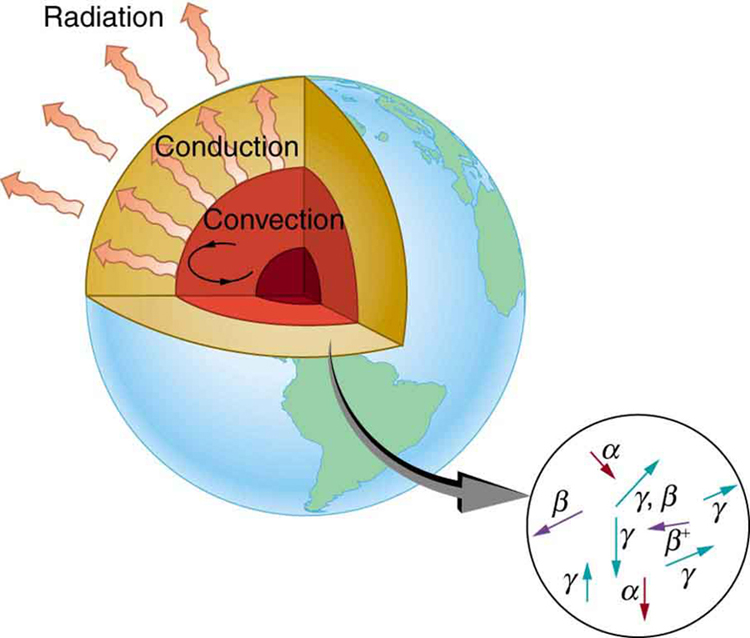
A major source of this long-term heating is the radioactive decay of naturally occurring isotopes that have been present since Earth's formation. Isotopes such as [latex]{}^{238}\mathrm{U}[/latex], [latex]{}^{235}\mathrm{U}[/latex], [latex]{}^{232}\mathrm{Th}[/latex], and [latex]{}^{40}\mathrm{K}[/latex] have half-lives comparable to the age of Earth and continue to release energy today. Although each individual decay produces only a tiny amount of energy, the enormous quantity of radioactive material distributed throughout Earth's mantle and crust generates a substantial amount of heat over geological timescales.
Some radioactive isotopes also decay through long chains of intermediate daughter nuclei. For example, uranium-238 undergoes a series of radioactive decays before ultimately becoming stable lead-206. Each step in the decay chain releases additional energy, contributing further to Earth's internal heat.
The amount of power generated by radioactive decay within any cubic meter of rock is very small. However, because Earth's interior occupies an enormous volume and because heat escapes only slowly through the crust, this continuous energy production has significantly slowed the planet's cooling. Modern geophysical studies estimate that radioactive decay supplies roughly half of Earth's present internal heat, with the remainder coming primarily from residual heat left over from planetary formation.
Radioactive decay also produces helium. During alpha decay, an alpha particle is emitted from the nucleus. After slowing down, the alpha particle captures two electrons and becomes a helium atom. Much of the helium extracted from natural gas reservoirs originated through this process over hundreds of millions of years. Because helium atoms are light and move rapidly, any helium that reaches Earth's atmosphere gradually escapes into space, making radioactive decay the principal long-term source of terrestrial helium.
What can we learn by comparing the binding energies of different nuclei? One of the first patterns that emerges is that the total binding energy (BE) is approximately proportional to the number of nucleons, [latex]A[/latex], in the nucleus. For example, it takes roughly twice as much energy to separate the nucleons in [latex]{}^{24}\mathrm{Mg}[/latex] as it does for [latex]{}^{12}\mathrm{C}[/latex], because the larger nucleus contains about twice as many nucleons.
Although total binding energy is useful, it does not allow a fair comparison between nuclei of different sizes. Instead, physicists divide the binding energy by the number of nucleons and examine the binding energy per nucleon, [latex]\mathrm{BE}/A[/latex]. This quantity measures, on average, how tightly each proton or neutron is bound within the nucleus and serves as an indicator of nuclear stability.
Figure 121.3 shows that the average binding energy per nucleon is about 8 MeV for many stable nuclei. However, it is noticeably smaller for both the lightest and the heaviest nuclei. The curve reaches a maximum for nuclei with mass numbers near [latex]A\approx60[/latex], close to iron and nickel. These nuclei are the most tightly bound and are therefore among the most stable found in nature.
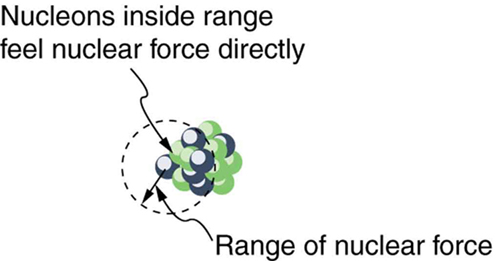
This behavior results from the competition between two fundamental forces. The strong nuclear force is attractive and is approximately 100 times stronger than the electrostatic (Coulomb) force between protons. However, unlike the Coulomb force, the strong nuclear force acts only over extremely short distances.
In light nuclei, each nucleon lies close enough to interact strongly with nearly all of the others. As additional nucleons are added, each one forms new attractive interactions, causing the binding energy per nucleon to increase steadily. This trend continues until nuclei reach mass numbers of approximately [latex]A\approx60[/latex].
For larger nuclei, the situation changes. Because the strong nuclear force has such a short range, newly added nucleons are too far away to interact strongly with every other nucleon. In contrast, the Coulomb force between protons acts over much longer distances, so every proton repels every other proton in the nucleus. As nuclei become larger, this increasing electrostatic repulsion gradually reduces the average binding energy per nucleon.
This competition between short-range nuclear attraction and long-range electrostatic repulsion also explains why stable heavy nuclei contain more neutrons than protons. Additional neutrons increase the attractive nuclear force without adding electrical repulsion, helping stabilize the nucleus by separating the positively charged protons.
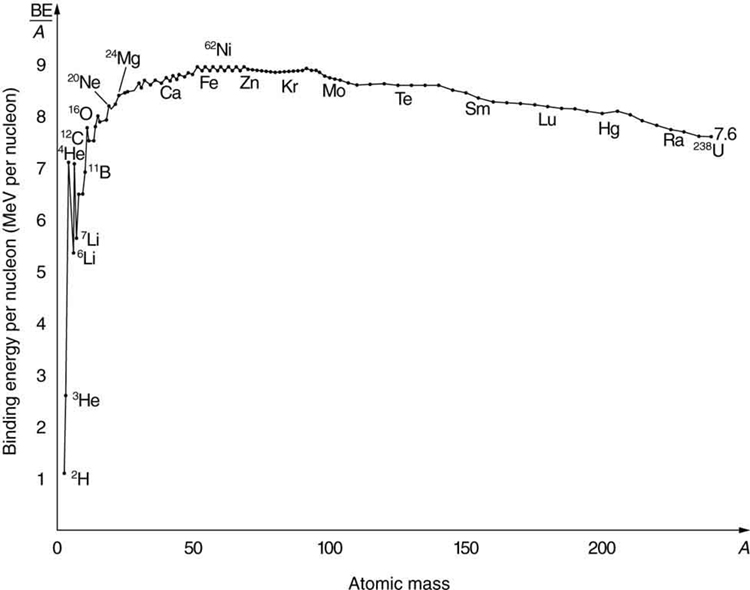
The graph in Figure 121.3 also contains several pronounced peaks that represent nuclei with exceptionally large binding energies per nucleon. These peaks provide additional evidence about nuclear structure. Many correspond to closed-shell, or magic-number, nuclei, whose proton or neutron shells are completely filled, making them especially stable. Nuclei with even numbers of both protons and neutrons, particularly those with [latex]Z=N[/latex], also tend to be more tightly bound than neighboring nuclei.
The same trends help explain the abundance of elements throughout the universe. Hydrogen is by far the most abundant element, followed by helium, while carbon and oxygen are among the next most common. These elements are produced through nuclear fusion inside stars. Heavier elements are synthesized primarily during explosive stellar events such as supernovae and neutron-star mergers. The exceptional stability of [latex]{}^{4}\mathrm{He}[/latex], visible as one of the prominent peaks in Figure 121.3, also helps explain why alpha particles are commonly emitted during the radioactive decay of heavy nuclei.
Why Iron Is So Stable
The peak in binding energy per nucleon near iron and nickel has important consequences throughout physics. Energy can be released whenever nuclear reactions move toward this peak. Light nuclei release energy by fusion, while very heavy nuclei release energy by fission. Both processes produce nuclei with larger binding energies per nucleon, making the final products more stable than the original nuclei.
Example 121.1: What Is the Binding Energy per Nucleon of an Alpha Particle?
Calculate the binding energy per nucleon, [latex]\mathrm{BE}/A[/latex], of [latex]{}^{4}\mathrm{He}[/latex], commonly known as the alpha particle.
Strategy
To determine the binding energy per nucleon, first calculate the total binding energy using the atomic-mass equation
and then divide the result by the number of nucleons, [latex]A[/latex]. The required atomic masses can be obtained from a table of atomic masses.
Solution
For [latex]{}^{4}\mathrm{He}[/latex], the nucleus contains two protons and two neutrons, so
Substituting these values into the binding-energy equation gives
Using the measured atomic masses
the mass defect is
Converting this mass defect into energy using
gives the total binding energy:
Finally, dividing by the four nucleons in the alpha particle gives
Discussion
A binding energy of approximately 7 MeV per nucleon is remarkably large for such a light nucleus. Most light nuclei have binding energies per nucleon closer to 3 MeV, making [latex]{}^{4}\mathrm{He}[/latex] exceptionally stable. This high stability appears as one of the prominent peaks in the binding-energy curve shown in Figure 121.3.
Because the alpha particle is so tightly bound, its mass is significantly lower than the combined masses of two free protons and two free neutrons. Consequently, it cannot spontaneously break apart into lighter particles. Conversely, when an alpha particle is produced during the radioactive decay of a heavy nucleus, the large binding energy of the alpha particle contributes to the energy released during the decay.
The exceptional stability of [latex]{}^{4}\mathrm{He}[/latex] also helps explain why alpha decay is common among heavy radioactive nuclei. Inside these nuclei, groups of two protons and two neutrons can temporarily cluster together. Because this combination is so strongly bound, it can sometimes escape the nucleus as a complete alpha particle, leaving behind a more stable daughter nucleus.
The overall trend in binding energy per nucleon has profound consequences throughout physics. It explains why energy is released when light nuclei fuse together inside stars, why heavy nuclei release energy when they undergo fission, and why elements are produced in different astrophysical environments. These same principles also underpin many practical applications of nuclear physics, including nuclear power generation and the production of medical isotopes used for diagnostic imaging and cancer therapy.
Problem-Solving Strategy: Binding Energy and Radioactivity Calculations
- Identify the quantity to be determined. Decide whether the problem involves binding energy, nuclear reaction energy, radioactive activity, half-life, or another nuclear quantity.
- List the known information. Record all given masses, half-lives, activities, atomic numbers, mass numbers, or other relevant data. Determine any additional quantities that can be inferred from the problem.
- Use atomic masses whenever appropriate. Most tabulated data list the masses of neutral atoms rather than bare nuclei. Ensure that the number of electrons balances on both sides of any nuclear reaction. If electrons do not cancel (for example, in beta-plus decay), include the appropriate electron mass correction (0.511 MeV per electron).
- For activity calculations, relate activity to the number of radioactive nuclei. The equation
[latex]R=\frac{0.693N}{t_{1/2}} =\lambda N[/latex]
is particularly useful. Problems involving [latex]N[/latex] often require Avogadro's number and the concept of the mole.
- Carry out the calculation carefully. Pay close attention to units, significant figures, algebraic signs, and powers of ten. Convert between atomic mass units, electron volts, and SI units when necessary.
- Evaluate the result. Check whether the numerical answer is physically reasonable. Compare its magnitude with worked examples, known values, or trends such as the binding-energy-per-nucleon curve. A correct calculation should also make sense conceptually.
Interactive Exploration: Nuclear Fission
Nuclear fission occurs when a heavy nucleus, such as uranium-235, absorbs a neutron and splits into two smaller nuclei. This process releases a large amount of energy, along with two or three additional neutrons. If these neutrons go on to trigger fission in neighboring nuclei, a chain reaction can develop. Depending on how many neutrons continue the process, the chain reaction may quickly die out, remain steady, or grow rapidly.
In this interactive simulation, you will investigate how chain reactions begin, why they occur only under certain conditions, and how nuclear reactors safely control the energy released during fission. You will also explore how neutron-absorbing control rods and non-fissionable materials influence the behavior of the reactor.
Guided Exploration
As you interact with the simulation, consider the following questions:
- Fire a single neutron into the fissile material. What happens when the neutron is absorbed by a uranium nucleus?
- Observe the fission products. Besides the two smaller nuclei, what other particles are produced, and why are they important?
- Create a chain reaction. Under what conditions does one fission event successfully trigger additional fission events?
- Experiment with different amounts of fissile material. How does the size of the sample affect whether the chain reaction dies out or becomes self-sustaining?
- Insert the control rods. What happens to the number of neutrons available to produce additional fission reactions? How does this affect the energy released?
- Replace part of the fissile material with non-fissionable isotopes. How does this change the probability of maintaining a chain reaction?
- Based on your observations, explain why nuclear power reactors use control rods and why maintaining a controlled chain reaction is essential for safe operation.
After completing the simulation, compare your observations with the concepts presented in this chapter. Every fission event converts a small amount of mass into energy according to Einstein's relation,
The released neutrons determine whether additional fission events occur. A critical reactor maintains a steady chain reaction in which each fission event produces, on average, one additional fission. Control rods regulate the neutron population by absorbing excess neutrons, allowing nuclear reactors to generate energy safely while preventing an uncontrolled increase in power.
Section Summary
- The binding energy (BE) of a nucleus is the energy required to completely separate the nucleus into its individual protons and neutrons. Because energy and mass are equivalent, the binding energy is directly related to the mass defect—the difference between the mass of the bound nucleus and the combined masses of its free nucleons.
- When atomic masses are used, the binding energy of a nuclide can be calculated from
[latex]\mathrm{BE} = \left\{ \left[ Zm\left({}^{1}\mathrm{H}\right) + Nm_n \right] - m\left({}^{A}X\right) \right\} c^{2},[/latex]
where [latex]m\left({}^{1}\mathrm{H}\right)[/latex] is the mass of a hydrogen atom, [latex]m\left({}^{A}X\right)[/latex] is the atomic mass of the nuclide, and [latex]m_n[/latex] is the mass of a neutron.
- The binding energy per nucleon, [latex]\mathrm{BE}/A[/latex], allows nuclei of different sizes to be compared on an equal basis. Larger values of [latex]\mathrm{BE}/A[/latex] indicate that nucleons are held together more tightly and that the nucleus is generally more stable.
- The binding energy per nucleon reaches its maximum for nuclei with mass numbers near [latex]A\approx60[/latex], such as iron and nickel. These nuclei are among the most stable found in nature because they represent the optimal balance between the attractive strong nuclear force and the repulsive electrostatic force between protons.
- The overall shape of the binding-energy curve explains why energy can be released by both nuclear fusion of light nuclei and nuclear fission of very heavy nuclei. In both cases, the reaction products have a larger binding energy per nucleon and are therefore more stable than the original nuclei.
- Exceptionally stable nuclei, including those with closed proton or neutron shells (magic numbers), appear as peaks on the binding-energy curve. These nuclear structure effects help explain patterns of nuclear stability and the natural abundances of many elements.
Conceptual Questions
- Stable nuclei with mass numbers greater than about [latex]A\approx40[/latex] contain more neutrons than protons. Explain why additional neutrons increase nuclear stability, and why this neutron excess becomes even more important for the heaviest nuclei.
Problems & Exercises
- [latex]{}^{2}\mathrm{H}[/latex], called deuterium or heavy hydrogen, is a loosely bound but stable isotope of hydrogen. It makes up approximately 0.015% of natural hydrogen. Deuterium has [latex]Z=N[/latex], which tends to increase stability, but both values are odd. Calculate its binding energy per nucleon, [latex]\mathrm{BE}/A[/latex], and compare your result with the approximate value shown in Figure 121.3.
- [latex]{}^{56}\mathrm{Fe}[/latex] is among the most tightly bound nuclides and accounts for more than 90% of natural iron. It contains even numbers of both protons and neutrons. Calculate its binding energy per nucleon, [latex]\mathrm{BE}/A[/latex], and compare your result with the approximate value shown in Figure 121.3.
- [latex]{}^{209}\mathrm{Bi}[/latex] is a very long-lived nuclide whose binding energy per nucleon is lower than that of medium-mass nuclei. Calculate [latex]\mathrm{BE}/A[/latex] for [latex]{}^{209}\mathrm{Bi}[/latex] and compare it with the approximate value shown in Figure 121.3.
-
- Calculate [latex]\mathrm{BE}/A[/latex] for [latex]{}^{235}\mathrm{U}[/latex], the less abundant of the two principal naturally occurring uranium isotopes.
- Calculate [latex]\mathrm{BE}/A[/latex] for [latex]{}^{238}\mathrm{U}[/latex], which makes up most natural uranium. Note that uranium-238 contains even numbers of both protons and neutrons. Is its binding energy per nucleon significantly different from that of uranium-235?
-
- Calculate [latex]\mathrm{BE}/A[/latex] for [latex]{}^{12}\mathrm{C}[/latex]. This stable and relatively tightly bound nuclide makes up most natural carbon.
- Calculate [latex]\mathrm{BE}/A[/latex] for [latex]{}^{14}\mathrm{C}[/latex]. Is the difference between the binding energies per nucleon of carbon-12 and carbon-14 significant? One isotope is stable and common, while the other is radioactive and rare.
- The fact that [latex]\mathrm{BE}/A[/latex] reaches its maximum for nuclei with [latex]A[/latex] near 60 suggests that the effective range of the nuclear force is comparable to the diameter of nuclei of this size.
- Calculate the diameter of a nucleus with [latex]A=60[/latex].
- Compare [latex]\mathrm{BE}/A[/latex] for [latex]{}^{58}\mathrm{Ni}[/latex] and [latex]{}^{90}\mathrm{Sr}[/latex]. Nickel-58 is one of the most tightly bound nuclides, whereas strontium-90 is larger and less tightly bound.
- This problem demonstrates in several ways that the 13.6-eV binding energy of the electron in a hydrogen atom is negligible compared with the rest energies of the proton and electron.
- Calculate the mass equivalent, in unified atomic mass units, of the 13.6-eV binding energy. Compare it with the mass of a hydrogen atom listed in the atomic-mass appendix.
- Subtract the proton mass from the mass of a hydrogen atom. Show that the difference equals the electron mass to approximately three significant figures, indicating that the atomic binding energy contributes negligibly to the total mass.
- Calculate the ratio of the electron's binding energy, 13.6 eV, to the energy equivalent of the electron's mass, 0.511 MeV.
- Explain how your answers confirm that atomic binding energies can usually be neglected in nuclear mass calculations.
- Unreasonable Results. A particle physicist discovers a neutral particle with a measured mass of 2.02733 u and assumes that it consists of two neutrons bound together.
- Calculate the proposed particle's binding energy.
- What is unreasonable about the result?
- Which assumptions are unreasonable or mutually inconsistent?
Glossary
- binding energy
- The energy required to completely separate a nucleus into its individual protons and neutrons. It is equal to the mass defect multiplied by [latex]c^2[/latex].
- binding energy per nucleon
- The total binding energy of a nucleus divided by its number of nucleons, [latex]\mathrm{BE}/A[/latex]. It indicates how tightly the average proton or neutron is bound within the nucleus and provides a useful measure of nuclear stability.
- mass defect
- The difference between the combined masses of the separate protons and neutrons in a nucleus and the actual mass of the bound nucleus.
The energy required to completely separate a nucleus into its individual protons and neutrons. It is equal to the mass defect multiplied by [latex]c^2[/latex].
The total binding energy of a nucleus divided by its number of nucleons, [latex]\mathrm{BE}/A[/latex]. It indicates how tightly the average proton or neutron is bound within the nucleus and provides a useful measure of nuclear stability.
The difference between the combined masses of the separate protons and neutrons in a nucleus and the actual mass of the bound nucleus.
