
Oscillatory Motion, Waves, and the Physics of Hearing
118 Simple Harmonic Motion: A Special Periodic Motion
Learning Objectives
- Describe a simple harmonic oscillator.
- Explain the link between simple harmonic motion and waves.
The oscillations of systems where the net force can be described by Hooke's law are especially important because they are both common and simple. This type of motion is known as simple harmonic motion (SHM), and the system itself is called a simple harmonic oscillator. If the system experiences no damping from friction or other non-conservative forces, it will oscillate symmetrically around an equilibrium position. Figure 118.1 shows an object attached to a spring on a frictionless surface, undergoing SHM with equal displacement on either side of equilibrium. The amplitude [latex]X[/latex] is the maximum displacement from equilibrium, and it reflects the energy of the oscillation. The units of amplitude and displacement depend on the system (e.g., meters for a spring, pressure units for sound waves).
Take-Home Experiment: SHM and the Marble
Place a marble in a bowl shaped like a hemisphere. Tilt the bowl periodically to roll the marble from one side to the other. Observe the regularity of motion. What is the restoring force in this setup? What role does your applied force play in maintaining SHM?
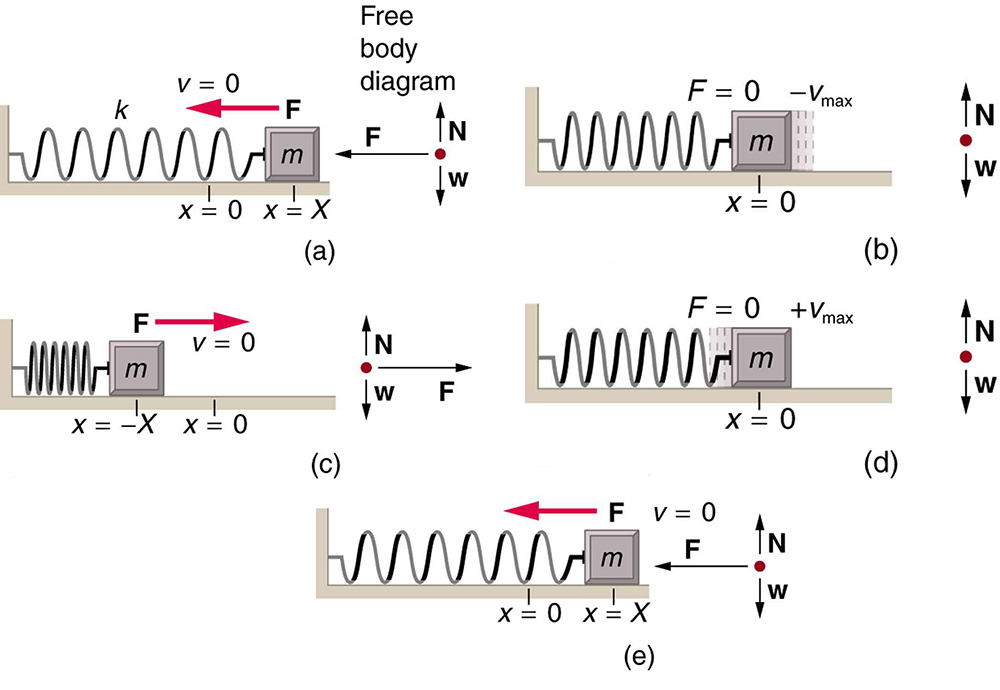
What makes SHM so valuable? A key feature is that the period [latex]T[/latex] and frequency [latex]f[/latex] of SHM are independent of amplitude. For instance, a guitar string vibrates at the same frequency regardless of how hard it is plucked. This constancy makes SHM useful for timekeeping devices. However, two physical quantities do influence the period: the system’s stiffness and its mass. A stiffer system (larger [latex]k[/latex]) has a shorter period. Conversely, a more massive system oscillates more slowly. Thus, both [latex]m[/latex] and [latex]k[/latex] directly affect SHM’s timing properties.
Period of a Simple Harmonic Oscillator
The period [latex]T[/latex] is calculated as:
Since [latex]f = \frac{1}{T}[/latex], the frequency [latex]f[/latex] is:
Neither equation depends on amplitude, highlighting one of SHM’s defining characteristics.
Take-Home Experiment: Mass and Ruler Oscillations
Secure two identical rulers to the edge of a table, leaving equal lengths extended. Attach a heavy object (like coins) to the end of one. Pluck both and observe how mass influences the period. Count how many cycles occur in a fixed time, and measure the period of each.
Example 118.1: Calculate the Frequency and Period of Oscillations: Bad Shock Absorbers in a Car
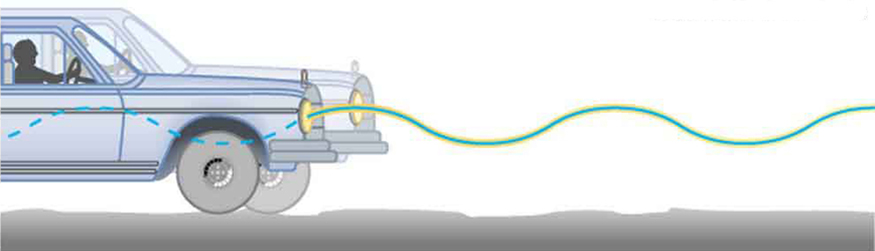
If the shock absorbers in a car go bad, then the car will oscillate at the least provocation, such as when going over bumps in the road and after stopping (See Figure 118.2). Calculate the frequency and period of these oscillations for such a car if the car’s mass (including its load) is 900 kg and the force constant ([latex]k[/latex]) of the suspension system is [latex]6\text{.}\text{53}×{\text{10}}^{4}\phantom{\rule{0.25em}{0ex}}\text{N/m}[/latex].
Strategy
The frequency of the car’s oscillations will be that of a simple harmonic oscillator as given in the equation [latex]f=\frac{1}{2\pi }\sqrt{\frac{k}{m}}[/latex]. The mass and the force constant are both given.
Solution
- Enter the known values of k and m:
[latex]f=\frac{1}{2\pi }\sqrt{\frac{k}{m}}=\frac{1}{2\pi }\sqrt{\frac{6\text{.}\text{53}×{\text{10}}^{4}\phantom{\rule{0.25em}{0ex}}\text{N/m}}{\text{900}\phantom{\rule{0.25em}{0ex}}\text{kg}}}[/latex]
- Calculate the frequency:
[latex]\frac{1}{2\pi }\sqrt{\text{72.}6/{\text{s}}^{–2}}=1\text{.}{\text{3656}/\text{s}}^{\text{–1}}\approx 1\text{.}{\text{36}/\text{s}}^{\text{–1}}=\text{1.36 Hz}[/latex]
- You could use [latex]T=2\pi \sqrt{\frac{m}{k}}[/latex] to calculate the period, but it is simpler to use the relationship [latex]T=1/f[/latex] and substitute the value just found for [latex]f[/latex]:
[latex]T=\frac{1}{f}=\frac{1}{1\text{.}\text{356}\phantom{\rule{0.25em}{0ex}}\text{Hz}}=0\text{.}\text{738}\phantom{\rule{0.25em}{0ex}}\text{s}[/latex]
Discussion
The values of [latex]T[/latex] and [latex]f[/latex] both seem about right for a bouncing car. You can observe these oscillations if you push down hard on the end of a car and let go.
The Link between Simple Harmonic Motion and Waves
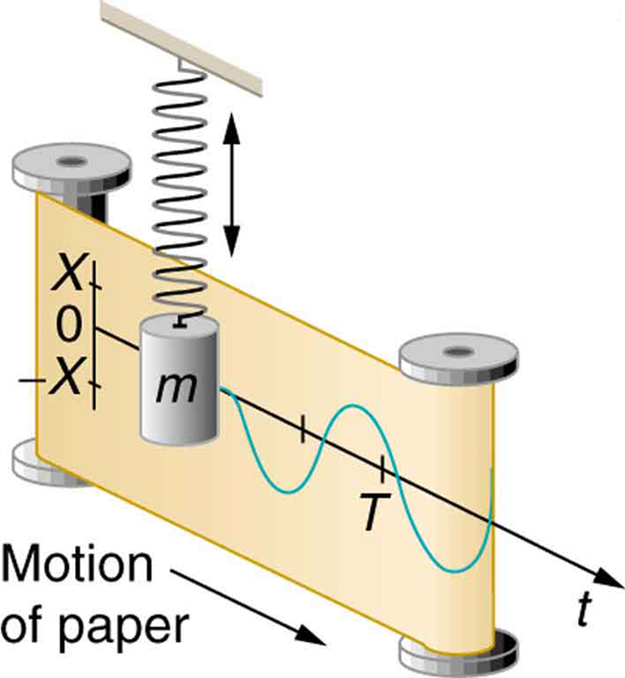
If you were to take a time-exposure photograph of a bouncing car driving by, the headlight would leave behind a wavelike trail, as shown in Figure 118.2. Similarly, Figure 118.3 shows the trace left by an object bouncing on a spring recorded on a moving strip of paper. In both cases, the path is sinusoidal. This illustrates the deep connection between simple harmonic motion (SHM) and sine waves.
The displacement [latex]x(t)[/latex] in any SHM system (with a restoring force obeying Hooke's law) is described by:
Here, [latex]X[/latex] is the amplitude of motion and [latex]T[/latex] is the period. At [latex]t = 0[/latex], the object is at maximum displacement, [latex]x(0) = X[/latex]. Because cosine is periodic, the object returns to the same position after one period. The corresponding velocity [latex]v(t)[/latex] is obtained by differentiating the displacement function:
where the maximum velocity is:
The negative sign indicates that the velocity is directed opposite the displacement when the motion begins (i.e., the object starts moving toward equilibrium). Acceleration [latex]a(t)[/latex] follows from Newton’s second law:
Notice that acceleration is proportional to and in the opposite direction of displacement—a hallmark of SHM.
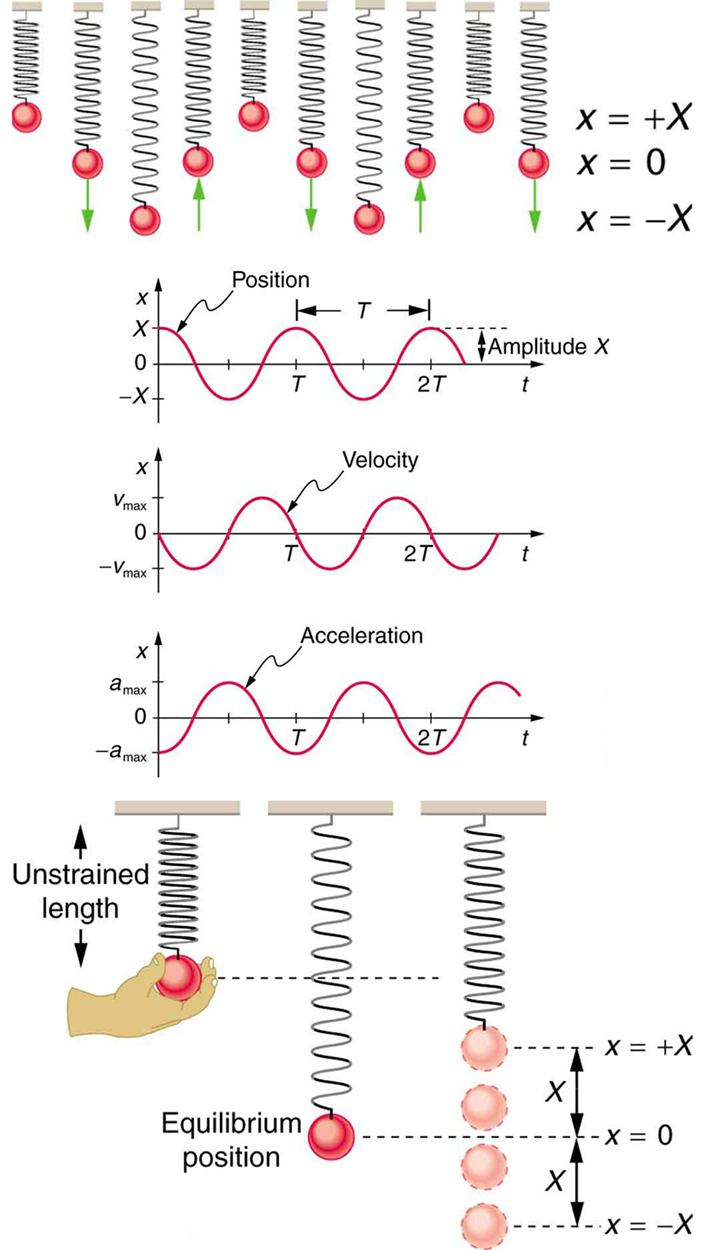
These mathematical expressions are fundamental to analyzing and visualizing wave-like motion in SHM. They also lay the groundwork for understanding wave interference and superposition.
Check Your Understanding
Interactive Exploration: Masses and Springs
Simple harmonic motion is found throughout nature and technology, from the vibrations of atoms and molecules to vehicle suspensions and biological tissues. In this simulation, you'll investigate how a mass attached to a spring oscillates and how the spring constant, mass, gravity, and damping affect the motion. You'll also observe how energy is continuously exchanged between kinetic and elastic potential energy during each oscillation. Experiment with different masses, spring stiffnesses, and gravitational environments while watching the motion and the energy graphs. Introduce damping to explore how friction affects the system and observe how mechanical energy is gradually transformed into thermal energy.
Guided Exploration
As you interact with the simulation, try to answer the following questions:
- Hang different masses from the same spring. How does increasing the mass affect the equilibrium position and the period of oscillation?
- Keep the mass constant and increase the spring stiffness. How does the motion change? Does the system oscillate faster or slower?
- Turn on the energy bar chart or energy graph. During one complete oscillation, when is the kinetic energy greatest? When is the elastic potential energy greatest?
- Add damping to the system. How does the amplitude of the oscillations change over time? What happens to the mechanical energy?
- Change the gravitational environment from Earth to another planet. How does gravity affect the equilibrium position of the mass? How does it affect the oscillatory motion?
- Slow the simulation down and observe the motion carefully. At what point during the oscillation is the restoring force greatest? How is this related to the amount the spring is stretched or compressed?
After completing the exploration, compare your observations with the concepts presented in this section. Notice that the spring exerts a restoring force that causes the mass to oscillate about its equilibrium position. During each oscillation, energy is continuously exchanged between kinetic and elastic potential energy, while damping converts some of the mechanical energy into thermal energy.
Healthcare Connection
The vocal cords approximate a simple harmonic oscillator during voiced speech. Air pressure from the lungs sets the two folds of tissue vibrating back and forth about an equilibrium position at a rate mainly determined by their length, tension, and mass, much like a mass on a spring oscillating at its natural frequency. Increasing vocal fold tension raises the frequency of vibration and therefore the pitch of the voice, which is part of why singers and speech-language pathologists pay close attention to vocal fold tension and why conditions such as vocal cord nodules or paralysis, which change the folds' effective mass or tension, can noticeably alter a person's pitch and voice quality.
Section Summary
- Simple harmonic motion (SHM) is oscillatory motion for a system in which the net restoring force is described by Hooke’s law. A system that exhibits SHM is called a simple harmonic oscillator.
- The maximum displacement from equilibrium is called the amplitude [latex]X[/latex]. The period [latex]T[/latex] and frequency [latex]f[/latex] of a simple harmonic oscillator are given by:
[latex]T = 2\pi \sqrt{\frac{m}{k}}[/latex][latex]f = \frac{1}{2\pi} \sqrt{\frac{k}{m}}[/latex]
where [latex]m[/latex] is the mass of the object and [latex]k[/latex] is the spring constant.
- The displacement as a function of time is:
[latex]x(t) = X \cos\left(\frac{2\pi t}{T}\right)[/latex]
- The velocity as a function of time is:
[latex]v(t) = -v_{\text{max}} \sin\left(\frac{2\pi t}{T}\right)[/latex]
where the maximum velocity is:
[latex]v_{\text{max}} = X \sqrt{\frac{k}{m}}[/latex] - The acceleration as a function of time is:
[latex]a(t) = -\frac{kX}{m} \cos\left(\frac{2\pi t}{T}\right)[/latex]
Conceptual Questions
- What conditions must be met to produce simple harmonic motion?
- If frequency is not constant for some oscillation, can the oscillation be simple harmonic motion?
- Can you think of any examples of harmonic motion where the frequency may depend on the amplitude?
- Give an example of a simple harmonic oscillator, specifically noting how its frequency is independent of amplitude.
- Explain why you expect an object made of a stiff material to vibrate at a higher frequency than a similar object made of a spongy material.
- As you pass a freight truck with a trailer on a highway, you notice that its trailer is bouncing up and down slowly. Is it more likely that the trailer is heavily loaded or nearly empty? Explain your answer.
- Some people modify cars to be much closer to the ground than when manufactured. Should they install stiffer springs? Explain your answer.
Problems & Exercises
- A type of cuckoo clock keeps time by having a mass bouncing on a spring, usually something cute like a cherub in a chair. What force constant is needed to produce a period of 0.500 s for a 0.0150-kg mass?
- If the spring constant of a simple harmonic oscillator is doubled, by what factor will the mass of the system need to change in order for the frequency of the motion to remain the same?
- A 0.500-kg mass suspended from a spring oscillates with a period of 1.50 s. How much mass must be added to the object to change the period to 2.00 s?
- By how much leeway (both percentage and mass) would you have in the selection of the mass of the object in the previous problem if you did not wish the new period to be greater than 2.01 s or less than 1.99 s?
- Suppose you attach the object with mass [latex]m[/latex] to a vertical spring originally at rest, and let it bounce up and down. You release the object from rest at the spring’s original rest length.
- Show that the spring exerts an upward force of [latex]2.00\phantom{\rule{0.25em}{0ex}}\mathrm{mg}[/latex] on the object at its lowest point.
- If the spring has a force constant of [latex]\text{10}\text{.}0\phantom{\rule{0.25em}{0ex}}\text{N/m}[/latex] and a 0.25-kg-mass object is set in motion as described, find the amplitude of the oscillations.
- Find the maximum velocity.
- A diver on a diving board is undergoing simple harmonic motion. Her mass is 55.0 kg and the period of her motion is 0.800 s. The next diver is a male whose period of simple harmonic oscillation is 1.05 s. What is his mass if the mass of the board is negligible?
- Suppose a diving board with no one on it bounces up and down in a simple harmonic motion with a frequency of 4.00 Hz. The board has an effective mass of 10.0 kg. What is the frequency of the simple harmonic motion of a 75.0-kg diver on the board?

Figure 118.5: This child’s toy relies on springs to keep infants entertained. (credit: By Humboldthead, Flickr) - The device pictured in Figure 118.5 entertains infants while keeping them from wandering. The child bounces in a harness suspended from a door frame by a spring constant.
- If the spring stretches 0.250 m while supporting an 8.0-kg child, what is its spring constant?
- What is the time for one complete bounce of this child?
- What is the child’s maximum velocity if the amplitude of her bounce is 0.200 m?
- A 90.0-kg skydiver hanging from a parachute bounces up and down with a period of 1.50 s. What is the new period of oscillation when a second skydiver, whose mass is 60.0 kg, hangs from the legs of the first (as seen in Figure 118.6)?

Glossary
- amplitude
- the maximum displacement from the equilibrium position of an object oscillating around the equilibrium position
- simple harmonic motion
- the oscillatory motion in a system where the net force can be described by Hooke’s law
- simple harmonic oscillator
- a device that implements Hooke’s law, such as a mass that is attached to a spring, with the other end of the spring being connected to a rigid support such as a wall
-
- wave interference
- the phenomenon that occurs when two or more waves meet at the same point in space, combining to form a new wave pattern. Interference can be constructive (waves reinforce each other, increasing amplitude) or destructive (waves partially or completely cancel each other, reducing amplitude)
a device that implements Hooke’s law, such as a mass that is attached to a spring, with the other end of the spring being connected to a rigid support such as a wall
proportional relationship between the force [latex]F[/latex] on a material and the deformation [latex]\Delta L[/latex] it causes, tensile strength the breaking stress that will cause permanent deformation or fraction of a material
the oscillatory motion in a system where the net force can be described by Hooke’s law
the maximum displacement from the equilibrium position of an object oscillating around the equilibrium position
force acting in opposition to the force caused by a deformation
time it takes to complete one oscillation
number of events per unit of time
The phenomenon that occurs when two or more waves meet at the same point in space, combining to form a new wave pattern. Interference can be constructive (waves reinforce each other, increasing amplitude) or destructive (waves partially or completely cancel each other, reducing amplitude)
the phenomenon that occurs when two or more waves arrive at the same point
